
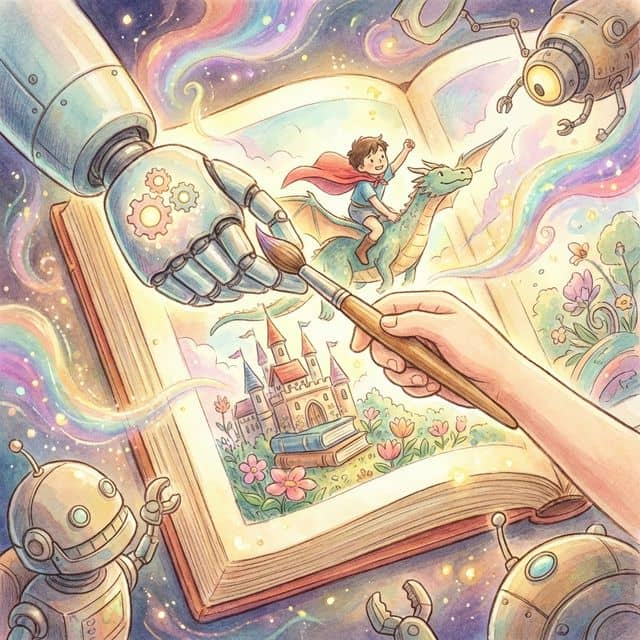
Discover how AI creates personalized children's books with custom illustrations, adaptive stories, and safe content. The future of kids' reading is here.
The Revolution Happening in Your Child's Bookshelf
For centuries, children's books have been one-size-fits-all. The same illustrations, the same characters, the same stories for every child. "Personalized" books meant stamping a name on a pre-made template. But artificial intelligence is changing everything about how we create stories for our children.
Today, AI can create a storybook character that looks exactly like your child — their hair texture, their skin tone, their eye color. It can craft stories around their specific fears, their milestones, and their world. This is not science fiction. It is the new standard in children's literature, and it is already transforming how millions of families experience storytime through personalized storybooks with photos.
The personalized children's book market is projected to reach $1.13 billion by 2032, growing at nearly 9% annually. AI-powered personalization is the engine driving that growth, moving far beyond the "name-only" books that have dominated the market for decades.
The Evolution of Personalization: A Timeline
Understanding where we are today requires looking at how far children's book personalization has come:
| Era | Technology | Level of Personalization |
|---|---|---|
| 1980s-1990s | Mail-order print shops | Name stamped on cover and a few pages |
| 2000s-2010s | Print-on-demand + web forms | Name inserted throughout text; choose from 2-3 character options |
| 2015-2022 | Digital illustration templates | Select hair/skin/eye color from preset avatars |
| 2023-Present | Generative AI | Fully custom character from description, adaptive storylines, consistent rendering across pages |
| Near Future | Multimodal AI + voice cloning | Custom illustrations + adaptive story + parent's voice narration + video animation |
Each leap in technology has brought us closer to the ultimate goal: a book that feels like it was written, illustrated, and narrated just for your child. With generative AI, we have finally arrived.
From Name-Stamping to True Personalization
For decades, "personalized" children's books simply meant inserting a child's name into a generic story. The illustrations? Still a generic character. The plot? Unchanged. The emotional connection? Minimal at best.
AI has shattered these limitations. Here is what modern AI-powered personalization actually delivers:
- Custom character illustrations: A hero who shares your child's exact appearance — hair type, skin tone, features, and style
- Theme-specific stories: Narratives tailored to your child's specific needs — overcoming fear of the dark, starting school, welcoming a new sibling
- Consistent character design: The same character on every page, in every scene, maintaining the immersive "that's me!" experience
- Diverse representation: Every child can finally see themselves in a storybook, regardless of their appearance or background
Learn more about the difference between name-only and truly personalized books — the gap is larger than most parents realize.
How AI Creates a Personalized Children's Book: The Complete Process
At Magical Hekaya, the process is simple for parents but sophisticated behind the scenes. Here is a step-by-step look at how an AI personalized children's book goes from your input to a finished story:
- You describe your child: Hair type, color, skin tone, eye color, and any distinctive features. Some platforms also ask about interests, fears, or milestones to customize the story theme.
- AI generates a character model: Using advanced generative models, the system creates a storybook character that captures your child's appearance in a beautiful illustrated style. This model serves as the "reference" for every page.
- Story adaptation: The AI selects or generates a storyline matched to the child's age range, chosen theme, and any specific needs (such as bibliotherapy goals).
- Page-by-page illustration: Each scene is generated with the child's character placed consistently in the environment — climbing mountains, befriending animals, conquering fears.
- Quality and safety filtering: Every generated image and text passage goes through automated content safety checks and quality scoring before being included.
- Assembly and delivery: The finished book is assembled as a digital reader, downloadable PDF, and optionally as a print-ready file for physical printing.
Curious about the technical details behind the illustrations? Read our deep dive into how AI creates unique story illustrations.
See AI Personalization in Action
Create a personalized storybook where your child is the hero, the illustrations look like them, and the story speaks to their heart — all in under five minutes.
Create Your Child's Story →AI Illustration Quality: How Good Is It Really?
One of the most common questions parents ask is whether AI-generated illustrations are actually good enough. The answer in 2026 is a resounding yes — but quality varies dramatically between platforms. Here are the key metrics that define illustration quality:
- Character consistency: Does the child character look the same on every page? Advanced AI systems maintain 95%+ consistency across scenes, which is critical for the "that's me!" recognition.
- Artistic style coherence: Are all pages in the same visual style (watercolor, cartoon, storybook)? The best platforms maintain a unified art direction throughout.
- Environmental detail: Are backgrounds rich and engaging, or flat and generic? High-quality AI illustration creates immersive worlds.
- Emotional expression: Can the AI render a range of emotions on the character's face — joy, surprise, determination, peace? This is where newer models truly excel.
- Resolution and print-readiness: AI-generated images must be high enough resolution for both screen display and professional printing at 300 DPI.
"The pace of improvement in AI illustration is extraordinary. What took a team of illustrators weeks to produce can now be generated in minutes — and the quality gap is closing rapidly. For personalized content, AI already surpasses what was economically feasible with human illustration."
— Dr. Sarah Chen, Digital Media Lab, Stanford University
AI vs Traditional Illustration: A Detailed Comparison
How does AI illustration stack up against traditional methods for children's books? Here is a feature-by-feature comparison:
| Feature | Traditional Illustration | AI-Powered Illustration |
|---|---|---|
| Personalization | Limited to preset character options | Fully custom character from description |
| Production Time | 2-6 weeks per book | Under 5 minutes per book |
| Cost Per Book | $30-$60+ (custom illustration is expensive) | Under $15 (AI scales efficiently) |
| Character Consistency | High (same artist) | High (reference model system) |
| Diversity of Representation | Limited by available templates | Unlimited — any appearance combination |
| Story Adaptability | Fixed storylines per template | Theme and content can adapt per child |
| Scalability | Expensive to scale | Near-zero marginal cost |
| Artistic Uniqueness | Each artist brings a unique style | Guided by style parameters; improving rapidly |
The takeaway: AI does not replace the artistry of traditional illustration for mass-market picture books. But for personalized books — where every single copy needs unique illustrations — AI is not just better. It is the only economically viable approach for delivering true personalization at scale.
The Therapeutic Edge: AI + Child Psychology
What makes AI-powered personalization truly revolutionary is not just the visual appeal — it is the therapeutic potential. Traditional publishing simply cannot create a book about fear of the dark starring your specific child. AI can.
As we explored in our article on how personalized books help children overcome fears, the mechanism of bibliotherapy — using books as therapeutic tools — is dramatically amplified when the child sees themselves in the story. Research shows that self-referential processing activates the medial prefrontal cortex, the brain region responsible for integrating new information with one's sense of self.
AI makes it possible to create therapeutic stories for every child, addressing:
- Specific phobias (monsters, storms, darkness)
- Life transitions (new sibling, moving house, starting school)
- Emotional challenges (separation anxiety, confidence building)
- Social situations (making friends, dealing with change)
Explore our full collection of therapeutic storybooks for anxious kids to see how this approach works in practice.
The AI Safety Framework: How Responsible Platforms Protect Children
Safety is the number one concern for parents considering AI-generated content for their children — and rightly so. Here is how a responsible AI children's book platform should protect your family:
Content Safety Layers
- Prompt-level guardrails: AI generation prompts are designed with built-in constraints that prevent inappropriate content from being generated in the first place
- Output filtering: Every generated image and text is automatically screened against safety classifiers before being shown to any user
- Age-appropriate vocabulary: Language models are constrained to age-appropriate vocabulary and themes
- Human review pipeline: New story templates and illustration styles undergo human review before being deployed
Data Privacy Protections
- Minimal data collection: Only the descriptive features needed to create the character are collected
- No photo storage: Responsible platforms generate artistic interpretations, not photo-realistic copies
- COPPA and GDPR compliance: Children's data requires the highest level of privacy protection
- Parent control: Parents can delete all data, including generated books, at any time
Addressing Common Concerns
"Won't AI Make Books Feel Cold or Mechanical?"
Quite the opposite. The stories created by AI-powered platforms are warm, emotionally intelligent, and crafted with principles from child psychology. AI handles the personalization — the custom illustrations, the name integration, the thematic adaptation. The heart of the story is human: love, courage, resilience, and belonging. Parents consistently report that their children form deeper emotional bonds with personalized books than with generic ones, precisely because the personalization makes the story feel more real.
"What About the Quality Compared to Hand-Illustrated Books?"
AI illustration quality has improved dramatically. While hand-illustrated books by master artists remain in a class of their own for mass-market publishing, AI excels in the personalization space where every book needs unique illustrations. The quality is more than sufficient to delight children and create lasting memories. The real question is not "Is AI art as good?" but "Would you rather have a beautifully illustrated book starring a generic character, or a beautifully illustrated book starring YOUR child?"
"Is This Just a Fad?"
The data says no. The personalized gifts market is growing at 9% annually, and the shift toward AI-powered personalization is accelerating, not slowing. Major publishers including Penguin Random House have invested in personalization technology. The question is not whether AI personalized books will become mainstream, but how quickly.
What the Future Holds
We are only at the beginning of what AI can do for children's literature. Here is what the near future looks like:
- Audio narration with parent voice cloning: AI voices that sound like Mom or Dad reading the story aloud — perfect for bedtime when a parent is traveling. Learn more about how audio storybooks support literacy.
- Video storybooks: Animated versions of personalized stories that bring illustrations to life. See our guide to video storybooks and bedtime.
- Adaptive storytelling: Stories that evolve based on the child's age, reading level, and emotional needs — growing with the child over years
- Multilingual stories: The same personalized book in any language for bilingual families, with culturally adapted narratives drawn from storytelling traditions around the world
- Interactive elements: Choose-your-own-adventure personalized stories where the child makes decisions that shape the narrative
How to Choose the Right AI Children's Book Platform
Not all AI book platforms are created equal. When evaluating options, look for these qualities (and check our detailed parent reviews guide and top personalized book companies comparison):
- Character consistency: Does the character look the same across all pages?
- Safety certifications: Does the platform explicitly describe its content safety framework?
- Privacy policy: Is it COPPA/GDPR compliant with clear data handling practices?
- Story quality: Are stories crafted with child development expertise, or just generated text?
- Output formats: Can you get digital, audio, and print versions?
- Representation: Can the platform create characters of any appearance, ethnicity, and background?
For a comprehensive guide to evaluating personalized books, see what makes a great personalized children's book.
Experience the Future Today
The future of children's literature is not coming — it is here. Magical Hekaya uses state-of-the-art AI to create personalized storybooks where your child is the hero, the illustration looks like them, and the story speaks to their heart. Every book is generated in minutes, delivered instantly, and available as a digital reader plus a high-resolution, print-ready PDF download that is yours forever — so you can print a copy at home if you like.
Create Your Child's AI-Personalized Storybook → | Explore More Articles →