
Help your child overcome fear of the dark with 5 proven strategies — from night lights to personalized stories that turn bedtime into a calm adventure.
The Most Universal Childhood Fear
If there's one fear that nearly every child experiences, it's fear of the dark. Between ages 2 and 6, it affects an estimated 73% of children. And while adults might see it as irrational, to a child, the fear is as real as anything they've ever experienced.
The clinical term is nyctophobia, and it's not actually about the dark itself — it's about what the child imagines might be in it. Monsters. Shadows. Something behind the curtain. At an age where the line between imagination and reality is razor-thin, these threats feel absolutely genuine.
The good news? With the right approach, you can help your child not just manage this fear, but genuinely overcome it. Explore our collection of children's books about fear of the dark designed specifically for this challenge. Here are five proven strategies.
Help Your Child Be Brave
Create a personalized story where your child conquers their fears — with AI illustrations and soothing audio narration.
Create a Brave Story →Strategy 1: Validate, Don't Dismiss
The instinct to say "There's nothing to be afraid of" is understandable, but it backfires. From the child's perspective, they just told you about something terrifying, and you said it doesn't exist. This creates a disconnect: Either I'm crazy for being scared, or my parents don't understand.
Instead, try: "I can see that you feel scared. That makes sense — the dark can feel big and unfamiliar. Let's figure out what we can do together."
This validates their emotion while positioning you as their ally, not their opponent.
Strategy 2: Create a "Light Map"
Give the child control over their environment. Together, set up:
- A warm-toned night light (amber/orange — not blue, which disrupts melatonin)
- Glow-in-the-dark stars on the ceiling — something beautiful to look at instead of imagining threats
- A "light path" from the bed to the door using small plug-in lights, so they can see the way if they need to get up
The key is that the child helps set this up. Choosing where to put the night light, which stars to stick on the ceiling — this transforms them from victim of the dark to architect of their own safety.
Strategy 3: The "Monster Spray" Technique
This classic technique works because it gives the child an action they can take. Fill a spray bottle with water (add a drop of lavender essential oil if you like) and label it "Monster Spray" or "Brave Mist."
Before bed, the child sprays each corner of the room, under the bed, and behind the curtains. The ritual announces: "This room is mine. Nothing scary is welcome here." It sounds simple, but the psychological power of ritual in childhood cannot be overstated.
Strategy 4: Shadow Puppet Play
Shadows are often the specific trigger for fear of the dark. One powerful way to disarm this fear is to make shadows fun. Use a flashlight to create shadow puppets on the wall — bunnies, dogs, birds.
This reframes the child's relationship with shadows: instead of "shadows are scary things I can't control," they become "shadows are fun things I create." The shift from fear to play is neurologically significant — it rewires the association in the amygdala.
Help Your Child Be Brave
Create a personalized story where your child conquers their fears — with AI illustrations and soothing audio narration.
Create a Brave Story →Strategy 5: The Personalized Story Method
This is the most powerful strategy, and it builds on the principles of bibliotherapy. Read your child a personalized story where they are the hero who conquers the dark.
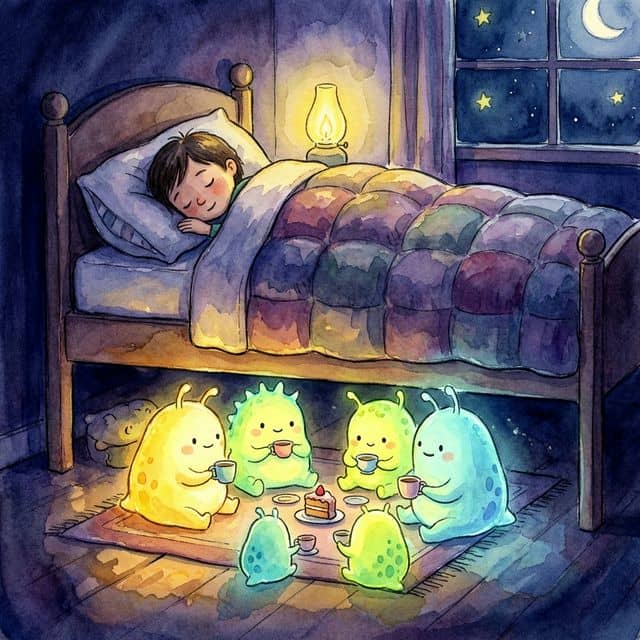
In the story, your child might discover that the monsters under the bed are actually friendly creatures having a tea party. Or that the shadows on the wall are dancing animals who need a friend. The darkness turns from threat to adventure — and the child is the brave explorer who transforms it.
Why does this work so well?
- Externalization: The child processes the fear from a safe distance (it's "story-me" facing the dark, not "real-me").
- Rehearsal: Each reading rehearses the brave response, building a neural pathway for courage.
- Reframing: The story literally changes what the child imagines when they think about "the dark."
- Personal: Because the hero is them, the lesson feels directly applicable: "I did it in the story — I can do it for real."
Create a personalized dark-conquering story at Magical Hekaya →
What NOT to Do
A few common approaches that seem helpful but can actually make things worse:
- Don't force exposure. Turning off all lights to "prove" there's nothing there can traumatize rather than desensitize.
- Don't use fear as punishment. Never threaten to put a child "in the dark room."
- Don't mock the fear. "You're too old to be scared of the dark" creates shame, not courage.
- Don't show scary media. Even "mildly" scary movies or shows can feed the beast. Stick to content that reinforces safety at night.
A Bedtime Routine for Fearful Children
Combine the strategies above into a nightly routine:
- 7:00 PM — Bath time (warm water is calming)
- 7:20 PM — "Room check" together + Monster Spray
- 7:30 PM — Read the personalized "brave in the dark" story
- 7:45 PM — Night light on, glow-stars visible, one big hug
- 7:50 PM — Goodnight — "You're the bravest hero I know"
Consistency is everything. After 2-3 weeks of this routine, most children show significant improvement.
Help Your Child Become the Hero of the Night
Fear of the dark doesn't have to define your child's bedtime. With validation, practical tools, and the power of a personalized story where they conquer the darkness, your child can build the courage to face the night with confidence.
Create Your Child's Dark-Conquering Story → | Learn More About Bibliotherapy →