
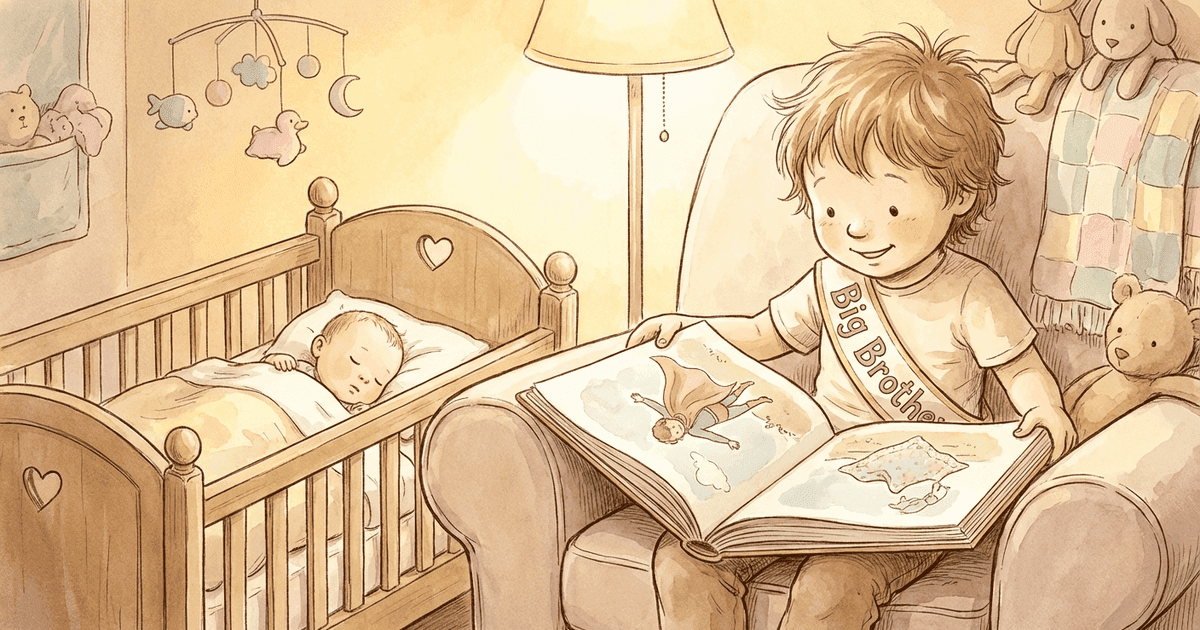
A personalized big brother or big sister book can ease the biggest emotional transition of a young child's life — turning anxiety into pride before the new baby even arrives.
The Biggest Emotional Event in a Young Child's Life
The arrival of a new sibling ranks among the most significant emotional experiences a young child will ever face — right alongside starting school and losing a first pet. For a child who has been the center of their parents' world since birth, the sudden presence of a new baby is genuinely disorienting. Overnight, the rhythms of the household change, the parents' attention is divided, and a small person who cannot yet articulate "I am afraid of being replaced" begins acting that out in other ways: clinginess, regression, tantrums, withdrawal.
Parents know this transition is coming. They prepare the nursery, they explain the concept of a sibling, they read books together. But there is an enormous difference between a generic children's book about a bear who gets a new baby sister and a personalized big brother or big sister book where your specific child — illustrated with their own face, named on every page — is the confident, loving hero of the story.
That difference is what this post is about.
The Psychology of the "Big Sibling" Identity
Child development researchers have long understood that children are profoundly influenced by the roles and labels they are given. When a parent says "you're my brave one" repeatedly, the child begins to organize their behavior around that identity. The same principle applies to the "big brother" and "big sister" designation — but only when the framing is genuinely positive and empowering, rather than merely factual.
Telling a two-year-old "you're going to be a big sister soon" is a neutral statement of fact. It doesn't tell the child how to feel, what to expect, or what the role means. But a story that shows that same child — illustrated as herself, with her face and her name — acting as a guide, a protector, a teacher, and a beloved companion to a new baby? That gives her an emotional blueprint for the role. She doesn't just know she's becoming a big sister. She feels what it's like to be one, before the baby even arrives.
This is why bibliotherapy — the use of stories to support emotional processing — is so well-established in clinical and educational contexts. Stories don't just entertain. They model behavior, normalize feelings, and give children frameworks for understanding their own experience. A story that places the child at the center of a positive sibling narrative does something profoundly useful: it shows them who they can be.
What Makes a Big Sibling Book Actually Effective
Not all sibling books are created equal. The children's section of any bookstore has dozens of titles addressing the new-baby transition, and many of them are well-intentioned but fundamentally miss the mark in one of three ways.
The first failure mode is framing the new baby as a source of disruption that the older child must simply endure. Books that spend most of their pages describing what the older child will lose — quiet, attention, their old routines — prime the child for resentment rather than excitement. The second failure mode is the opposite extreme: portraying the new baby as purely wonderful, leaving no room for the older child's real and valid feelings of anxiety or jealousy. Children who feel their emotions are being dismissed disengage quickly. The third failure mode is the most common: the story features a generic character whose circumstances roughly match the child's, but there is no real emotional identification because the hero simply isn't them.
A genuinely effective big sibling book does three things well. First, it places the child unambiguously in the hero role — not the supporting character, not the one who must adjust, but the capable, important, admired big sibling. Second, it frames the new baby as something the older child has power over in a positive sense: they can teach them things, show them the world, make them laugh. This shifts the dynamic from competition to mentorship. Third, it uses language and imagery specific enough to feel real — which is why a book featuring the child's actual face and name operates on a completely different emotional level than any generic alternative.
Why a Personalized Photo Book Is More Powerful for This Transition
There is a well-documented psychological phenomenon called the "self-reference effect": humans remember and emotionally engage with information more deeply when it is connected to themselves. For children, this effect is especially pronounced. A child who sees a cartoon bear going through the new-sibling experience processes it as a story about a bear. A child who sees their own illustrated face, reads their own name in the text, and watches a character who looks unmistakably like them navigating the same feelings — that child processes it as a story about themselves.
This distinction changes everything about how the child internalizes the message. The confidence the illustrated hero displays becomes a model the child naturally wants to emulate. The warmth the big sibling shows toward the baby feels like an instruction the child has already, in some sense, rehearsed. By the time the real baby arrives, the older child has read themselves into the hero role dozens of times. The story has become part of how they understand their own identity.
You can explore what it means for a child to be the main character in their own book and the research behind why it has such a lasting emotional impact.
Create Your Child's Personalized Book
Upload a photo and your child becomes the hero — illustrated AI storybook with audio narration, ready in under 5 minutes.
Story Themes for the New Sibling Transition
Magical Hekaya offers several story themes specifically designed for the big brother and big sister moment. These aren't generic "new baby" books retrofitted with a child's name — they are narratives built from the ground up around the emotional experience of the older child.
In the most popular themes, the older child is cast as the expert guide who welcomes the new baby into a world full of wonders: animals to discover, colors to name, games to play, and family moments to share. The baby arrives not as a competitor but as an audience and admirer — someone who will look up to the big sibling as their first hero. This framing consistently produces the emotional outcome parents are hoping for: the older child feels important, not sidelined.
There are also dual-sibling themes where both children appear in the illustrations — the older child clearly positioned as the confident lead, the baby nestled alongside as the cherished new member of the adventure. Parents who have a clear photo of the older child and a photo (or expected appearance) of the newborn can create a book that features both from the very first pages.
For families with strong cultural or religious traditions, Magical Hekaya's themes include variations that honor those contexts — making the big sibling moment feel rooted in the family's specific identity, not a generic Western narrative. You can see the full range at the personalized storybook page.
Who Buys These Books — and Why
Personalized big sibling books come from several directions in a family's life. The most common purchaser is the parent themselves, who wants to give the older child something meaningful and fun in the weeks before the new baby arrives — a gift that says "you matter, you are celebrated, this transition is yours too."
Grandparents are the second most common source. A grandmother who wants to help ease her grandchild's anxiety about the new baby often finds that a personalized book — one she can sit and read with the child during her visits — becomes her most powerful tool. The grandparent gift dimension is significant here: the book becomes associated with the warmth and safety of Grandma's presence, which gives it additional emotional weight.
Aunts, uncles, and close family friends sometimes give a personalized big sibling book as a baby shower gift directed not at the baby — who receives everything else — but at the older child, who is often overlooked in the shower gift-giving frenzy. This is an especially thoughtful and increasingly popular approach, and parents almost always respond with deep gratitude.
Timing the Gift Right
The timing of a big sibling book matters more than most parents expect. Give it too early — three or four months before the due date — and the concept of the new baby still feels abstract to a toddler. The emotional resonance of the book is lower because the child cannot yet connect the story to their lived reality.
The sweet spot is two to four weeks before the due date. At this point, the child is aware that something big is about to change — the nursery is ready, the conversations are more frequent, the parents' energy has shifted. The book arrives at exactly the moment the child needs a story that tells them how to feel and who to be. Reading it every night in those final weeks allows the child to absorb and rehearse the big sibling identity before the baby arrives.
If the baby has already arrived, don't worry — the book is equally effective in the first weeks after birth. In fact, some parents find that presenting the book to the older child at the hospital or in the first days home creates an unforgettable moment: here is a gift just for you, because you are now the big brother, and that is something worth celebrating.
Frequently Asked Questions
When should I give my child a big brother or big sister book?
Ideally, give it two to four weeks before the new baby's due date. This window gives your child enough time to absorb the story and internalize the big sibling identity without the concept of the new baby feeling too abstract. Reading it repeatedly in those final weeks helps build emotional familiarity with the role. If the baby has already arrived, it's not too late — the book is equally effective in the first weeks after birth, when the older child is navigating real feelings in real time.
Does a personalized sibling book actually help with adjustment?
Yes — and the research backs this up. Bibliotherapy, the use of stories to support emotional processing, is well-documented as an effective tool for helping children navigate life transitions. When the story features the child as the hero and frames the sibling role as empowering, it gives the child an emotional script to follow. A personalized book that shows their own face in the big sibling role is significantly more impactful than a generic book about an unnamed character going through the same experience.
What age is best for a big brother or big sister book?
Personalized big sibling books work best for children aged 2 to 7. Children aged 2 to 4 are in the prime window — they understand the story, identify deeply with the illustrated hero, and are at the age where sibling adjustment is most emotionally intense. Children aged 5 to 7 engage at a higher level and can use the book as a starting point for deeper conversations about the transition. Children under two benefit from the calming read-aloud experience even if they don't fully process the narrative.
Yes. Magical Hekaya offers story themes where both the older child and the new baby appear in the narrative. In these stories, the older child is unambiguously the hero — the guide, the teacher, the protector — while the new baby plays a beloved supporting role. This framing avoids any sense of competition or displacement. The older child is not replaced; they are elevated. These dual-sibling themes are among the most requested options from parents navigating the new-baby transition.