
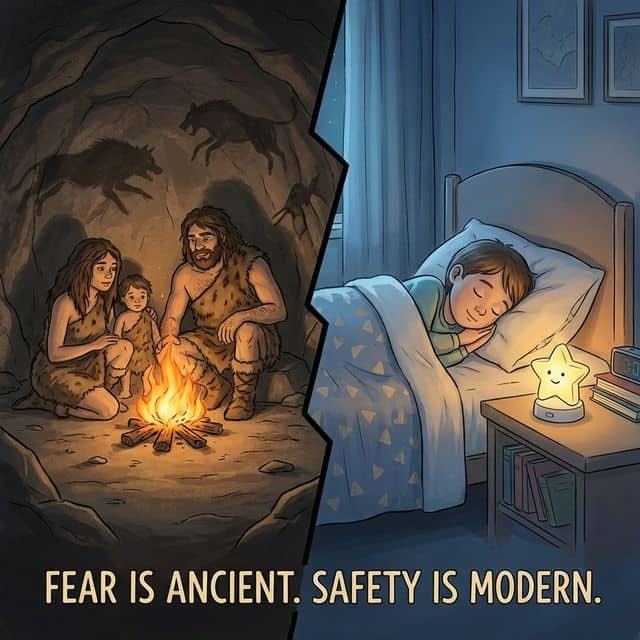
It's not just your kid—fear of the dark is a survival instinct. Learn the evolutionary science behind nyctophobia and how to build a modern 'campfire' of safety.
It is frustrating when your logical explanation that 'there are no monsters' doesn't work. But logic doesn't work because the fear isn't logical—it's biological. Your child isn't being difficult; they are being human.
The Biology of Fear: Why We Scared of the Dark
Thousands of years ago, children who were afraid of the dark survived. The ones who wandered into the dark cave... didn't. This fear is hardwired into our DNA.
When the lights go out, your child's amygdala (the brain's alarm system) lights up. It doesn't care that you live in a safe suburb with deadbolt locks. It asks one question: "Where is the predator?"
This is why saying "There is nothing to be scared of" fails. You are fighting millions of years of evolution with a sentence.
The Modern "Cave Fire"
In ancient times, the fire was the safety zone. Today, we need to create a modern equivalent.
1. Lighting Matters
Use a night light, but be careful with the color.
- Good: Red, orange, or amber light. This mimics fire/sunset and doesn't interfere with melatonin.
- Bad: Blue or bright white light (LEDs). This mimics the sun and tells the brain to "Wake up, it's morning!"
2. The Voice of a Parent
Your voice reading a story is the ultimate signal of safety. If mom/dad is calm enough to sit and read a book, there must be no predators nearby. It regulates their nervous system.
Reframing the Dark
Bibliotherapy is powerful here. We need to tell the brain a new story about what the dark is. That is why children's books about fear of the dark can be so transformative.
Is the dark a scary void? Or is it a velvet blanket? Is it where monsters hide? Or is it where dreams live?
In our personalized stories, we often include scenes where the dark is beautiful—full of fireflies, moonbeams, and friendly owls. By associating the dark with wonder instead of danger, we can slowly reprogram the amygdala's response.
Turn the Dark Into a Magical Adventure
Create a personalized story where your child discovers that the dark is full of wonder — fireflies, moonbeams, and friendly owls. Reframe the fear with their own hero story.
Create Their Night Adventure →Validation Over Logic
Instead of dismissing the fear, validate it.
Don't say: "Don't be silly, big boys aren't scared."
Do say: "I know it feels scary. I used to get scared too. But I am right down the hall and this house is safe."
When is it Too Much?
Fear of the dark usually peaks at age 4-5 and naturally declines by age 8-9. If the fear is so intense that your child cannot sleep alone significantly past this age, or if it causes panic attacks, it might be time to consult a pediatrician about anxiety.
Turn the Dark into Magic
Create a story where your child discovers a magical world that ONLY appears at night. Make them eager to turn the lights out.
Discover the MagicIt Gets Better
Remember, this fear is a sign that your child's brain is working exactly as it should—trying to keep them safe. With patience, a good night light, and the right stories, they will learn to trust the night.