
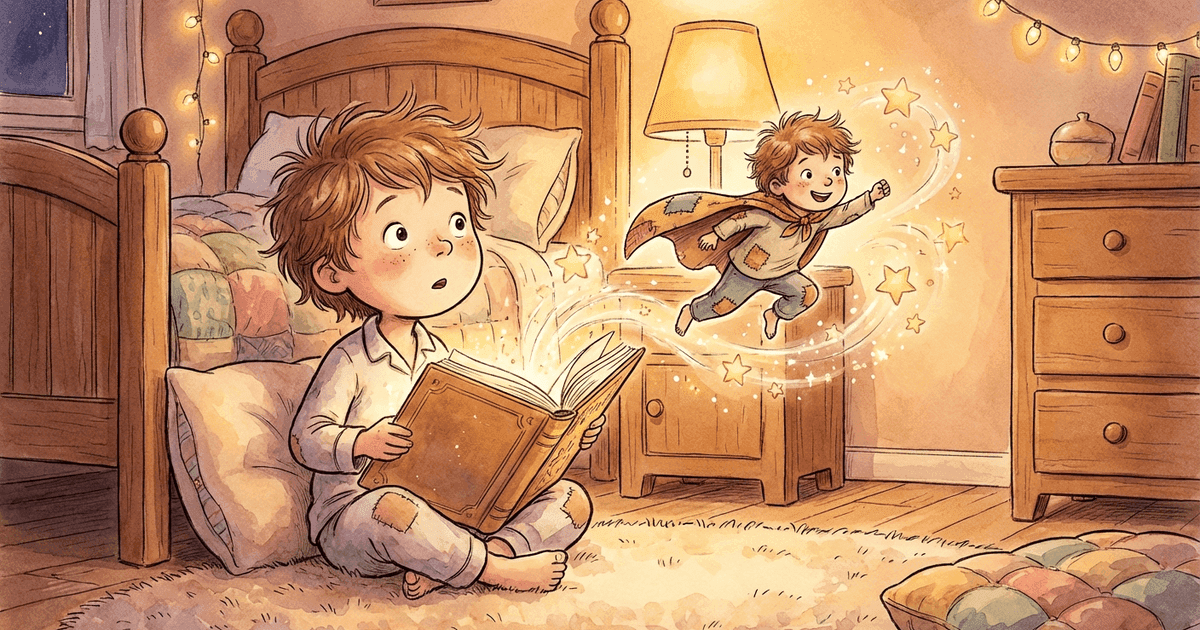
Everything you need to know about children's books where your child is the star — how they work, what types exist, and how AI now creates illustrated characters from a single photo.
What Parents Are Really Looking for When They Search This
When a parent types "book where my child is the main character" into a search engine, they are not looking for a technical definition. They are imagining a moment: their child opening a book, seeing the character on the first page, and saying — with complete certainty — "that's me." They are looking for the version of reading that is not just engaging but personally electrifying. The version that makes a child who drags their feet at story time suddenly ask to read again and again.
That moment is real. It happens every time a child encounters a story that places them at the center — not a character who shares their name, but a character who looks like them, whose face they recognize, whose adventures feel like extensions of their own life. This guide explains exactly how these books work, what the different levels of personalization actually mean, and how modern AI has made true photo-based character personalization something any parent can access in minutes.
Three Levels of Personalization: What Each One Actually Means
Not all "personalized books" are created equally. Parents searching for a custom illustrated book with their child's photo are often surprised to discover that the market contains products that are very different from each other, despite using the same marketing language. Understanding the three levels of personalization helps you choose the right product for your child's age and your expectations.
Level 1: Name-Only Personalization
The simplest and oldest form of personalized children's book. A pre-written story with fixed illustrations gets your child's name inserted at specific points in the text. "Emma went to the magical forest" instead of "The girl went to the magical forest." The character in the illustrations looks nothing like your child — they are a generic, universal figure designed to be racially and aesthetically neutral. Name-only books have been popular for decades because they are inexpensive to produce, but their personalization is superficial. A child reading their own name in a book is mildly pleased. A child seeing their own face is transformed.
Level 2: Avatar Personalization
A significant step forward. Parents use an online builder to create a cartoon avatar: they choose skin tone, hair color, hair style, eye color, and sometimes clothing. The system maps this avatar onto character templates and produces a book where the main character matches the avatar they built. This approach is more personal than name-only — a child can see something closer to themselves — but it still requires abstracting a real person into a cartoon template. Toddlers under 3 often fail to connect an avatar with themselves because they recognize faces, not stylized representations. Older children enjoy the customization process but are rarely surprised by the result the way they are when their actual photo appears.
Level 3: AI Photo-Based Illustration
The most powerful and most recent level. A parent uploads a real photo of their child. Advanced AI image generation analyzes the child's actual facial features — skin tone, eye shape, hair texture, general proportions — and uses them to illustrate a consistent character throughout a complete storybook. The character does not look exactly like a photograph, but it is clearly, unmistakably the child. The recognition is immediate and often remarkable: children see their face on page one and the rest of the book belongs to them. This is the technology that Magical Hekaya is built on.
The Psychology: Why Seeing Their Face Matters More Than Seeing Their Name
The self-reference effect is one of the most consistent findings in cognitive psychology. First documented in the 1970s and replicated hundreds of times since, it describes the tendency for people to encode, process, and remember information more deeply when it is related to themselves. Information that connects to "me" is not processed like other information — it goes through a different, deeper cognitive pathway.
For children, this effect operates through the most primal self-representation they have: their face. Before a child can read their own name, before they have a developed sense of narrative identity, they recognize their face. They know that face from mirrors, from phone cameras held in front of them, from photographs shown by parents and grandparents. When a character in a story has that face, the self-reference effect activates fully. The story becomes not just engaging but personally relevant in a way that abstract name insertion simply cannot replicate.
Studies on children's book engagement — including research published in the British Journal of Educational Psychology — have found that children spend significantly longer with books in which they see themselves represented. Longer engagement means more language exposure, more repetition, and ultimately deeper literacy development. A book where your child is the main character is not a gimmick. It is a mechanism for turning a reluctant reader into an eager one. Our post on how being the hero builds confidence explores the psychological benefits in more depth.
How AI Creates a Character from a Single Photo
Parents who are new to AI personalization often have a reasonable question: can a machine really look at one photo of my child and produce consistent illustrations of them across an entire story? The answer, in 2026, is yes — and the process is worth understanding because it demystifies both what the technology can do and what its limitations are.
When you upload a photo to Magical Hekaya, the AI does not simply paste your child's face onto template images. Instead, it analyzes the photo to extract a set of visual features: the specific shape and color of the eyes, the tone and texture of the skin, the curl pattern and color of the hair, the general proportions of the face. These features are encoded as a kind of visual fingerprint.
When generating each page of the story, the AI uses this fingerprint to construct the character in the scene from scratch — in the appropriate pose, expression, clothing, and lighting for that page — while maintaining consistency with the features extracted from the original photo. The result is an illustrated character who looks like a warmly drawn version of your child, not a photorealistic copy, but consistently and recognizably them across every page of the book.
The hardest technical challenge is character consistency: ensuring that the character on page one looks like the same character on page twelve, even when they are running, sleeping, laughing, or surrounded by dragons. This is what separates high-quality AI personalization from cheaper alternatives that produce characters who subtly shift from page to page. It is worth checking sample outputs from any service before ordering, specifically to evaluate consistency. Read our article on what an AI children's book actually is for a deeper look at how the technology works.
What to Look for When Choosing This Type of Book
With several services now offering some form of "child as main character" personalization, there are a few specific criteria that separate a book worth buying from one that disappoints.
Character likeness and consistency. This is the core promise of a photo-based personalized book. Look for sample images that show the same character across multiple pages, in different poses and scenes. If the samples show a character who looks vaguely similar across pages, that is a sign of weaker AI or template-based methods.
Art style. The illustration style should feel warm, inviting, and appropriate for children — typically watercolor, soft digital illustration, or storybook-style art. Overly photorealistic or uncanny illustration styles can feel unsettling, especially for young children.
Audio narration. This feature is particularly valuable for children under 5, who may not yet be reading independently. A warm, paced voice reading the story aloud means the book works at bedtime, in the car, and during solo play — not just when a parent is available to read.
Story quality. The illustration personalization matters, but so does the story itself. A weak, generic plot will not hold a child's attention no matter how accurate the character likeness is. Look for stories with proper narrative arcs, age-appropriate vocabulary, and themes that connect emotionally.
Content safety. Any platform generating AI content for children should have clear policies on content moderation. Stories and illustrations should be reviewed to ensure they are age-appropriate, free from scary or inappropriate elements, and safe for the intended audience.
Comparison: Name-Only vs Avatar vs AI Photo
| Feature | Name-Only | Avatar | AI Photo |
|---|---|---|---|
| Character looks like my child | No | Partially | Yes |
| Works well for toddlers under 3 | Marginally | Partially | Best |
| Instant digital delivery | Usually | Usually | Yes (< 5 min) |
| Audio narration | Rarely | Sometimes | Included |
| Unique story generation | No (template) | No (template) | Yes |
| Starting price (digital) | $15–$25 | $25–$45 | From $4.99 |
| Self-reference effect activation | Partial | Moderate | Full |
Create Your Child's Personalized Book
Upload a photo and your child becomes the hero — illustrated AI storybook with audio narration, ready in under 5 minutes.
Start Creating NowHow to Create One with Magical Hekaya: Step by Step
The process of creating a children's book with your child's photo on Magical Hekaya takes most parents less than 5 minutes from start to finish. Here is exactly what happens at each step.
- Upload a photo. Choose a clear, well-lit photo of your child's face. A standard smartphone photo taken in natural light is ideal. Face-on or slight angle works best; avoid heavy shadows or sunglasses.
- Enter your child's details. Add their name, age, and any optional details like their favorite animal or a sibling's name if the story includes family members.
- Choose a story theme. Browse from over 72 themes spanning adventure, bedtime, fears, milestones, birthdays, and cultural stories. Each theme is tagged by recommended age range so you can filter by your child's stage.
- Preview the story. See how the personalized details will appear in the narrative before the AI generates the full illustrations.
- Generate and receive. The AI illustrates every page of the story using your child's photo as the character reference. The full digital book with audio narration is delivered in under 5 minutes.
- Read, share, or print. Access the book instantly online, share a link with family members, or print the high-resolution PDF at home for the bookshelf.
Story Themes Where "Child as Hero" Has Maximum Impact
Not all story themes benefit equally from photo-based personalization. The themes where seeing their own face as the hero has the deepest emotional impact tend to be those where the story touches on something real in the child's inner life.
Fear-based stories — stories about overcoming fear of the dark, monsters, or a new situation — work extraordinarily well with photo personalization. When a child sees themselves as the brave character who faces and conquers their fear, the story becomes therapeutic. They are not watching a fictional hero be brave. They are watching themselves be brave. Our guide to how being the hero builds confidence explores this mechanism in detail.
Milestone stories — starting school, welcoming a new sibling, moving to a new home — carry enormous emotional weight for young children. A story where they see themselves navigating that milestone with courage and warmth provides a genuine scaffold for the real experience. See our post on helping children adapt to a new sibling for more on this.
Adventure stories — where the child character goes on a quest, explores a magical world, or rescues a creature in need — activate the most joyful version of the self-reference effect. These stories do not just tell a child they are brave and capable; they show it to them in full illustrated color, in a narrative that is undeniably theirs.
Bedtime stories where the character mirrors the child's own routine — complete with their name and face — have been shown to reduce bedtime resistance in young children. The familiarity is calming, and the story's conclusion (the child character drifts off to sleep) models the behavior parents are trying to encourage.
Frequently Asked Questions
How is a book where my child is the character different from a name-only book?
A name-only book inserts your child's name into a pre-written story with generic illustrations. The character looks nothing like your child — they are a universal placeholder. A book where your child is the character uses either an avatar or, in AI-powered services, your child's actual photo to generate illustrations where the character genuinely resembles them. The emotional impact is dramatically different: research on the self-reference effect shows that children process and remember information far more deeply when it is connected to their own face and identity, not just their name.
Does the AI actually make the character look like my child?
With current AI image generation technology, yes — to a degree that was not possible even two years ago. Magical Hekaya uses advanced AI illustration models that analyze your child's facial features, skin tone, hair, and general appearance from a single uploaded photo, then recreate those characteristics consistently across every page of the story. The result is not a photorealistic copy but a warm, illustrated character that parents and children immediately recognize as them. Character consistency — the same face appearing identically across twelve or more pages — is the key technical challenge, and modern AI handles it with remarkable accuracy.
What photo should I use?
The best photo for AI personalization is a clear, well-lit shot of the child's face, ideally taken face-on or at a slight angle, with minimal background clutter. Natural daylight works best. The photo should be recent enough to reflect how the child currently looks. Avoid sunglasses, heavy shadows across the face, or photos where the child is turned away. A standard smartphone photo taken in good light is more than sufficient — you do not need a professional portrait.
How long does it take?
With Magical Hekaya, a complete illustrated digital storybook with audio narration is generated in under 5 minutes. You upload a photo, choose your story theme, confirm the child's name and details, and within minutes you have a full personalized book ready to read. You receive a high-resolution, print-ready PDF with audio narration — yours forever, nothing to ship — available immediately and ready to gift on the same day it is ordered. Print it at home if you'd like a physical copy.
Are these books safe for children's data and privacy?
At Magical Hekaya, children's privacy is treated as a core responsibility. Uploaded photos are used only to generate the illustrations and are not sold, shared with third parties, or used to train AI models without explicit consent. Parents retain full control and can request deletion of their child's data and generated books at any time. The platform is designed with GDPR and COPPA principles in mind. Before using any personalized book service, it is worth reviewing their data retention and deletion policies.