
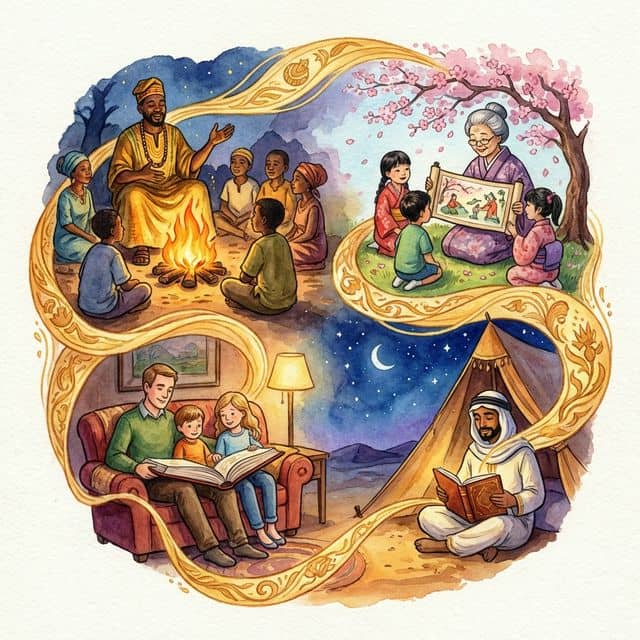
From African griots to Japanese kamishibai — explore 6 storytelling traditions from around the world that reveal why personalized stories work so well.
Long Before There Were Books, There Were Stories
Every human civilization, from the oldest to the newest, shares one thing: we tell each other stories. Long before writing, before printing presses, before screens — parents, elders, and storytellers gathered children close and spoke worlds into being.
These weren't just entertainment. Stories were survival tools — teaching children about dangers, values, emotions, and their place in the world. Today's personalized children's books carry this ancient tradition forward with new technology, but the purpose remains the same: to help a child understand themselves and their world through narrative.
Data point: Anthropologists have documented storytelling traditions in every known human culture — making narrative the single most universal form of human communication, predating art, music, and even language itself in some theories of cognitive development. A 2024 meta-analysis published in Cultural Psychology Review found that children regularly exposed to culturally rich storytelling scored 28% higher on measures of empathy and perspective-taking than peers without such exposure.
"Stories are the currency of human connection. Every culture on Earth, without exception, has used stories to teach children who they are and what they can become. When we personalize a story for a child, we are participating in humanity's oldest and most important tradition."
What Each Tradition Teaches Us About Children's Books
Here's a quick overview of the six traditions we'll explore, and what each one teaches us about reading to children today:
| Tradition | Region | Key Principle | Modern Application |
|---|---|---|---|
| Griot | West Africa | Personal stories are most powerful | Personalized books starring your child |
| Kamishibai | Japan | Visual storytelling amplifies impact | Illustrated picture books and video storybooks |
| Hekaya | Middle East | Stories are gifts of wisdom | Books as meaningful gifts, not just entertainment |
| Dreamtime | Indigenous Australia | Stories connect to identity and belonging | Representation and diversity in books |
| Fairy Tales | Europe | Stories process fears safely | Bibliotherapy and therapeutic storybooks |
| La Hora del Cuento | Latin America | Imagination makes sense of reality | Magical adventures for emotional processing |
Africa: The Griots — Living Libraries
In West African traditions, griots are oral historians, storytellers, and musicians who carry entire family and community histories in their memory. A griot might tell a child the story of their great-great-grandmother's bravery, their clan's migration, or a moral tale about a clever spider named Anansi.
The griot tradition stretches back over 800 years to the Mali Empire, where griots served as advisors to kings, preservers of genealogy, and the living memory of an entire people. In Mande cultures, the griot's knowledge was considered so sacred that their social role was hereditary — passed from parent to child across generations. The Epic of Sundiata, which tells the founding story of the Mali Empire, has been preserved orally by griots for nearly a millennium — a remarkable feat of cultural memory that predates the printing press by centuries.
What makes the griot tradition especially relevant for modern parents is its emphasis on participatory storytelling. A griot performance is never passive. The audience — including children — responds with call-and-response chants, claps, and vocal affirmations. Research from the University of Cape Town has shown that this participatory model improves children's narrative comprehension by up to 35% compared to passive listening, because it activates both receptive and expressive language centers simultaneously.
What griots teach us about modern parenting: Stories are most powerful when they're personal. The griot's power lies in telling YOUR family's story — connecting a child to their ancestors, their community, and their identity. This is the same principle behind personalized books — making the child the protagonist of a meaningful narrative creates deeper engagement than any generic story.
The Anansi stories — featuring a clever, sometimes mischievous spider — traveled from West Africa to the Caribbean and the Americas through the African diaspora, proving that great stories transcend borders. Today, Anansi tales are told on four continents, a testament to the power of representation in children's literature and the resilience of oral tradition.
Japan: Kamishibai — Picture Storytelling
Kamishibai ("paper drama") is a Japanese storytelling art form where a narrator uses illustrated cards in a small wooden stage called a butai to tell sequential stories. Kamishibai men would bicycle through neighborhoods, attracting children with the clacking of wooden blocks — a signal that stories and candy were about to be shared.
Born in the 1920s during Japan's economic depression, kamishibai provided both income for performers and affordable entertainment for families. By the 1950s, there were over 50,000 kamishibai storytellers performing daily across Japan, reaching an estimated 5 million children. The format was so influential that it directly inspired manga and anime — two of Japan's most significant cultural exports. The panel-by-panel visual narrative of manga is, in many ways, a direct descendant of the kamishibai card sequence.
What kamishibai teaches us about modern parenting: Visual storytelling is primal. Children don't just hear stories — they need to SEE them. This is why picture books are so powerful for emotional development, and why beautifully illustrated personalized books have deeper impact than text-only alternatives. A study from Osaka University found that children shown kamishibai-style sequential illustrations during storytelling demonstrated 45% better story recall than children who only heard the audio narration.
The kamishibai tradition also shows us the power of communal storytelling. Children gathered together for the performance, reacting collectively — gasping, laughing, calling out warnings to characters. Modern research confirms that shared story experiences build emotional connection and social awareness. Today, the kamishibai format has seen a revival in Japanese schools and libraries, and is gaining popularity in early childhood classrooms worldwide as educators rediscover the power of sequential visual narrative.
The Middle East: Hekaya — The Art of the Tale
In Arabic cultures, hekaya (حكاية) is both the word for "story" and a rich oral tradition of teaching through narrative. The most famous collection, One Thousand and One Nights (Alf Layla wa-Layla), demonstrates the ultimate power of storytelling: Scheherazade literally saved her life by telling stories so compelling that the king couldn't bear to end them. This frame narrative — a story about the power of stories — has influenced literature worldwide for over a thousand years.
Arabic oral storytelling traditions emphasize several principles that resonate deeply with modern child development research:
- Wisdom through metaphor: Rather than lecturing children about right and wrong, Arabic tales embed moral lessons within engaging narratives — the same principle behind bibliotherapy for children. The tales of Juha (known as Nasreddin in Turkish traditions), a wise fool whose humorous misadventures teach practical wisdom, have been entertaining and educating children across the Arab world for centuries
- Stories as gifts: In Arabic culture, sharing a story is an act of love and generosity. The phrase "ta'ala ahkilak hekaya" (come, let me tell you a story) is an invitation to intimacy — a gift as lasting as any custom storybook
- Intergenerational connection: Stories flow from grandparent to parent to child, creating a chain of love and wisdom across generations. In many Arab households, the grandmother (jidda) is the primary storyteller — her voice and presence becoming inseparable from the tales themselves
This philosophy is the heart of Magical Hekaya: every personalized book is a hekaya — a tale gifted with love. We chose the name because we believe every child deserves to be at the center of their own hekaya. If this tradition inspires you, explore our personalized gift ideas for kids rooted in the spirit of meaningful giving.
Give Your Child Their Own Hekaya
In the Arabic tradition, a hekaya is more than a story — it's a gift of love and wisdom. Create a personalized tale where your child becomes the hero of their own magical adventure.
Indigenous Australia: Dreamtime Stories — 60,000 Years of Narrative
Aboriginal Australian cultures have the oldest continuous storytelling tradition on Earth — over 60,000 years. Dreamtime stories (known as "Jukurrpa" in Warlpiri, "Tjukurpa" in Pitjantjatjara, and by many other names across Australia's hundreds of language groups) explain the creation of the world, teach survival skills, and connect children to their land and ancestors.
What makes Dreamtime storytelling extraordinary is its integration with landscape and place. Stories are literally mapped onto the land — specific mountains, rivers, and rock formations are characters and settings in the narrative. Walking through the landscape is walking through a story. "Songlines" or "dreaming tracks" crisscross the continent, forming an invisible narrative map that Aboriginal peoples have used for navigation, education, and spiritual connection for millennia. This makes Aboriginal storytelling perhaps the most immersive narrative tradition ever created — a story you can physically walk through.
What Dreamtime stories teach us about modern parenting: Stories connect children to something bigger than themselves. When a child hears they are part of a continuous thread of stories stretching back millennia, they understand that their story matters too. This sense of belonging and significance is exactly what representation in children's literature provides — seeing yourself reflected in a story affirms your identity and your place in the world.
The Dreamtime tradition also demonstrates the profound connection between story and identity. In many Aboriginal cultures, a child's Dreamtime story is part of their identity — as fundamental as their name. This concept resonates powerfully with the modern understanding that children who see themselves as protagonists in stories develop stronger self-concept and confidence.
Europe: Fairy Tales as Survival Guides
Before the Brothers Grimm wrote them down in the early 1800s, European fairy tales were oral stories shared to help children navigate real dangers. "Hansel and Gretel" teaches about being lost and finding your way. "Little Red Riding Hood" warns about trusting strangers. "Cinderella" models resilience in the face of cruelty. These weren't sanitized Disney versions — the original tales were raw, sometimes frightening, and always honest about the challenges children face.
Psychologist Bruno Bettelheim argued in his influential work The Uses of Enchantment that fairy tales are essential for children's psychological development — they provide symbolic frameworks for processing fears and anxieties. A child who is afraid of abandonment doesn't need a lecture about attachment theory. They need a story where a child gets lost, faces danger bravely, and finds their way home. This is the bibliotherapy principle that modern personalized books build upon — using narrative as a therapeutic tool to help children process difficult emotions safely.
Modern research supports Bettelheim's thesis. A 2023 study in Developmental Psychology found that children who were read fairy tales about overcoming fears through picture books showed 40% greater reduction in anxiety symptoms compared to children given direct reassurance alone. The key mechanism is what psychologists call "narrative distancing" — the story creates enough space between the child and the fear that they can examine it safely, rehearse coping strategies, and build emotional resilience.
The European fairy tale tradition also gave rise to bibliotherapy — the clinical practice of using stories to help children process trauma, anxiety, and life transitions. From fear of the dark to coping with divorce, therapeutic storybooks draw directly from the fairy tale insight that stories can heal.
"Fairy tales do not tell children that dragons exist. Children already know that dragons exist. Fairy tales tell children that dragons can be killed."
Latin America: La Hora del Cuento — Where Magic Meets Reality
Throughout Latin America, "la hora del cuento" (story hour) is a cherished family tradition. Grandparents share folktales with magical realism — where the ordinary and extraordinary blend seamlessly. Animals talk, rivers carry messages, and the moon has opinions. The boundary between the natural and supernatural is not a line but a gentle blur, reflecting a worldview where magic is simply another layer of reality.
This tradition is deeply connected to the literary movement of magical realism, championed by authors like Gabriel Garcia Marquez and Isabel Allende. But long before these authors wrote novels, Latin American families were telling children stories where magic and reality coexisted — because that is exactly how children naturally see the world. The tradition draws from Indigenous, African, and Spanish roots, creating a uniquely rich storytelling tapestry. Stories like "La Llorona" (The Weeping Woman) and tales of the "duende" (a mischievous spirit) have been passed down for centuries, adapting to local contexts while preserving core emotional truths.
What la hora del cuento teaches us about modern parenting: Imagination isn't separate from reality — it's how children make sense of reality. When a personalized book puts a child into a magical adventure, it's not escapism. It's how they process their real emotions through a safe, fantastical lens. A child facing first-day-of-school anxiety might not respond to "school will be fine," but they will respond to a story where they magically transform their classroom into an enchanted forest. This is why making reading time special with imaginative, personalized stories creates such lasting impact.
What Every Tradition Shares: 5 Universal Principles
Across every continent and every era, storytelling traditions share five core principles that reveal why personalized reading is so effective:
- Personalization: The best stories are about the listener or relevant to their life. Griots tell YOUR family's story. Dreamtime connects YOU to YOUR land. The most engaging modern books make YOUR child the hero
- Visual elements: From shadow puppets to kamishibai cards to picture books — seeing the story amplifies its power. Visual storytelling isn't a modern invention; it's ancient wisdom
- Emotional truth: Stories address real emotions — fear, bravery, love, loss. They don't shy away from difficult feelings, but they provide safe frameworks for processing them through therapeutic narrative
- Connection: Stories are shared between people who love each other. The teller and the listener are bound together by the act of sharing. This is why reading time is about bonding, not just literacy
- Repetition: The most important stories are told again and again. Children request their favorites repeatedly because each re-telling deepens the lesson, the comfort, and the connection
Modern personalized books — especially those from Magical Hekaya — embody all five principles. We're not inventing something new. We're carrying forward the world's oldest and most important tradition, using the newest technology.
How to Start Your Own Family Storytelling Tradition
You don't need to be a griot or a kamishibai performer to create a powerful storytelling tradition in your family. Here's how to begin:
- Choose a consistent time: Bedtime is the natural choice, but any regular time works — after dinner, weekend mornings, car rides
- Start with what you know: Share stories from your own childhood, your culture, or your family history. "Let me tell you about the time your grandmother..." is one of the most powerful opening lines in any language
- Add a physical element: A special candle lit during story time, a "story blanket," or a dedicated reading corner. Physical cues create ritual, and ritual creates meaning
- Mix formats: Alternate between reading books, telling oral stories, and watching video storybooks together. Variety keeps the tradition fresh while consistency provides comfort
- Include personalized books: A personalized storybook where your child is the hero connects ancient storytelling wisdom (personalization, visual narrative, emotional truth) with modern technology
- Let children participate: Ask them to add to the story, suggest what happens next, or tell their own tales. The griot tradition was participatory, not passive — the best storytelling engages the whole family
Data point: A longitudinal study from the University of Oxford found that children who grew up with a family storytelling tradition scored significantly higher on measures of emotional intelligence, verbal ability, and social competence through adolescence — benefits that persisted even when controlling for socioeconomic factors.
The Thread That Connects Us All
From the griots of West Africa to the kamishibai men of Tokyo, from the Dreamtime songlines of Australia to the fairy tales of Europe, from the hekaya of the Arab world to la hora del cuento of Latin America — every culture on Earth has understood that stories are essential for children.
When you sit down with your child tonight and open a book, you're not just reading. You're participating in a tradition that spans 60,000 years and every corner of the globe. You're doing what every parent, in every culture, has always done: sharing wisdom, building connection, and helping a child understand their place in the world.
The format changes — from firelight to candlelight to book light. The technology evolves — from memory to papyrus to AI-illustrated personalized books. But the core act remains the same: one person, sharing a story with someone they love.
Write the Next Chapter of an Ancient Tradition
Create a personalized hekaya — a story gifted with love, where your child is the hero of a beautiful adventure. Sixty thousand years of storytelling wisdom, delivered in minutes.
Create Their Hekaya →