
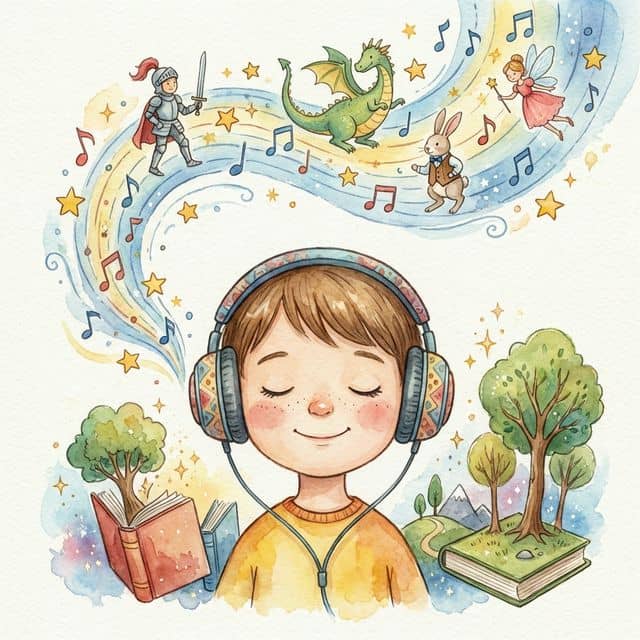
Audio storybooks help reluctant readers fall in love with stories. Discover the brain science behind listening and 5 proven ways to use them every day.
When "Read to Me" Becomes "I Don't Want To"
Every parent knows the struggle: you have bought beautiful books, you have carved out time for reading, but your child will not sit still. They squirm. They interrupt. They would rather play with toys or watch a screen. You start to worry: Is my child going to hate reading?
Take a breath. Your child might just be an auditory learner. And audio storybooks might be the key that unlocks their love of stories — and eventually, their love of reading.
A 2025 Scholastic Kids & Family Reading Report found that children who regularly listen to audiobooks read 43% more books overall than children who do not. Audiobooks do not replace reading — they amplify it. If you have been wondering whether screen time vs reading is an either-or choice, audio storybooks offer a compelling third path.
The Science of Listening
Here is a surprising fact: the brain processes spoken stories and written stories through many of the same neural pathways. A landmark study at the Gallant Lab at UC Berkeley used fMRI scans to show that whether a person reads a story or listens to one, the same semantic maps light up across the cerebral cortex.
For children who struggle with the mechanics of reading — decoding letters, tracking words, sitting still — audiobooks bypass the bottleneck and deliver the story directly. The result is powerful:
- Vocabulary expansion: Children hear words in context, including complex vocabulary they would not encounter in early readers. Research shows audiobook listeners develop vocabularies 30% larger than non-listeners by age 7.
- Comprehension skills: Following a spoken narrative builds the same comprehension abilities needed for reading — sequencing, inference, prediction, and recall
- Emotional engagement: A skilled narrator's voice conveys tone, emotion, and pacing that bring stories to life in ways that flat text on a page cannot. This connects directly to the way picture books and emotional development work hand in hand.
- Attention span building: Audio stories train children to sustain focus over longer periods, gradually building the concentration muscle needed for all learning
"Audiobooks are not cheating. They are a different pathway to the same destination — a mind enriched by stories. For reluctant readers, they may be the only pathway that works."
Audio vs. Physical Books: What the Research Shows
| Skill | Audiobooks | Physical Books |
|---|---|---|
| Vocabulary | Excellent — exposure to complex words in context | Good — limited by reading level |
| Comprehension | Strong — prosody aids understanding | Strong — self-pacing aids understanding |
| Decoding (Phonics) | Weak — doesn't practice letter recognition | Strong — builds letter-sound connections |
| Attention Span | Builds sustained listening focus | Builds sustained visual focus |
| Accessibility | Excellent for dyslexia, ADHD, visual challenges | May be challenging for some learners |
| Convenience | Works during car rides, play, and chores | Requires seated, focused time |
The conclusion from research is clear: audiobooks and physical books build complementary literacy skills. Neither is superior — they are different tools for different moments, and children benefit most when they have access to both. For a broader perspective on how stories shape young minds, explore our guide on the benefits of personalized reading.
Why Some Children Resist Traditional Reading
It is important to understand why some children resist sitting for story time. It is rarely because they do not like stories — it is usually because the format does not match their learning style:
- High energy: Some children are kinesthetic learners who need to move. Audiobooks let them listen while playing with Legos, drawing, or riding in the car — no sitting still required
- Visual processing challenges: Children with dyslexia or visual processing differences can find printed text frustrating and exhausting. Audiobooks remove this barrier entirely while delivering the same story
- Short attention spans: A physical book demands both visual and cognitive focus. An audiobook only demands auditory attention, which many young children find easier to sustain
- Bedtime resistance: Some children associate books with "time to sleep" and resist the entire ritual. Audio stories played during quiet play or bath time can be a gentler entry point. See our tips on making reading time special for more ideas.
- Negative associations: If a child has struggled with reading instruction, they may associate books with stress. Audiobooks rebuild a positive relationship with stories without the pressure of decoding
Signs Your Child Is an Auditory Learner
Not sure if your child would respond to audio storybooks? Here are signs that your child may have a strong auditory learning preference:
- They remember songs, jingles, and spoken instructions easily but struggle to recall visual information
- They talk through problems out loud rather than drawing or writing them down
- They are distracted by background noise — this is actually a sign they are always listening and processing sound
- They love music and rhythm and may tap, hum, or sing while doing other activities
- They can retell stories they heard in impressive detail, even if they resist reading those same stories
- They ask lots of questions during activities — they learn by discussing, not by observing
If several of these describe your child, audio storybooks are likely to be a powerful literacy tool. Even children who are not primarily auditory learners benefit from the multi-sensory experience of combining audio with visual illustrations.
Audio + Personalization = Magic
Now imagine taking the power of audio and combining it with personalization. Your child hears a story where the hero has their name. The narrator says "And then Maya took a deep breath and opened the magic door..." — and Maya's eyes light up because that is her.
This is not just a nice touch — it is backed by neuroscience. The self-reference effect means that the brain pays more attention to and remembers information better when it is connected to oneself. When your child hears their name in a story, their brain shifts from passive listening to active engagement. Combined with AI-powered visual personalization, the result is a story experience that feels truly their own.
At Magical Hekaya, our personalized storybooks with photos can be paired with audio narration, creating a multi-sensory experience that engages children who resist traditional reading.
Your Child's Name, Your Child's Story — Now in Audio
Every Hekaya book comes with professional audio narration. Your child hears their own name spoken in a warm, engaging voice as they follow along with their personalized adventure.
Create Their Audio Story →5 Ways to Use Audio Storybooks
Here are five proven strategies for incorporating audio storybooks into your child's daily life — each backed by research on how children learn best:
1. The Car Companion
Turn commutes, road trips, and errands into story time. Instead of music or silence, play your child's personalized audio storybook. The confined car environment actually helps focus attention — there are fewer distractions and less ability to wander off. Many parents report that their children's most engaged listening happens in the car. It also replaces the "are we there yet?" loop with something meaningful. For longer drives, queue up multiple stories and let the journey fly by.
2. The Bedtime Wind-Down
Audio storybooks are a natural fit for the transition from active play to sleep. Instead of a parent reading (which requires lights on, upright posture, and a fully awake reader), an audio story can play in a darkened room while your child lies quietly in bed. The familiar voice, predictable narrative, and gentle pacing act as a natural calming signal. Start the audio 15 minutes before target sleep time and let the story ease them into rest. Check out our guide on bedtime books by age to find the right story length and complexity for your child.
3. The Read-Along Trainer
Put the physical book in your child's lap and play the audio version simultaneously. Have them follow along, turning pages when the narrator moves to the next scene. This builds the crucial connection between spoken and written words — the foundation of independent reading. The audio provides the decoding support so your child can focus on word recognition rather than struggling to sound out every syllable. It is like having a patient reading tutor available anytime.
4. The Travel Buddy
Planes, trains, waiting rooms, and doctor's offices — these are situations where children are bored, restless, and often handed a screen by default. An audio storybook with a pair of kid-friendly headphones turns dead time into story time. Unlike video, audio allows children to rest their eyes, look around, or quietly play with a small toy while still absorbing a narrative. Pack a few personalized stories on your phone before any trip, and you have an instant entertainment library that also builds literacy skills.
5. The Sick Day Soother
When your child is unwell and stuck at home, they often do not have the energy for active play or the focus for screen time. Audio storybooks are gentle enough for a child resting on the couch or in bed. The familiar narration provides comfort, the story provides mental engagement without physical demands, and personalized stories — where the hero shares their name — offer a special kind of reassurance. It is like a warm blanket for the imagination.
The Bridge to Independent Reading
Audiobooks are not a dead end — they are a bridge. Research from Scholastic's "Kids & Family Reading Report" found that:
- 85% of children who listen to audiobooks also read printed books
- Children who use audiobooks read more overall than those who do not
- Audiobook listeners show stronger vocabulary and comprehension on standardized tests
- Children who start with audiobooks transition to independent reading earlier than children who only have access to screen-based entertainment
Think of audiobooks as training wheels. They build the love of story, the vocabulary, and the comprehension skills that make independent reading not just possible, but enjoyable. A child who already loves a story from listening to it is motivated to pick up the physical book and try to read it themselves.
This is especially true for personalized stories. When a child knows the hero looks like them and has their name, the motivation to engage with the physical book is even stronger. Learn more about choosing age-appropriate books to find the perfect starting point for your child's independent reading journey.
Pairing Audio with Other Formats
Audio storybooks work best as part of a multi-format approach to literacy:
- Audio + Physical Book: The read-along method described above — builds word recognition and page-turning skills
- Audio + Video Storybook: For visual learners who benefit from seeing illustrations while hearing narration
- Audio + Drawing: Have your child draw scenes from the story while listening — builds comprehension and creative expression simultaneously
- Audio + Discussion: Listen together and talk about the story — builds critical thinking and emotional intelligence
The key is meeting your child where they are and gradually expanding their comfort zone. A child who starts by listening while playing with toys may progress to listening while looking at illustrations, then to following along with text, and eventually to independent reading. Every step on this journey builds essential literacy skills.
Getting Started
If your child resists traditional reading, audio storybooks offer a proven, research-backed path to literacy that works with your child's natural preferences rather than against them. Start with a story they will love — a personalized story featuring themselves as the hero — and watch their relationship with storytelling transform.
Create a Story They'll Love to Listen To
Start with a personalized storybook featuring your child as the hero — then bring it to life with audio narration they'll ask to hear again and again.
Create Their Story →