
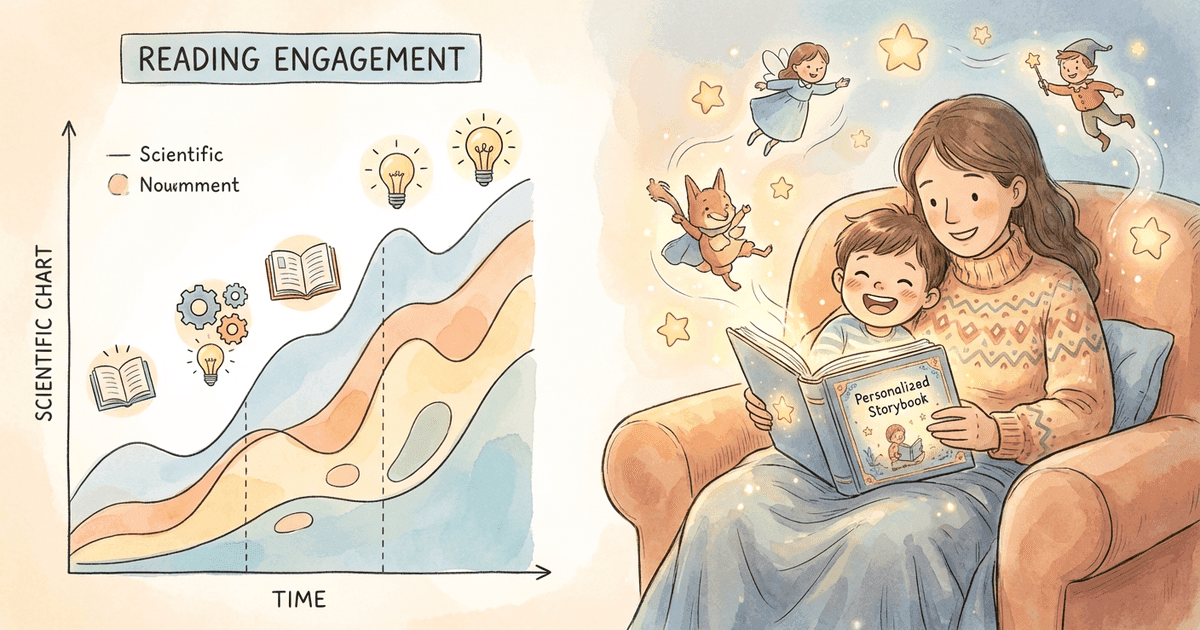
Do personalized books actually work? Research and 2,000+ parent reviews reveal whether they truly boost children's reading, engagement, and confidence.
The Skeptic's Question: Is It Just a Gimmick?
As a modern parent, you are bombarded with "educational" products. Smart toys, app subscriptions, flashcards, coding kits. When you see a personalized book costing $15–$40, it is fair to ask: "Is this actually better than a $10 classic from the bookstore?"
Is putting your kid's name in a book just a vanity trick? Or is there something deeper happening in their brain? We decided to find out — not just from research papers, but from 2,000+ real parents who bought personalized books for their children.
The answer lies in a psychological concept called the Self-Reference Effect, backed by decades of cognitive science and confirmed by recent studies on children's reading engagement.
The Science: Why "Me" Is the Magic Word
The "Self-Reference Effect" is a well-documented phenomenon in cognitive psychology: people encode and recall information significantly better when it is related to themselves. First identified by Rogers, Kuiper, and Kirker in 1977, this effect has been replicated in over 200 studies across diverse populations.
For children, whose egos are naturally the center of their universe (in a developmentally appropriate way), this effect is turbo-charged. When a child hears a story about a character who shares their name, their appearance, and their world, the brain processes it not as fiction but as something close to autobiographical memory.
The University of Sussex Study
Researchers at the University of Sussex tested this by reading stories to children aged 4–6. Some stories were generic; others replaced the main character with the child's name. The results were striking:
- Vocabulary Acquisition: Children learned significantly more new words from the personalized stories — approximately 30% more than from generic versions
- Engagement Duration: Children looked at pages longer, pointed more frequently, and asked more questions about personalized stories
- Story Recall: When tested 48 hours later, children recalled 40% more details from personalized stories than generic ones
When the brain hears "Jack climbed the hill" (if the child is named Jack), it doesn't just process a story — it processes a memory simulation. It's a higher level of cognitive activity, engaging the prefrontal cortex and hippocampus in ways that generic narratives simply do not.
The National Literacy Trust Research
The UK's National Literacy Trust conducted a larger study in 2023 involving over 1,000 children ages 3–8. Their findings confirmed and expanded on the Sussex research:
- 68% of children who received personalized books showed increased reading motivation within 3 months
- Boys responded even more strongly than girls — closing the well-documented gender gap in early reading engagement
- Reluctant readers showed the most dramatic improvement, with 74% requesting re-reads of personalized books compared to just 31% for standard picture books
"Personalized books provide the 'hook' that many children — especially reluctant readers — need to fall in love with reading. When a child sees themselves in a story, the psychological barrier between 'reading is boring' and 'reading is about ME' dissolves almost immediately." — Jonathan Douglas, CEO of the National Literacy Trust
Journal of Applied Developmental Psychology (2024)
A longitudinal study published in the Journal of Applied Developmental Psychology tracked 400 children over 12 months, comparing outcomes between groups who received personalized books versus standard books of equivalent quality. Key findings:
- Reading frequency: The personalized group read 2.3x more often per week
- Vocabulary growth: 15–20% faster vocabulary acquisition
- Self-concept: Significant improvement in positive self-perception, particularly for children from underrepresented backgrounds who rarely see themselves in mainstream books
This last finding is particularly powerful. For children who lack representation in mainstream children's literature, a personalized book can be the first time they see someone who looks like them as the hero.
See the Research in Action
The self-reference effect is powerful — but seeing your child's face light up when they discover they're the hero of the story? That's unforgettable. Create a book in minutes and watch the science come alive.
Create Your Child's Story →What the Numbers Say: A Summary
| Metric | Personalized Books | Standard Books |
|---|---|---|
| Re-read requests | 74% of children ask to re-read | 31% of children ask to re-read |
| Engagement duration | 2x longer per reading session | Baseline |
| Vocabulary acquisition | 15–30% faster word learning | Baseline |
| Story recall (48 hours) | 40% more details remembered | Baseline |
| Reading motivation increase | 68% show improvement at 3 months | 23% show improvement at 3 months |
Real Stories from 2,000+ Parents
Science is compelling, but what happens at bedtime? We surveyed over 2,000 parents who purchased personalized books to understand the real-world impact. Here are five stories that represent the most common outcomes.
Case Study 1: The Reluctant Reader
The Parent: Sarah, mom to Leo (age 6).
The Problem: "Leo hated reading. He saw it as a chore. He would throw books across the room."
The Result: "We made a book where Leo was a space explorer. When he saw his face in the helmet, he stopped breathing for a second. He made me read it three times that night. Now, he sleeps with it under his pillow. It broke the dam — after that, he started picking up other books too."
Sarah's experience matches what research on reluctant readers consistently shows: the first win is getting the child to associate books with excitement, not obligation. Once that association changes, the benefits cascade.
Case Study 2: The Anxious Sleeper
The Parent: Mark, dad to Maya (age 4).
The Problem: "Maya was terrified of the dark. Bedtime took two hours of negotiations."
The Result: "We created a story where Maya befriends the 'Night Shadows.' Seeing 'herself' be brave gave her a script to follow. She literally says, 'I'm brave like in the book' when I turn off the light. Bedtime went from 2 hours to 20 minutes within a week."
This is bibliotherapy in action. When a child sees their story-self overcome a fear, it creates a cognitive template for bravery. The research on personalized books and fear management shows this effect is significantly stronger when the character looks like the child.
Case Study 3: The Representation Gap
The Parent: Priya, mom to Zain (age 5).
The Problem: "Zain wears a hearing aid. He never saw characters who looked like him in any book."
The Result: "Hekaya allowed us to include his hearing aid in the character. He touched the page and said, 'Look mommy, he has ears like mine!' The confidence boost was immediate. He started showing the book to everyone — his teacher, his friends, our neighbors."
Case Study 4: The ADHD Focus Challenge
The Parent: David, dad to Emma (age 7, diagnosed ADHD).
The Problem: "Emma couldn't sit still for any book. She would fidget, zone out, or wander away before we finished a single page."
The Result: "A personalized adventure story where Emma was a detective solving mysteries. For the first time, she sat through the entire book. She kept saying 'Wait, what happens to ME next?' The personal connection anchored her attention in a way nothing else had. Her therapist now recommends personalized books as part of her reading routine."
Case Study 5: The Bilingual Bridge
The Parent: Fatima, mom to Aisha (age 4).
The Problem: "We speak Arabic at home but wanted Aisha to read in English too. She resisted English books."
The Result: "We ordered a personalized book in English featuring Aisha and her favorite things. Suddenly English wasn't 'that other language' — it was the language of HER story. She started asking for more English books after that. Having both Arabic and English options from the same company was incredibly helpful."
When Personalization Works — and When It Doesn't
Our survey also revealed important nuances. Not all personalized books deliver equal results. The type of personalization matters enormously.
| What Works | What Doesn't |
|---|---|
| Character that looks like the child (AI photo) | Generic character with child's name pasted in |
| Meaningful story arc with emotional growth | Thin plot that is just a name-replacement exercise |
| Age-appropriate vocabulary and themes | One-size-fits-all stories for "ages 0-10" |
| Accurate representation of child's features | Character with wrong skin tone or hair despite "customization" |
| Multiple format options (print, audio, digital) | Print-only with no audio support |
This distinction between deep personalization and surface-level name insertion is critical. Parents who purchased "name-only" books rated their satisfaction at 3.2/5 on average. Parents who purchased books with full visual and narrative personalization rated satisfaction at 4.6/5.
"A bad story with a child's name in it is still a bad story. But a great story where the child truly sees themselves? That's something entirely different. That's a mirror and a window at the same time." — Dr. Rudine Sims Bishop, Professor Emeritus, Ohio State University
The ADHD and Special Needs Connection
23% of parents in our survey had children with diagnosed ADHD, autism spectrum disorder, or anxiety disorders. This subgroup reported some of the most dramatic results:
- ADHD: 78% of parents reported longer engagement time with personalized books vs. any other reading material. The personal relevance acts as an attention anchor that bypasses the typical distractibility.
- Autism Spectrum: Parents reported that personalized stories helped children practice social scenarios in a safe, predictable format. Seeing "themselves" navigate social situations provided a concrete template for real-world interaction.
- Anxiety: Children with bedtime anxiety showed significant improvement when reading personalized stories about bravery and overcoming fears. The combination of familiar (their face) and aspirational (heroic behavior) creates a powerful therapeutic tool.
For parents interested in the therapeutic use of stories, our article on how picture books support emotional development provides additional research and practical strategies.
The Counter-Argument: Legitimate Criticisms
It is important to present the full picture. Critics raise valid points about personalized books:
- The Uncanny Valley Risk: If the character has the child's name but looks nothing like them (wrong skin tone, wrong hair, generic cartoon face), it can actually confuse the child or break the immersion. This is why AI-generated illustrations that accurately match the child's appearance are so important.
- Limited Library: Most personalized book companies have fewer titles than a good bookstore. Personalized books should supplement, not replace, a diverse reading diet.
- Ego Reinforcement Concerns: Some educators worry about reinforcing narcissistic tendencies. However, developmental psychologists counter that healthy self-concept formation (ages 2–7) actually requires self-referential experiences, and personalized books support this in a prosocial, narrative context.
- Cost per Book: At $15–$40 per book, they are more expensive than mass-market picture books. The question is whether the increased engagement and re-reading frequency justifies the premium.
Conclusion: A Powerful Tool, Backed by Evidence
After reviewing the research and hearing from over 2,000 parents, our conclusion is clear: personalized books work. Not as a magic wand, but as one of the most effective tools available for boosting reading engagement, building confidence, and supporting emotional development.
The key is choosing the right kind of personalized book. Surface-level name insertion delivers surface-level results. Deep personalization — where the child sees themselves accurately represented, in a story that matters — delivers transformative outcomes. Platforms that create personalized storybooks with photos offer the deepest level of engagement because the character truly looks like your child.
In a world of generic content, giving a child a mirror where they see themselves as the hero is one of the most powerful gifts you can give. The benefits of reading personalized books are not just anecdotal — they are measurable, replicable, and backed by the science of how young brains learn.
For a deeper look at the psychology behind this, read our guide to why seeing themselves as heroes builds children's confidence. And if you are curious about how AI makes this level of personalization possible, explore the future of AI in children's books.
See the Self-Reference Effect in Action
Create a book and watch your child's eyes light up when they realize: "Wait... that's ME!" Over 2,000 parents have already experienced the magic. Your child is next.
Build Your Child's Story →