
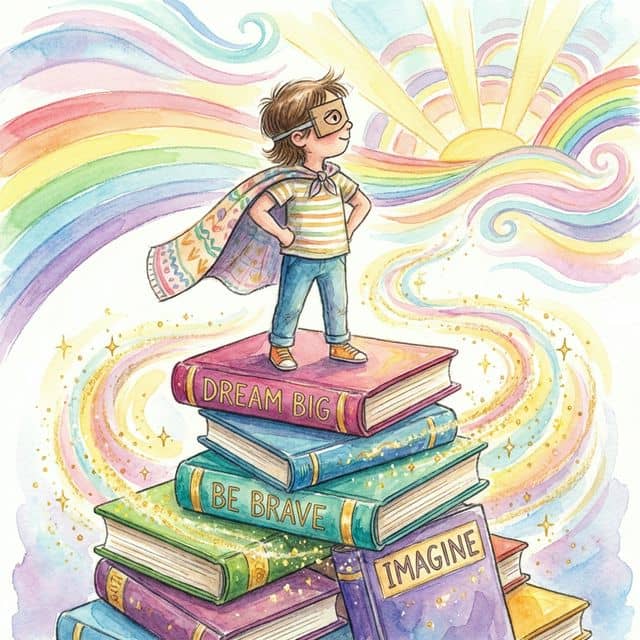
Learn how personalized books build children's confidence by casting them as the hero. Discover the psychology behind the Hero's Journey adapted for young kids.
The Story That Shapes Who They Become
Every child is writing an internal story about who they are. Am I brave? Am I smart? Do I matter? These questions don't wait for adulthood — they begin forming as early as age 2. And the answers children settle on during these formative years create the foundation of their self-concept for life.
Here's the remarkable thing: stories are one of the most powerful tools for shaping that self-concept. When a child hears a story about a hero, they don't just follow the plot — they become the hero in their imagination. And when that hero literally is them — their name, their face, their world — the effect on confidence is profound.
See Your Child as the Hero
Create a personalized storybook starring your child — with AI illustrations and audio narration. Ready in 5 minutes.
Create Their Story →The Hero's Journey: Not Just for Grown-Ups
Joseph Campbell's "Hero's Journey" — the narrative arc found in myths from ancient Greece to Star Wars — isn't just for adults. Child psychologists have adapted this framework for young children, and it looks something like this:
- The Ordinary World: The child is at home, comfortable but perhaps facing a challenge (a fear, a new experience).
- The Call to Adventure: Something happens that requires bravery — a noise in the dark, a first day at school, a new sibling arriving.
- Facing the Challenge: The child-hero encounters the scary or difficult thing head-on.
- The Victory: Through courage, kindness, or cleverness, the hero succeeds.
- The Return: The child returns home, changed — braver, wiser, more confident.
When a personalized storybook places your child in this arc, they don't just read about heroism — they rehearse it.
"If They Can See It, They Can Be It"
Representation matters — and not just in the diversity sense (though that's critical too). When we say "if they can see it, they can be it," we mean something deeply psychological: children model their behavior on what they see.
A 2020 study from the University of Virginia found that children who saw characters that looked like them succeeding in stories scored 23% higher on subsequent problem-solving tasks. Seeing someone "like me" succeed doesn't just inspire — it activates capability beliefs.
This is why personalized books are so much more powerful than generic ones for confidence-building. When the hero has your child's name, your child's face, and your child's world, the message isn't "someone out there can be brave." The message is: "YOU can be brave." Creating personalized storybooks with photos ensures the deepest level of identification between the child and their story hero.
The Neuroscience of Self-Recognition in Stories
When children encounter their own name in text, brain imaging studies show activation in the medial prefrontal cortex — the brain region associated with self-referential processing. This means the brain treats the story events as personally relevant, enhancing both emotional engagement and memory formation.
See Your Child as the Hero
Create a personalized storybook starring your child — with AI illustrations and audio narration. Ready in 5 minutes.
Create Their Story →Real-World Impact: What Parents Report
Parents who use personalized storybooks consistently report behavioral changes:
- "After reading her Hekaya book every night for a week, she started telling us she was brave."
- "He used to cry at every new situation. Now he says, 'I can do this — just like in my story.'"
- "My daughter carries her book everywhere. She calls it 'my brave book.'"
These aren't anomalies. They're predictable outcomes of a psychological principle: narrative identity. The stories we tell ourselves about ourselves become the blueprint for our behavior.
How to Maximize the Confidence Effect
To get the most confidence-building benefit from a personalized storybook:
- Read actively, not passively. Pause at brave moments and say, "Look — you did that! You were so brave!" Use present tense to make it feel real.
- Connect to real challenges. Before a scary situation (dentist visit, first sleepover), read the story and say, "Remember how brave you were in your book? You can do the same thing today."
- Let them tell the story. After a few readings, let your child "read" it to you from memory. This reinforces their role as the competent narrator of their own life.
- Celebrate the hero. After the story, say, "I'm so proud of the hero in this story." Watch their face light up — they know the hero is them.
Beyond Fear: Confidence for Everyday Moments
Personalized hero stories aren't just for overcoming fears — they deliver the wider benefits of reading personalized books too. They build confidence for all the "small" moments that feel huge to a child:
- Trying a new food
- Speaking up in a group
- Riding a bike without training wheels
- Making a new friend at the playground
- Sleeping in their own bed for the first time
Every one of these moments is a mini Hero's Journey. And every personalized story that celebrates your child's bravery adds another layer to their growing confidence.
Give Your Child the Gift of Seeing Themselves as the Hero
At Magical Hekaya, we create personalized storybooks where your child isn't just a reader — they're the star. With AI-generated illustrations that match your child's appearance, every page tells them: "You are brave. You are capable. You are the hero of this story — and of your own life."