
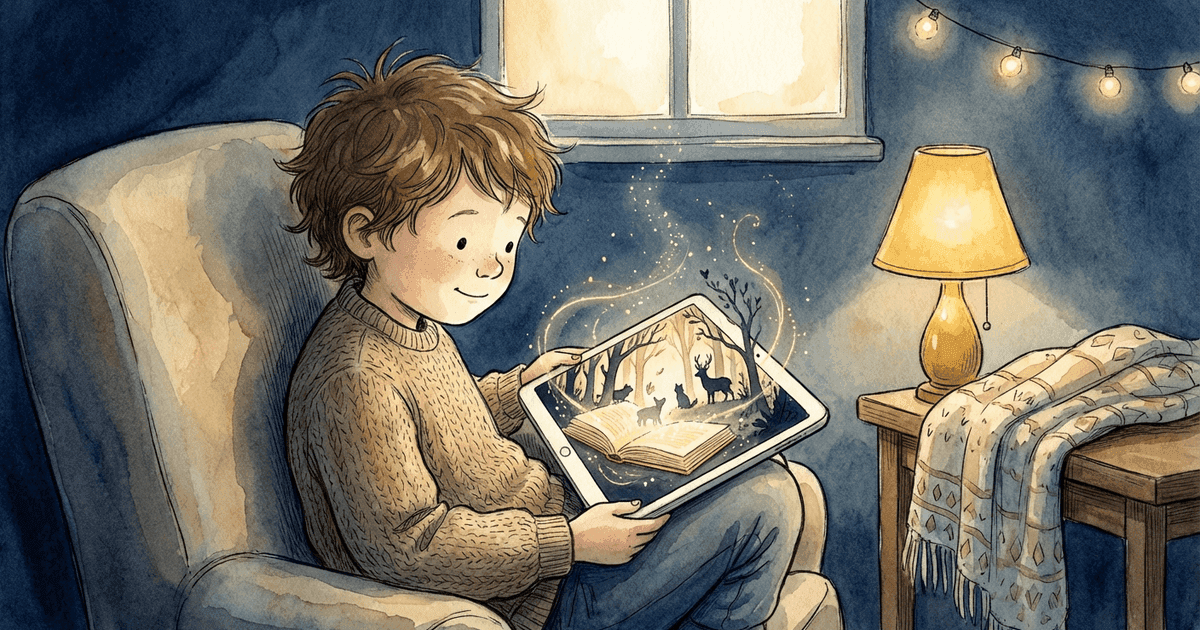
Video storybooks blend books and screens into guilt-free educational screen time. Discover how motion books boost kids' literacy and calm bedtime too.
The "Good" Screen Time We Have Been Waiting For
We all know the rule: "Read to your child every day." But let us be honest. Sometimes you are driving. Sometimes you are cooking. Sometimes you have lost your voice from a cold. Sometimes you are simply exhausted.
In these moments, parents usually hand over a phone with YouTube Kids or a streaming app. The guilt is immediate. But what if there was a middle ground? A format that had the convenience of a video but the educational nutrition of a book?
Enter the Video Storybook — and it is changing the screen time conversation for millions of families.
According to a 2025 Common Sense Media report, children ages 2-8 spend an average of 2.5 hours per day on screens. The question is not whether your child will have screen time. It is whether that screen time will be junk food or brain food. Video storybooks are firmly in the brain food category. Understanding how screen time and reading research intersect is the first step to making smarter choices.
What Exactly Is a Video Storybook?
A video storybook (sometimes called a "motion book") is a hybrid format. It preserves the text and original illustrations of a book but adds:
- Audio Narration: A warm, expressive voice reading the text with emotion and proper pacing for young listeners
- Reading-Speed Pacing: The video moves at the speed of reading, not the speed of a cartoon — typically 3-5 seconds per sentence
- Visual Guidance: The camera pans and zooms (the "Ken Burns effect") to highlight specific details, guiding the child's eye exactly where it should be looking
- Text Highlighting: Some video storybooks highlight words as they are read, building word recognition
Unlike a cartoon, which does all the cognitive work for the child, a video storybook invites the child to read along. It is closer to having someone read a book to you than to watching a show.
Video Storybooks vs. Other Screen Content
| Feature | Video Storybook | YouTube/Cartoons | Static E-book |
|---|---|---|---|
| Pacing | Reading speed — slow and deliberate | Rapid cuts every 2-3 seconds | Child-controlled, static pages |
| Text Visibility | Text displayed prominently for read-along | No text — dialogue only | Text displayed, no audio guidance |
| Narration | Professional, expressive reading | Character voices, sound effects heavy | None (unless TTS) |
| Brain Activity | Activates reading and imagination networks | Passive consumption, reduced imagination | Active reading, but less engagement for reluctant readers |
| Personalization | Can feature YOUR child (Hekaya) | Generic characters | Name insertion only (most) |
| Bedtime Suitability | Calming, wind-down appropriate | Stimulating, delays sleep | Good, but may need parent involvement |
The Research: Why "Motion" Matters
A study published in the Journal of Experimental Child Psychology found that "motion books" can bridge the gap for reluctant readers and support comprehension in ways static formats cannot:
- Attention Anchor: The subtle movement keeps the child's attention on the screen/page 40% longer than a static image
- Vocabulary Context: When the narrator says "The bird flew," and the camera pans up to the bird, the child makes an instant connection between the word and the image — reinforcing vocabulary acquisition
- Accessibility: For children with dyslexia or processing differences, the multi-sensory input (seeing + hearing + movement) reinforces comprehension through multiple pathways
- Emotional processing: The pacing of a video storybook gives children time to process emotions, unlike the rapid scene changes in cartoons. This is closely related to how picture books and emotional development work hand in hand
This is consistent with what researchers have found about screen time vs reading — the format matters far more than the medium. A well-designed video storybook on a tablet can be more educationally valuable than a poorly chosen physical book.
"Motion books bridge the gap between the passive consumption of video and the active engagement of reading. They are the closest we've come to 'good' screen time for young children."
"Not all screen time is created equal. When children engage with slow-paced, narrated, literacy-focused content like video storybooks, we see brain activation patterns that closely mirror those we see during shared book reading with a parent. This is fundamentally different from what happens during fast-paced cartoon viewing."
— Dr. John Hutton, Reading & Literacy Discovery Center, Cincinnati Children's Hospital
5 Signs Your Child Would Love a Video Storybook
Not sure if video storybooks are right for your family? Here are five indicators that your child would particularly benefit:
- They resist sitting for traditional story time but happily watch a screen. A video storybook meets them where they are and delivers book-quality content in a format they enjoy. If this sounds familiar, read more about audio storybooks for reluctant readers as a complementary strategy.
- They are a visual or auditory learner. Some children absorb information better through seeing and hearing simultaneously rather than through text alone. Video storybooks provide multi-sensory input.
- They ask to re-watch favorite shows. This repetition instinct is actually a literacy-building behavior. Redirect it toward video storybooks and they will absorb vocabulary, narrative structure, and emotional lessons.
- They are in the pre-reading stage (ages 3-5). Video storybooks with text highlighting build word recognition and phonemic awareness — essential pre-reading skills — without pressure.
- You travel frequently or have a busy schedule. Video storybooks are the most portable version of story time. Planes, cars, waiting rooms — your child's personalized story goes everywhere.
Your Child's Story, Now in Motion
Every Hekaya book comes with a free video storybook version — featuring YOUR child's personalized illustrations with gentle animation and professional narration.
The Magical Hekaya Approach: The "Digital Twin"
At Magical Hekaya, we believe a personalized story is a keepsake your child returns to again and again. Nothing beats the closeness of making reading time special together at bedtime — your child's own illustrated story on the screen, read aloud with warm narration.
That is why every Magical Hekaya book comes with a Digital Twin — a personalized video version of the story that extends the magic beyond the page.
This is not just a generic video. It features YOUR child's character — the same AI-powered personalization from their illustrated story, brought to life with gentle motion and professional narration:
- Your child sees themselves walking through enchanted forests and climbing magical mountains
- They hear their name spoken in the narration — "And then Maya took a deep breath..."
- The video becomes a portable "comfort object" they can take anywhere — a familiar story in any setting
- Parents can use it for calming bedtime routines when reading aloud is not possible
The benefits of personalized reading are well-documented — children who see themselves in stories show higher engagement, stronger comprehension, and deeper emotional connection to the material.
5 Perfect Moments for Video Storybooks
1. The "Travel Saver"
You are at 30,000 feet. The seatbelt sign is on. You cannot reach the book bag. Hand over the tablet with the Magical Hekaya video story. It is calming, familiar, and fills 10 minutes of flight time without overstimulating their brain. Unlike a random cartoon, you know exactly what they are watching and what values it reinforces.
2. The "Sick Parent" Day
You have the flu. Your throat is on fire. You literally cannot read a bedtime story. Play the video version. Cuddle with your child while the professional narrator does the heavy lifting. You still get the bonding; you just outsource the voice. No guilt required.
3. The "Read-Along" Trainer
For early readers (ages 5-7), put the physical book in their lap and play the video on the screen. Have them follow along in the book as the narrator reads. It is like a modern version of the "turn the page when you hear the beep" cassette tapes from the 1990s — but personalized and beautifully produced.
4. The "Waiting Room" Calm-Down
Doctor's office. Dentist waiting room. DMV (yes, really). Instead of handing over a device with fast-paced games or cartoons, play their personalized video storybook. It keeps them calm, engaged, and you avoid the post-screen-time meltdown that comes from overstimulating content.
5. The "Grandparent Connection"
Grandparents who live far away can share the video storybook during a video call — watching the story together in real-time. It creates a shared experience even across distance, and gives grandparents a way to be part of story time.
The Parent's Guide to Using Video Storybooks
Getting the most out of video storybooks requires a bit of intentionality. Here are practical tips for integrating them into your family's routine:
Set the Stage
Treat video storybook time like you would physical book time. Dim the lights, find a cozy spot, and remove distractions. The environment signals to your child that this is reading time, not random screen time. If you need help building a full routine, our guide on bedtime books by age offers age-specific suggestions.
Co-View When Possible
For children under 4, sit with them and watch together. Pause the video to ask questions: "What do you think happens next?" or "How is Maya feeling right now?" This dialogue transforms passive viewing into active learning — the same dynamic that makes shared book reading so powerful.
Use the Pause Button
Unlike TV shows, video storybooks are designed to be paused. Encourage your child to stop and look at the illustrations, point to words they recognize, or retell what just happened. This is where the real literacy magic happens.
Rotate Between Formats
Use the video storybook as a complement to the physical book, not a replacement. A great pattern: read the physical book at bedtime, play the video version during car rides, and use the audio version during quiet play time. Each format reinforces the story in a different way.
Set Boundaries Early
Decide in advance how many video storybooks your child can watch in one sitting. One or two is ideal. Because video storybooks are calming by design, the transition away from screen time is far smoother than turning off a cartoon — but having a consistent limit builds healthy habits.
Addressing the Screen Time Concern
We understand the hesitation. Screen time guidelines exist for good reasons. But the research is increasingly clear that content quality matters far more than screen time quantity for educational outcomes.
The American Academy of Pediatrics does not recommend zero screen time — it recommends high-quality, age-appropriate, co-viewed content. Video storybooks check every one of these boxes:
- High-quality: Professional narration, beautiful illustrations, literacy-focused pacing
- Age-appropriate: Content designed specifically for young children with appropriate themes and vocabulary
- Co-viewing friendly: Perfect for watching together, discussing, and connecting — just like shared book reading
For a deeper dive into what the research actually says, see our article on screen time vs reading: what science says. The data may surprise you.
How Video Storybooks Support Reluctant Readers
If your child resists traditional book reading, video storybooks can serve as a bridge. The audio narration builds listening skills while the visual pacing teaches children how stories flow. Over time, many parents report that children who start with video storybooks naturally transition to wanting the physical book as well — because they already know and love the story.
This is especially powerful when combined with personalization. A child who sees themselves as the hero of a video story is motivated to engage with that story in every format available — video, audio, and eventually the printed page.
Conclusion: Evolution, Not Replacement
Video storybooks are not here to kill the library. They are here to extend it. They allow the magic of storytelling to exist in spaces where physical books cannot go — airplanes, cars, waiting rooms, sick days, and when a parent is traveling.
The AI in children's books revolution means that these video storybooks are no longer generic. They feature your child, your story, your values. Combined with the proven benefits of personalized reading, video storybooks represent the future of children's literacy — where technology serves the story, not the other way around. Explore the full range of personalized storybooks available in digital, audio, and video formats.
By combining the deep personalization of Magical Hekaya with the convenience of video, we give parents one more tool in their toolkit. The illustrated book for bedtime. The audio version for car rides. The video version for everything in between. Three formats, one magical story, always starring your child.
Create Your Child's Video Storybook → | Explore More Articles →