
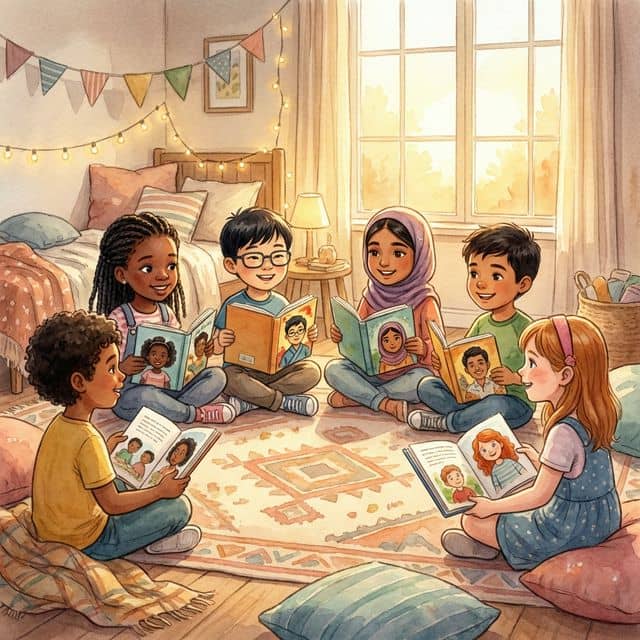
Discover how the mirror and window theory explains why representation in children's books shapes identity, builds empathy, and boosts self-confidence.
If They Can See It, They Can Be It
In 2023, the Cooperative Children's Book Center found that only 29% of children's books featured characters of color — despite the fact that over 50% of children in the U.S. under age 5 are children of color. For many children, opening a book means looking at characters who don't look like them.
This gap matters more than most people realize. Representation in children's literature isn't a luxury — it's a developmental necessity. And the gap goes beyond race: children with disabilities, children from non-traditional family structures, children who wear religious clothing, and children with unique features are even more drastically underrepresented.
The Representation Gap: By the Numbers
Before we explore why representation matters, let's look at how significant the problem actually is.
| Group | % of U.S. Children | % Represented in Children's Books | Gap |
|---|---|---|---|
| Black/African American | 14% | 9% | -5% |
| Hispanic/Latino | 26% | 7% | -19% |
| Asian/Pacific Islander | 6% | 4% | -2% |
| MENA / Arab | 2% | <1% | Nearly invisible |
| Children with disabilities | 15% | 3.4% | -11.6% |
Sources: Cooperative Children's Book Center (2023), U.S. Census Bureau, National Center for Education Statistics
When a child never sees someone who looks like them in a book, the message is clear: "Your story isn't worth telling." That message, received hundreds of times throughout childhood, shapes self-image in profound and lasting ways.
The Mirror and Window Theory
Education scholar Rudine Sims Bishop described books as serving three essential functions:
- Mirrors: Books that reflect a child's own identity, experience, and appearance. Mirrors tell the child: "You exist. You matter."
- Windows: Books that show a child lives and experiences different from their own. Windows build empathy and understanding.
- Sliding Glass Doors: Books that invite children to step into another world and experience it as if it were their own.
"Books are sometimes windows, offering views of worlds that may be real or imagined, familiar or strange. When lighting conditions are just right, however, a window can also be a mirror."
— Dr. Rudine Sims Bishop, Ohio State University, originator of the Mirrors and Windows framework
Every child needs all three. But mirrors come first. A child who has never seen themselves reflected in a book receives a subtle, devastating message: "Your story isn't worth telling." And for children from underrepresented backgrounds, finding those mirrors in traditional bookstores is incredibly difficult.
What the Research Says
The impact of representation on children has been extensively studied, and the findings are consistent and compelling:
- Children who see themselves in books show higher self-esteem scores (Journal of Educational Psychology, 2019)
- Exposure to diverse books reduces racial bias in children as young as 3 (Developmental Science, 2021)
- Children who read books with characters matching their identity show greater reading motivation — they read more often and for longer
- The "Doll Test" (first conducted in the 1940s, replicated many times since) shows that children internalize societal messages about which appearances are valued — books can counter these biases
- A 2022 study in Child Development found that children who regularly read diverse books scored 23% higher on measures of cultural empathy and were rated by teachers as more inclusive in peer interactions
The research on picture books and emotional development reinforces this: when children emotionally engage with characters they identify with, the learning goes deeper. Representation isn't just about visibility — it's about the depth of emotional processing that happens when a child sees themselves in the story.
The Problem With Traditional "Diverse" Books
Even well-intentioned diverse books have limitations:
- Limited representation: A book might feature a Black character but not match your child's specific hair type or skin tone
- Stereotypical narratives: Some "diverse" books reduce characters to their cultural identity rather than showing them as fully realized individuals with adventures, dreams, and fears
- Availability gaps: Finding books featuring children with specific combinations of features (e.g., mixed-race, hijab-wearing, glasses, wheelchair) is extremely difficult
- Tokenism: A single character of color in a sea of white characters doesn't constitute real representation
- Issue-centered narratives: Many diverse books center the character's "difference" as the main plot, rather than showing diverse children having universal adventures
This is where personalized books solve a problem traditional publishing simply cannot. As we explore in our comparison of personalized books vs. name-only books, true personalization goes far beyond inserting a name — it means creating a character that looks exactly like your child. Modern personalized storybooks with photos use AI to guarantee that every child sees a hero who truly looks like them.
Every Child Deserves to See Themselves as the Hero
Traditional publishing can't represent every child. But AI personalization can. Create a book where your child's unique features — their hair, their skin, their beautiful face — make them the star of an incredible adventure.
Create Their Story →How Personalized Books Guarantee Representation
At Magical Hekaya, every book features a hero who looks exactly like your child. Our AI-powered illustrations capture:
- Hair: Curly, straight, braids, locs, hijab, bald — every hair type represented
- Skin tone: The full beautiful spectrum of human skin
- Features: Eye shape, nose, freckles, glasses — the details that make your child them
- Abilities: Adaptive equipment, prosthetics, wheelchairs — every body is a hero's body
As we explored in our article on why heroes build confidence, seeing yourself as the protagonist of a story activates powerful self-referencing processes in the brain. The message is clear: "I am worthy of being the hero."
This is especially powerful for children who are almost never represented in mainstream books — children from MENA backgrounds, children with visible disabilities, children with unique features. For these kids, a personalized book may be the first time they've ever seen someone who looks like them starring in a story. That moment is transformative.
Beyond Appearance: Cultural Representation
True representation goes beyond skin deep. It includes:
- Names: Hearing your own name — not an anglicized version — in a story validates cultural identity. A child named Fatima or Priyanka deserves to hear their name spoken by a story hero
- Family structures: Two moms, a single dad, grandparent caregivers, multigenerational homes — all families are "normal." Books that reflect your child's actual family structure tell them their home is valid
- Environments: Not every child lives in a suburban house with a white picket fence. Stories should reflect diverse living situations — apartments, rural homes, and cities around the world
- Languages: Incorporating bilingual elements honors the child's linguistic heritage. Our article on storytelling traditions from around the world explores how cultural narrative styles enrich children's reading experiences
- Cultural celebrations: Eid, Diwali, Lunar New Year, Kwanzaa — children should see their family's celebrations reflected in the stories they read
"When children see themselves reflected in the pages of a book, something profound happens. They understand, perhaps for the first time, that their story is worth telling."
— Dr. Ebony Elizabeth Thomas, author of The Dark Fantastic and Professor at the University of Michigan
How to Audit Your Bookshelf: A Practical Guide
Want to know how well your child's bookshelf represents the real world? Here's a simple audit you can do in 15 minutes:
- Pull out 20 books (a representative sample from your child's collection)
- Count the main characters: How many are white? How many are characters of color? How many have visible disabilities? How many are from non-traditional family structures?
- Check the narratives: Are diverse characters having universal adventures (friendship, bravery, bedtime), or are their stories only about their "difference"?
- Look at the authors: Are diverse stories being told by authors from those communities?
- Ask the mirror question: Does your child see someone who looks like them in at least 5 of these 20 books?
- Ask the window question: Does your child see characters who look different from them in at least 5 of these 20 books?
If your bookshelf scores below 5 on either the mirror or window question, it's time to diversify. Our guide to personalized gifts includes recommendations for building a more representative library.
What Parents Can Do Today
- Audit your bookshelf: Use the guide above to assess your child's current library. Does it reflect the diversity of the real world?
- Seek "mirrors" AND "windows": Your child needs books where they see themselves AND books where they learn about others. Both are equally important
- Choose personalized books: For guaranteed, perfect representation, create a personalized storybook where your child is the hero
- Discuss differences: Use books as springboards for conversations about diversity, inclusion, and respect. Ask, "How is this family different from ours? How is it the same?"
- Support diverse authors: Seek out books written by authors from diverse backgrounds — authentic voice matters. Look for #OwnVoices books
- Don't make it a one-time event: Representation should be woven throughout your child's reading life, not limited to cultural heritage months
The Promise of AI Personalization
Traditional publishing will never be able to represent every child. There are simply too many combinations of features, backgrounds, and identities for any catalog to cover. But AI-powered personalization changes the equation entirely.
When you upload your child's photo to Magical Hekaya, our AI creates a character that is uniquely them. Not an approximation. Not "close enough." Them. Every child, regardless of their background, features, or abilities, can finally be the hero of their own story.
This isn't just about making a nice gift. It's about sending a child the most powerful message they can receive: "You are worthy of being the hero."
Every Child Deserves to Be the Hero
Create a book where your child sees themselves — their hair, their skin, their beautiful features — as the star of an incredible adventure. Because every child's story is worth telling.
Create Their Story →