
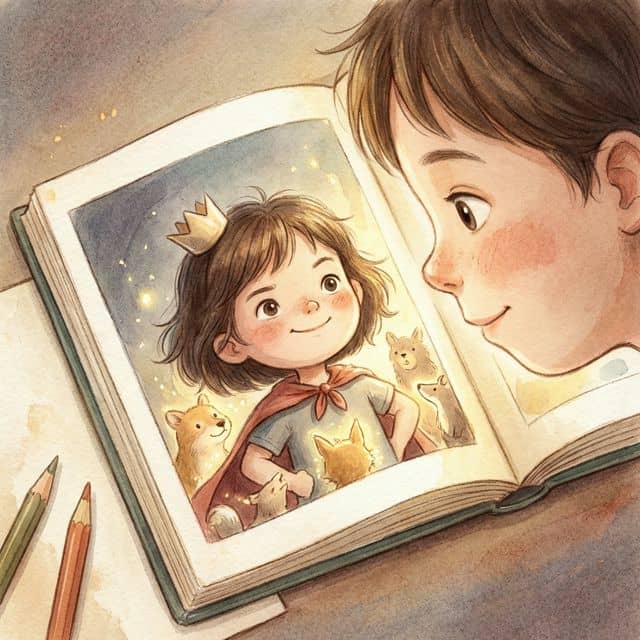
Research shows picture books are the most powerful tool for building emotional intelligence in children aged 2-6. Learn how illustrations teach empathy.
The Hidden Superpower of Picture Books
Most parents choose picture books for the pretty illustrations and simple stories. But behind every colorful page is a powerful engine of emotional development. Picture books are one of the most effective tools for teaching children to understand, express, and manage their emotions — skills collectively known as Emotional Intelligence (EQ).
A 2023 meta-analysis published in Early Childhood Research Quarterly found that children who are read emotionally-themed picture books 3+ times per week score 34% higher on emotional comprehension assessments than peers who aren't. That's not a small difference — it's the gap between a child who melts down when frustrated and one who says, "I feel really angry right now."
And here's the exciting part: when those illustrations feature your child, the emotional learning goes even deeper.
How Children "Read" Emotions in Pictures
Before children can read words, they read faces. From infancy, humans are wired to detect emotional expressions — wide eyes mean surprise, a downturned mouth means sadness, a smile means safety. Picture books serve as a training ground for this innate ability.
When a child looks at an illustration of a character who looks worried, their brain activates the same neural networks as if they were feeling worried themselves. Neuroscientists call this mirror neuron activation, and it's the biological basis of empathy.
This is why the quality of illustrations matters enormously. Expressive, emotionally rich artwork teaches children to differentiate between subtle feelings — not just "happy" and "sad," but "nervous," "proud," "frustrated," and "hopeful." Research from the University of Cambridge found that children who regularly engage with high-quality picture book illustrations can distinguish between 27 distinct emotions by age 5, compared to just 8-10 for children with limited exposure.
"Picture books are the first art gallery a child visits. They teach visual literacy — the ability to read meaning from images — which is the foundation of emotional literacy."
— Dr. Myra Barrs, literacy researcher and former Director of the Centre for Literacy in Primary Education
The Five EQ Skills Picture Books Develop
Emotional Intelligence isn't a single skill — it's a constellation of five interconnected abilities. Picture books develop all five simultaneously, which is what makes them such a powerful tool.
| EQ Skill | What It Means | How Picture Books Build It |
|---|---|---|
| Emotional Vocabulary | Naming feelings accurately | Words like "anxious" and "proud" appear in meaningful context |
| Empathy | Feeling what others feel | Following characters through challenges activates mirror neurons |
| Self-Regulation | Managing big feelings | Characters model coping strategies (deep breaths, asking for help) |
| Self-Awareness | Recognizing own emotions | Characters with mixed feelings validate the child's emotional complexity |
| Social Skills | Navigating relationships | Stories about sharing, apologizing, and including others provide scripts |
1. Emotional Vocabulary
Children can't manage feelings they can't name. Picture books introduce emotion words in context: "Maya felt anxious as she peeked around the corner." This contextual learning is far more effective than simply telling a child what "anxious" means.
Research from Yale's Center for Emotional Intelligence shows that children with a rich emotional vocabulary have better mental health outcomes, stronger friendships, and higher academic achievement. Their RULER program found that children who learn to distinguish between 30+ emotion words show a 10% increase in academic performance.
For practical strategies on expanding your child's emotional word bank, our guide on the science behind bibliotherapy explains the mechanisms in more detail.
2. Empathy and Perspective-Taking
When children follow a character through challenges, they practice seeing the world through someone else's eyes. "How does the bear feel when his friend moves away?" This simple question during reading time builds the neural architecture for empathy.
A fascinating 2021 study in Developmental Psychology tracked 400 preschoolers and found that those read empathy-focused picture books twice a week for 8 weeks showed measurable increases in prosocial behavior — sharing more, comforting upset peers, and including others in play. The control group, who were read factual books about animals and nature, showed no such gains.
3. Emotional Regulation
Stories model healthy coping. A character takes deep breaths when angry. Another asks for a hug when scared. These scripted responses become templates that children can access when they experience overwhelming feelings.
This is why therapeutic storybooks for anxious children are so effective. When a child has "rehearsed" calming down through a character, they have a ready-made script for real-life situations. As we discussed in our article on bibliotherapy, this "rehearsal through story" helps children develop coping strategies before they need them.
4. Self-Awareness
When a child sees a character experiencing conflicting emotions — happy about a new baby but also jealous — it validates their own mixed feelings. This normalization of emotional complexity builds self-awareness, the foundation of all emotional intelligence.
Books that address new sibling transitions or first-day-of-school anxiety are particularly powerful for building self-awareness because children can directly map the character's experience onto their own life.
5. Social Skills
Picture books often depict social situations: sharing, apologizing, including someone left out. These scenarios give children cognitive scripts for complex social interactions they haven't yet experienced.
A longitudinal study from the University of Virginia found that children who were read socially-themed picture books regularly were rated by teachers as having 40% better social skills by first grade — including cooperation, assertiveness, and conflict resolution.
Build Your Child's EQ Through Personalized Stories
When the hero of the story looks exactly like your child, emotional learning becomes personal. Create a book where your child practices courage, empathy, and self-regulation — as themselves.
Create Their EQ-Building Story →Why Personalized Illustrations Amplify Emotional Learning
Standard picture books feature characters that may look nothing like your child. Personalized books change everything. When the character shares your child's appearance — their hair texture, their skin tone, their features — a powerful psychological process called self-referential encoding kicks in.
The brain processes self-relevant information more deeply. So when "story-them" feels scared and then finds courage, your child doesn't just observe empathy — they experience it firsthand. The lesson moves from "that character was brave" to "I can be brave."
This is exactly why seeing themselves as the hero builds lasting confidence. The power of representation isn't just about diversity — it's about creating the deepest possible emotional engagement with the story.
At Magical Hekaya, our AI-powered illustrations generate expressive characters that look exactly like your child. When your child sees "themselves" navigating emotions on the page, they're building emotional intelligence in the most personal way possible. Discover how personalized storybooks with photos take this emotional engagement to the next level.
Age-by-Age Emotional Development Through Picture Books
Different ages benefit from different emotional themes. Here's what to focus on at each stage:
Ages 2-3: Naming Basic Emotions
At this stage, children are learning the basics: happy, sad, angry, scared. Choose books with clear, exaggerated facial expressions and simple emotional scenarios. Books like The Color Monster that use color-coding for emotions work wonderfully. When reading, point to faces and ask, "How does she feel?" The goal is building a foundation of 4-6 core emotion words.
Ages 3-4: Understanding Causes of Emotions
Now children can start understanding why characters feel certain ways. "The bunny is sad because his friend left." This cause-and-effect understanding is crucial for empathy. Choose books that clearly show the event that triggers the emotion, and ask, "Why is he feeling that way?" For more on choosing the right books at this stage, see our age-by-age book guide.
Ages 4-5: Mixed and Complex Emotions
Preschoolers can begin to grasp that you can feel two things at once — excited AND nervous about starting school. Books addressing transitions and changes are ideal. This is also when books that help children overcome specific fears become most effective.
Ages 5-6: Perspective-Taking and Empathy
With Theory of Mind now developing, children can consider how someone else feels. Choose books that present different characters' viewpoints on the same event. Ask, "How do you think she felt when that happened?" This is the sweet spot for building deep empathy.
How to Use Picture Books for Emotional Growth: A Parent's Playbook
Simply reading the words isn't enough to unlock a picture book's emotional potential. Here's how to make each reading session a masterclass in emotional development:
- Point to faces: "Look at her eyebrows — how do you think she's feeling?" This trains emotional recognition.
- Name the emotions: Use specific words beyond just "happy" or "sad." Try "relieved," "frustrated," "overwhelmed," or "grateful."
- Connect to their experience: "Have you ever felt like that? When?" This builds self-awareness.
- Ask "What would you do?": This develops problem-solving and emotional regulation.
- Revisit key moments: Flip back to emotional turning points and discuss them. Repetition deepens learning.
- Pause before turning the page: Let children predict what will happen based on the character's emotions. "She looks nervous — what do you think she'll do?"
- Use the book as a reference later: When your child is upset, recall the story: "Remember when the bunny was worried? What helped him?" This bridges fiction and reality.
"The most important thing a parent can do during reading time isn't reading the words — it's asking the questions. Every open-ended question you ask during a picture book is an EQ lesson."
— Dr. Marc Brackett, Director of the Yale Center for Emotional Intelligence and author of Permission to Feel
The Long-Term Impact: EQ Predicts Life Success
A longitudinal study tracking 800 children from preschool through high school found that children with high EQ at age 5 were significantly more likely to graduate college, hold steady employment, and have healthy relationships as adults. The roots of that emotional intelligence? Books, conversations, and emotionally attuned parenting.
Research from the Collaborative for Academic, Social, and Emotional Learning (CASEL) shows that EQ skills taught in early childhood produce an 11:1 return on investment — for every dollar invested in social-emotional learning, $11 is returned in improved academic outcomes, reduced behavioral interventions, and higher future earnings.
Picture books aren't just bedtime entertainment. They're the building blocks of emotional intelligence. And when they're personalized, they become the most powerful emotional learning tool in your home. Combined with making reading time special every night, you're giving your child a foundation that lasts a lifetime.
Give Your Child the Gift of Emotional Intelligence
Create a personalized book where your child learns to name, understand, and manage their emotions — starring themselves. Our AI-powered illustrations capture your child's unique features for the deepest possible emotional connection.
Create Their Story →