
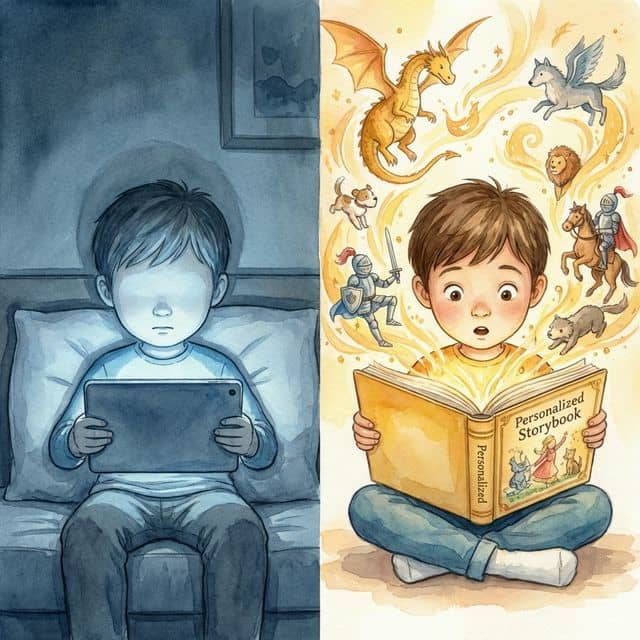
Screen time vs reading — what does the latest research say about your child's brain development? Get the science-backed facts and practical daily tips.
The Modern Parent's Dilemma
Your child would rather watch a 10-second video loop than sit for a story. Their eyes glaze over at books but light up for tablets. You feel guilty about screen time but also exhausted by the constant battle to limit it.
You are not alone. The average child ages 2–8 now spends nearly 3 hours per day on screens — compared to about 25 minutes reading or being read to. That is a 7:1 ratio of screens to books. But before you spiral into guilt, let us look at what the research actually says about how screens and books each affect your child's developing brain.
The answers might surprise you. The picture is more nuanced than "screens bad, books good" — but also more urgent than many parents realize.
Screen Time vs Reading: At a Glance
| Factor | Screen Time (Passive) | Reading (Physical Books) |
|---|---|---|
| Brain Activity | Reduced imagination, language, and literacy regions | Activates language, imagination, and empathy centers |
| Language Development | Weaker expressive language scores | 1.4M more words heard by age 5 with daily reading |
| Attention | Conditions brain for rapid stimulation | Builds sustained attention capacity |
| Parent-Child Interaction | Minimal conversation during viewing | 3x more conversation during shared reading |
| Sleep Impact | Blue light delays sleep by 30+ minutes | Physical books promote earlier, deeper sleep |
| Cognitive Engagement | Passive consumption — brain receives | Active processing — brain generates images and meaning |
What Screens Do to the Developing Brain
Research from Cincinnati Children's Hospital (2019), published in JAMA Pediatrics, used brain MRI scans on preschoolers and found that:
- Higher screen use was associated with lower white matter integrity in brain tracts related to language and literacy
- Children with more screen time showed weaker expressive language skills
- Screen-heavy children had lower cognitive function scores on standardized assessments
A 2023 meta-analysis in JAMA Pediatrics covering 80+ studies and over 500,000 children confirmed: passive screen time is consistently associated with lower cognitive and language outcomes in children under 12.
But why? The key issue is passivity. Most screen content delivers stimulation to the child — fast edits, loud sounds, constant novelty, algorithmically optimized for maximum attention capture. The child's brain receives but doesn't generate. It consumes but doesn't create. Over time, this conditions the brain to expect external stimulation rather than generating its own.
"The developing brain adapts to the stimulation it receives most frequently. A brain that spends 3 hours daily receiving rapid-fire visual stimulation will struggle to generate the sustained, slow-burn attention that reading requires." — Dr. Dimitri Christakis, Director, Center for Child Health, Behavior and Development, Seattle Children's Hospital
The 2024 WHO Global Study
The World Health Organization's 2024 global report on children and digital media — covering 45 countries and over 1 million children — added important context to the screen time debate. Key findings:
- Children under 2 showed the most significant developmental impacts from screen exposure, with measurable language delays at just 1 hour/day of passive viewing
- Ages 3–5: More than 1 hour/day of passive screen time was associated with attention difficulties by school entry
- The displacement effect was as important as the direct effect — every hour on screens replaced approximately 40 minutes of interactive play and 20 minutes of reading/being read to
- Background screens (TV on in the background) reduced the quantity and quality of parent-child verbal interactions by an estimated 20%
What Reading Does to the Developing Brain
In contrast, the same Cincinnati research team studied children who were read to frequently. The brain scans told a completely different story:
- Brain scans showed significantly more activity in language and imagination regions
- Children showed stronger neural connections in areas supporting reading readiness
- The most pronounced benefits occurred with interactive, engaged reading — asking questions, discussing the story, connecting it to the child's life
Reading is fundamentally active: the child's brain must generate images, predict outcomes, empathize with characters, and process language in real-time. Every page turn is a cognitive workout. The benefits of reading personalized books are even more pronounced because the self-reference effect deepens this cognitive engagement.
Stanford University: The Reading Brain
Research from Stanford's Center for Reading and Language found that the act of reading activates a unique neural circuit they call the "reading brain network." This network, which develops primarily between ages 3 and 8, connects:
- Visual processing areas — decoding letters and images
- Language comprehension centers — extracting meaning from text
- The default mode network — responsible for imagination, empathy, and inner storytelling
This interconnected circuit is what allows fluent reading later in life. Screen time does not build this circuit. Only the sustained, active process of reading — or being read to — develops these connections. And the window for building this network is primarily ages 3–8, making these years critical for establishing reading habits.
Build Your Child's Reading Brain
Every page of a personalized story exercises the neural circuits that screens leave dormant. Give your child a book that's more exciting than any screen — one where THEY are the hero.
Create Their Personalized Story →The Critical Difference: Brain Activation Patterns
Dr. John Hutton's research at Cincinnati Children's Hospital summarized it memorably:
"When children listen to stories, their brains have to do the heavy lifting of creating the images. With screen videos, the images are given to them — the brain's imagination circuits are underutilized. It's the difference between building a muscle and watching someone else lift weights."
This does not mean screens are evil. But it means that reading exercises brain muscles that screens leave dormant. Both have a place in modern childhood, but they are not interchangeable. Twenty minutes of reading does something fundamentally different to the brain than twenty minutes of YouTube.
Physical Books vs. Digital Books: The Tablet Question
"But what about reading on a tablet?" This is a fair and important question. If the content is the same, does the medium matter? Research says yes — especially for young children.
- Parent-child interaction: A Temple University study found 3x more conversation during physical book reading vs. tablet reading. Parents ask more questions, children make more comments, and the discussion is richer and more sustained.
- Comprehension: Multiple studies show children comprehend and retain more from physical books. The tactile experience — turning pages, feeling the weight, pointing at images — creates stronger memory anchors.
- Distraction: E-books with interactive features (tapping, swiping, animations, sound effects) actually reduce comprehension. Children focus on the gimmicks, not the story. A study in Pediatrics found that interactive e-book features pulled attention away from narrative comprehension in 80% of observed reading sessions.
- Sleep: Blue light from screens suppresses melatonin production. Reading a physical book before bed promotes sleep; reading on a screen can delay sleep onset by 30+ minutes and reduce sleep quality throughout the night.
This is why our bedtime book guide strongly recommends physical books over digital formats at night. And it is a key reason why print-on-demand personalized books — the physical kind your child can hold, cuddle, and bring to bed — have advantages that digital-only formats cannot match.
Replace Screen Time with Story Time
A personalized book where your child is the hero competes with screens on their own terms — personal, exciting, and impossible to put down. Try it and see.
Create Their Personalized Book →Screen Time Guidelines by Age: What the AAP Recommends
The American Academy of Pediatrics (AAP) provides clear guidelines that every parent should know. Here is the current framework:
| Age Group | Screen Time Guideline | Reading Recommendation |
|---|---|---|
| Under 18 months | Avoid screens except video calling | Read aloud daily from birth; board books and cloth books |
| 18–24 months | Limited, high-quality content with parent co-viewing only | Interactive reading with pointing and naming; personalized books effective |
| 2–5 years | Max 1 hour/day of high-quality programming | 15–20 min daily reading minimum; best age for personalized books |
| 6+ years | Consistent limits; ensure it doesn't displace sleep, exercise, or reading | 20+ min daily; transition to independent reading with continued read-alouds |
The AAP emphasizes that not all screen time is equal. A video call with grandparents, a co-viewed educational show, or a creative app used with a parent are all qualitatively different from passive video consumption. However, even "quality" screen time should not displace physical play, social interaction, or reading time.
The Secret Weapon: Making Books More Exciting Than Screens
Here is the uncomfortable truth most parenting articles won't tell you: banning screens rarely works long-term. Restriction creates forbidden-fruit appeal. The more you fight screens, the more alluring they become. The better strategy? Make books so exciting that children choose them.
This is where personalized books have an unfair advantage. A generic storybook competes poorly against the dopamine machine of a screen. But a book where the child sees themselves as the hero? That is different. That is personal. No YouTube video stars YOUR child. No iPad game features YOUR child saving the day. Personalized storybooks with photos leverage the same personal relevance that makes screens compelling, but channel it into something that builds rather than depletes the reading brain.
Research on the benefits of personalized reading shows that children:
- Spend 2x longer engaged with personalized books vs. generic ones
- Request personalized books for re-reading far more often than any other format
- Show higher emotional engagement and story comprehension
- Voluntarily choose their personalized book over screen time in observed settings
A Magical Hekaya personalized book does not just compete with screens — it can win. And it does so by leveraging the same psychological principle that makes screens addictive (personal relevance) while building the brain circuits that screens neglect.
Practical Steps for Finding Balance
The goal is not zero screen time — it is a healthy balance where reading holds its own. Here are evidence-based strategies that work:
- Replace, don't just remove: Instead of saying "no more iPad," say "let's read YOUR book first." Give them something better, not just something less.
- Create reading rituals: Make reading time magical with fort-building, cozy lighting, warm milk, and special snacks. The ritual itself becomes the reward.
- Model reading: Children who see parents reading physical books are significantly more likely to read themselves. Pick up a book near your child — they notice more than you think.
- Choose the right books: Boring books cannot compete with exciting screens. Choose books that are genuinely exciting — personalized stories, interactive plots, beautiful illustrations. Our guide to choosing age-appropriate books can help.
- Set screen boundaries, not bans: Follow the AAP guidelines above. Pair screen limits with reading time — for every 30 minutes of screens, offer 15 minutes of reading as a "cooldown."
- Use audio as a bridge: If your child loves their tablet, try audio storybooks as a bridge between screen habits and reading habits. Listening to a story engages the imagination circuits in ways that video does not.
- Make it social: Reading together is social. Screens (except video calls) are typically isolating. Frame reading as family time: "Who wants to read the adventure book together?" builds positive associations.
- Track progress, not restrictions: Instead of counting screen minutes to subtract, count reading minutes to celebrate. "We read for 25 minutes tonight — that's a new record!" is more motivating than "You have 10 minutes of screen time left."
What About Educational Screen Time?
Parents often ask: "But what about educational apps? My child learns letters on the iPad." This is valid, and the research offers a nuanced answer.
Interactive educational apps CAN be beneficial — but with important caveats:
- They work best when co-used with a parent who asks questions and extends the learning
- They should supplement, not replace, physical reading and hands-on play
- The best educational apps are slow-paced, narration-heavy, and encourage response from the child (like Mr. Rogers' style, not rapid-fire YouTube)
- Even the best apps do not build the reading brain network the way physical books do
Think of it this way: educational screen time is like a vitamin supplement. It can help, but it cannot replace the "whole food" of physical reading. Both have a place, but one is the foundation and the other is a complement.
The Long-Term Picture
The choices you make now about screen time vs. reading shape your child's cognitive development for decades. Children who are heavy readers by age 8 perform better academically, show stronger empathy, have larger vocabularies, and report higher life satisfaction as adults. Children who are heavy screen users by age 8 face higher risks of attention difficulties, social challenges, and lower academic achievement.
This is not about guilt or perfection. It is about tilting the balance. Every time you choose to read together instead of turning on the screen, you are building neural architecture that will serve your child for life. Every personalized story that captures your child's attention for 15 minutes is 15 minutes of brain-building that no app can replicate.
For more on how stories support development, explore our articles on how picture books support emotional development and the power of representation in children's literature.
Win the Screen Time Battle
Give your child something no screen can offer: a beautiful, personalized book where THEY are the hero. It is printed, it is personal, and it is more exciting than any video. Over 2,000 parents have already made the switch.
Create Their Book →