
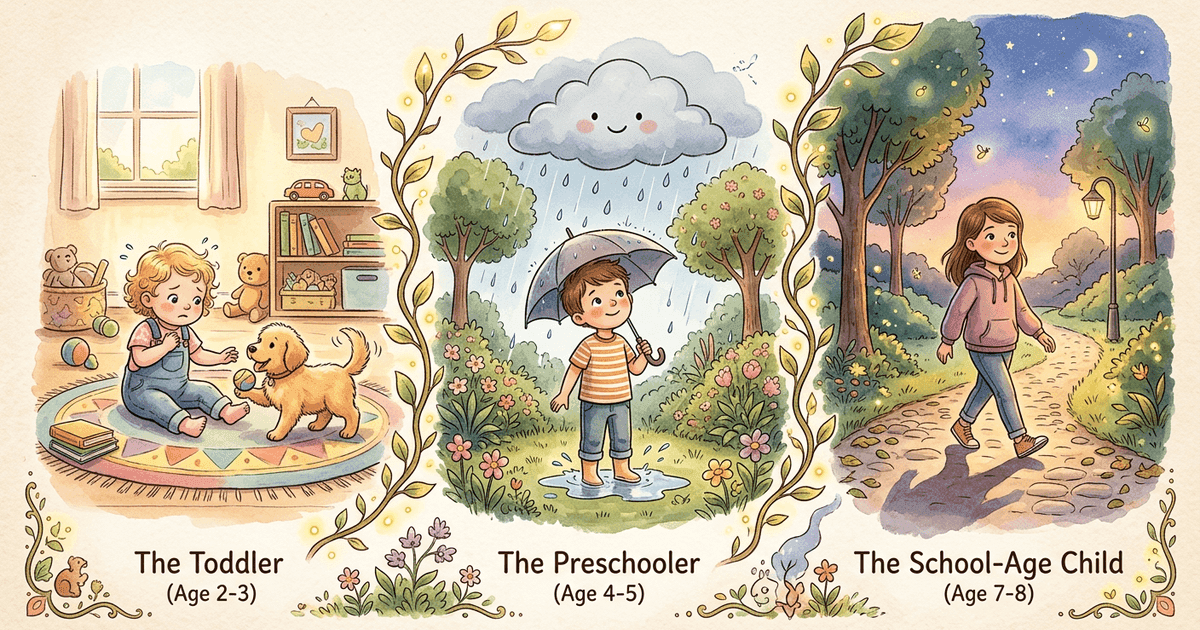
Understand children's fears by age from infancy to age 12. Learn what's normal, when to worry, and proven strategies to help your child feel safe and brave.
Every child is afraid of something. The toddler who screams when a balloon pops. The 4-year-old who insists the closet door must stay shut at night. The 8-year-old who suddenly cannot stop thinking about earthquakes. These fears can feel alarming to parents, but most of them are not just normal — they are healthy signs of development.
Understanding children's fears by age gives you a roadmap. It tells you what to expect, when to gently help, and when something might need professional attention. This guide walks through every major stage from birth to age 12, explains the psychology behind each fear, and gives you practical strategies to support your child through each one.
The single most important thing to know before we begin: fear in children is not a flaw. It is the brain's way of keeping them safe while they learn to navigate a world they do not yet fully understand.
Ages 0-2 — The Instinct Years
In the first two years of life, fears are driven almost entirely by survival instincts rather than imagination. Your baby is not "afraid" in the way an older child is — they are reacting to stimuli that their developing nervous system interprets as potential threats. These reactions are hardwired, automatic, and completely normal.
Loud Noises (Birth Onward)
The very first fear most humans experience is the Moro reflex, also called the startle reflex. From birth, sudden loud noises — a dog barking, a door slamming, a vacuum cleaner starting up — trigger an automatic response: arms flung wide, back arched, followed by crying. This reflex typically diminishes by 4-6 months, but sensitivity to loud sounds can persist well into the toddler years.
The startle response exists because, from an evolutionary perspective, sudden loud sounds often meant danger. Your baby's brain has not yet learned to categorize sounds as "safe" or "unsafe," so it defaults to treating all sudden sounds as threats. This is why a baby who has heard a blender a hundred times may still cry when it starts — their primitive brain overrides their experience.
Stranger Anxiety (6-12 Months)
Around 6 months, babies develop enough memory and facial recognition to know who is familiar and who is not. By 8 months, many babies begin showing stranger anxiety — crying, clinging, or turning away when approached by unfamiliar people. This fear typically peaks between 8 and 12 months.
Stranger anxiety is actually a cognitive milestone. It means your baby can distinguish between known and unknown faces, which requires sophisticated memory. It is not shyness, rudeness, or a sign that something is wrong. It is your baby's brain saying, "I do not have enough data about this person to feel safe."
Separation Anxiety (8-18 Months)
Closely related to stranger anxiety, separation anxiety emerges around 8 months and often peaks between 14 and 18 months. Your baby cries when you leave the room because they have developed object permanence — they know you still exist when you are out of sight — but they have not yet developed the cognitive ability to understand that you will come back.
Separation anxiety is one of the most intense fears in early childhood, and it is also one of the most important. It reflects a secure attachment, which means your child has bonded to you deeply enough that your absence causes genuine distress. This is healthy.
How to Help at This Age
- Respond consistently. When your baby cries from fear, pick them up. You cannot spoil a baby by responding to their distress — you are teaching them that the world is safe.
- Practice brief separations. Leave the room for short periods and always return with a warm greeting. This teaches your baby that leaving does not mean disappearing.
- Introduce new people slowly. Let your baby observe a new person from the safety of your arms before any direct interaction.
- Minimize startle triggers. Warn your baby before loud sounds when possible ("I am going to turn on the blender now!") and offer comfort immediately after unexpected ones.
Ages 2-4 — When Imagination Outpaces Understanding
This is the age when fears shift from instinctive to imaginative. Between 2 and 4, a child's imagination develops rapidly, but their ability to distinguish fantasy from reality lags behind. The result is a perfect storm: they can imagine terrifying things, but they cannot reason their way out of believing those things are real. This is why common childhood fears intensify dramatically during these years.
Fear of the Dark
The dark is one of the most universal childhood fears, and it typically begins around age 2 or 3. It is not the darkness itself that frightens a child — it is what their imagination fills the darkness with. At this age, a child genuinely cannot tell the difference between what they imagined and what is real. The monster they pictured under the bed feels as real to them as the bed itself.
Fear of the dark is so common that researchers estimate up to 90% of children experience it at some point between ages 2 and 10. For a deeper exploration of this specific fear, including whether your child's experience is typical, read our article on whether being afraid of the dark is normal.
Monsters and Imaginary Creatures
Closely tied to fear of the dark, many 2-4 year-olds develop fears of monsters, ghosts, or other imaginary creatures. These fears peak around age 3 to 4 and are a direct result of the imagination explosion happening in their brains. They see a shadow and their brain, which is wired to detect threats, fills in the blanks with the scariest thing it can conceive.
Animals
Dogs, insects, snakes, and spiders are common fears at this age. A child does not need to have had a bad experience with an animal to fear it — the fear can develop from a picture in a book, a scene in a video, or simply from the unpredictability of animal behavior. A dog that is friendly but loud and fast can be genuinely terrifying to a 3-year-old who cannot predict what it will do next.
Thunder and Loud Sounds
While the Moro reflex has faded by now, sensitivity to loud sounds continues. Thunder, fireworks, and loud machinery are common triggers. At this age, the fear adds a new dimension: the child's imagination. A 3-year-old does not just hear thunder — they imagine what could be causing it, and their explanations are often more frightening than reality.
How to Help at This Age
- Validate before you explain. Say "I understand that feels scary" before saying "There is nothing under the bed." The child needs to feel heard before they can hear you.
- Use concrete tools. A nightlight, a "monster spray" bottle (water with lavender), or a brave stuffed animal gives the child something tangible to fight an intangible fear.
- Read stories about overcoming fear. Books about overcoming fear of the dark are especially effective at this age because children process emotions through stories more easily than through direct conversation.
- Avoid forced exposure. Do not lock a child in a dark room to "teach" them there is nothing to fear. Forced exposure increases fear rather than reducing it.
- Explore the fear during the day. Play with shadows during daylight. Talk about what lives in the dark (owls, stars, fireflies). Make the feared thing familiar in a safe context.
Does Your Child Fear the Dark or Monsters?
Take our 2-minute quiz to get personalized story recommendations that help your child build bravery — starring themselves as the hero.
Take the Fear Quiz →Ages 4-6 — Growing Awareness, Growing Fears
Between 4 and 6, children become more aware of the world beyond their home. They start school, interact with more people, and absorb information from conversations, media, and peers. Their fears begin to reflect this expanding awareness while still carrying the imaginative intensity of earlier years.
Fear of the Dark (Continues and Often Intensifies)
Surprisingly, fear of the dark often intensifies between ages 4 and 6 rather than fading. This is because the child's imagination has become more sophisticated. A 2-year-old imagines a vague "something" in the dark. A 5-year-old imagines a specific creature with specific abilities hiding in a specific place. The more detailed the imagined threat, the more real it feels.
If your child is struggling with nighttime fears at this age, our complete guide on how to help your child overcome fear of the dark offers step-by-step strategies that work.
Being Alone
At this age, being alone in a room — even during the day — can trigger anxiety. This is different from the separation anxiety of toddlerhood. A 5-year-old is not just afraid that a parent will not return; they are afraid of what might happen while they are alone. Their growing awareness of danger, combined with limited ability to protect themselves, creates a genuine sense of vulnerability.
Imaginary Creatures (More Elaborate)
The monsters become more specific and more persistent. A 5-year-old might develop an elaborate mythology around the creature in their closet — it only comes out when the light is off, it does not like the color blue, it can be scared away by singing a certain song. These detailed belief systems show cognitive growth, even though they are built around a fear.
Natural Disasters
As children become aware of events beyond their immediate experience — through overheard news, school conversations, or picture books about weather — some develop fears of earthquakes, tornadoes, floods, or fires. They understand that these things can happen but do not yet understand probability, so they may believe a tornado is imminent even if they live somewhere tornadoes never occur.
How to Help at This Age
- Teach the difference between "possible" and "likely." A 5-year-old can begin to understand that while something could happen, it probably will not. Use concrete comparisons they can grasp.
- Give them agency. Let them choose their nightlight, create a "bravery plan" for bedtime, or decide where their comfort object sleeps. Control reduces fear.
- Limit media exposure. Children at this age absorb frightening content from sources you might not expect — news playing in the background, an older cousin's video game, a book illustration at the library. Monitor and curate what they see.
- Use personalized stories. A story where your child is the brave character who faces the dark, calms the storm, or befriends the creature transforms the fear narrative from "I am helpless" to "I am the hero." This is the foundation of how personalized books help children overcome fears.
- Practice brave behavior together. Walk into a dark room holding hands. Listen to a thunderstorm together while snuggled on the couch. Shared brave experiences build the child's confidence that they can handle these situations.
Ages 6-8 — The Reality Shift
A major cognitive shift happens around age 6 or 7. Children begin to understand that death is permanent, that bad things happen to real people, and that parents cannot protect them from everything. This is when fears shift from imaginary threats to real-world concerns. It is one of the most challenging transitions in childhood, both for the child and for parents.
Death and Injury
Around age 6, most children develop an understanding of the permanence of death. Before this, a child might think of death as temporary — like a character in a cartoon who gets flattened and pops back up. Once they understand that death is real and irreversible, they often become deeply anxious about the safety of their parents, grandparents, pets, and themselves.
Questions like "Will you die?" or "What happens when I die?" are common and healthy at this age. They are not signs of depression or morbid thinking — they are signs of cognitive growth meeting emotional processing.
Natural Disasters and Fire
The vague awareness of natural disasters that began at age 4-5 now becomes more concrete. A 7-year-old can understand what a fire does, how an earthquake works, and that these events kill people. School fire drills, while important, sometimes intensify these fears because they make the threat feel imminent.
School Performance
As academic expectations increase, some children develop fear of failure, fear of getting in trouble, or fear of not understanding material. This is especially common in children who are perfectionistic or who have learning differences that make certain tasks harder.
Being Different or Not Fitting In
Social awareness sharpens between 6 and 8. Children become acutely aware of how they compare to peers — their clothes, their abilities, their family structure, their lunch. Fear of being "weird" or excluded begins to emerge, laying the groundwork for the social anxieties that intensify in later years.
How to Help at This Age
- Answer questions honestly but age-appropriately. When a child asks about death, do not avoid the topic. Give simple, truthful answers: "Yes, all living things die eventually, but most people live for a very long time." Avoidance increases anxiety; honesty, delivered gently, reduces it.
- Create safety plans together. For fears about fire or natural disasters, practice what to do. Having a plan gives children a sense of control, which directly reduces fear.
- Separate performance from identity. Help your child understand that a bad grade does not make them a bad student. Celebrate effort, not just results.
- Normalize difference. Read books and share stories about diverse families, abilities, and experiences. The more "different" feels normal, the less threatening it becomes.
- Watch for avoidance patterns. A child who suddenly does not want to go to school, attend a birthday party, or sleep alone may be experiencing fear that has crossed from normal to problematic. Pay attention to behavioral changes.
Ages 8-12 — The Social and Existential Years
Pre-adolescence brings a dramatic shift in the nature of fear. The monsters are gone. The dark is mostly manageable. Instead, the fears become social, abstract, and existential. Children at this age are developing the ability to think about the future, understand complex social dynamics, and grasp world events — and all of these new abilities bring new anxieties.
Social Rejection and Bullying
By age 8-10, peer relationships become central to a child's identity. Fear of being excluded, mocked, or bullied is one of the most common fears in this age group. This fear is intensified by social media exposure, which many children in this age range begin to encounter. The child's social world expands from their classroom to a wider, less controllable environment.
Academic Performance
As schoolwork becomes more demanding, fear of failure can intensify. Standardized testing, grades, and academic comparisons create pressure that some children internalize as fear. A child who was confident in second grade may become anxious in fourth grade as expectations increase.
World Events
Children aged 8-12 are increasingly aware of war, disease, climate change, and political conflict. Unlike younger children who fear vague "bad things," children at this age understand specific threats and may worry about them with adult-level detail but without adult-level coping mechanisms.
Physical Appearance
As puberty approaches, many children become self-conscious about their bodies. Fear of being too tall, too short, too heavy, too thin, or simply "wrong-looking" compared to peers is extremely common. This fear is often silent — children at this age are less likely to voice appearance concerns to parents.
How to Help at This Age
- Keep communication lines open. Children this age are less likely to volunteer their fears. Create regular, low-pressure opportunities to talk — car rides, walks, bedtime chats. Ask open-ended questions rather than yes/no questions.
- Validate social fears. Do not dismiss concerns about friendship or fitting in as trivial. These fears are developmentally appropriate and feel enormous to the child experiencing them.
- Teach media literacy. Help your child understand that news is designed to be alarming, that social media shows curated highlights, and that the world is not as dangerous as it sometimes appears on screens.
- Model healthy coping. Share age-appropriate examples of how you handle your own worries. Children this age are watching how adults manage stress, and they model what they see.
- Encourage journaling or creative expression. Writing, drawing, or storytelling about fears helps children externalize and process emotions they may not be ready to discuss verbally.
- Know when to seek help. If fear begins to interfere with school attendance, friendships, sleep, or appetite for more than a few weeks, consult a professional.
When Fear Becomes a Problem — Signs to Watch For
Everything described above falls within the range of normal fears in children. But sometimes fear crosses a line from a healthy developmental stage into something that needs professional attention. As a parent, knowing the difference is crucial.
Duration
Normal fears tend to wax and wane over weeks or months. If a specific fear persists at the same intensity for more than six months with no signs of improving, it may have become a phobia or anxiety disorder.
Intensity
All children feel fear strongly in the moment. But if your child's fear triggers panic attacks (racing heart, difficulty breathing, feeling of doom), physical symptoms (regular stomachaches, headaches, or nausea tied to the fear), or extreme emotional reactions that seem disproportionate to the situation, the intensity has moved beyond typical.
Avoidance
A child who is nervous about a dog but still walks past one with a parent's hand to hold is experiencing normal fear. A child who refuses to go outside because there might be a dog, who will not visit a friend's house because they have a pet, or who screams and runs at the sight of any animal has moved into avoidance behavior that limits their life.
Impact on Daily Life
The clearest signal that fear has become a problem is when it starts interfering with the things a child needs to do: sleeping, eating, going to school, making friends, participating in activities. If fear is shrinking your child's world rather than being something they move through, it is time to seek help.
When to Seek Professional Help
If you recognize the patterns above, start with your pediatrician. They can rule out medical causes and refer you to a child psychologist or therapist who specializes in childhood anxiety. Cognitive behavioral therapy (CBT) is the gold-standard treatment for childhood phobias and anxiety disorders, and it has excellent outcomes when started early. There is no shame in seeking help — you are not failing as a parent. You are recognizing that your child needs more support than you can provide alone, which is itself an act of excellent parenting.
Help Your Child Build Bravery With a Story Starring Them
Personalized storybooks where your child is the brave hero have been shown to reduce fear and build confidence. Create one in minutes.
Create a Bravery Story →How Personalized Stories Help Children Process Fear
One of the most effective and accessible tools for helping children manage fear is bibliotherapy — the practice of using stories to support emotional and psychological well-being. Bibliotherapy has been used by child psychologists for decades, and a growing body of research confirms its effectiveness for childhood fears and anxiety.
The mechanism is straightforward: when a child reads or hears a story about a character who faces a fear, they mentally rehearse the experience of confronting and overcoming that fear themselves. Their brain processes the fictional experience using many of the same neural pathways it would use for a real experience. This is why a child who reads about a character who bravely sleeps in a dark room often feels slightly braver about sleeping in their own dark room afterward.
Personalized stories take this a step further. When the character in the story has the child's name, looks like the child, and lives in the child's world, the brain's self-reference effect activates. The child does not just observe a character being brave — they experience themselves being brave. The neural distinction between "a character did it" and "I did it" blurs, and the confidence transfers.
For a detailed look at the research behind this approach, read our article on the science behind bibliotherapy for kids. If your child is specifically struggling with nighttime fears, our personalized storybooks for fear of the dark are designed with input from child development specialists to address this common fear directly.
Matching Stories to Your Child's Specific Fear
Not all fears need the same story. A child who fears the dark needs a story about nighttime bravery. A child who fears animals needs a story about befriending a gentle creature. A child who fears being alone needs a story that reinforces their inner strength. The more closely the story matches the specific fear, the more effective it is.
Not sure which fear to address first? Our fear quiz takes just two minutes and recommends the right personalized story theme based on your child's age and specific concerns. It is a simple starting point that many parents have found helpful.
Why the Hero Must Be Your Child
Generic bravery stories help, but personalized bravery stories help more. A 2024 study published in the Journal of Clinical Child and Adolescent Psychology found that children who read personalized fear-confrontation stories showed a 34% greater reduction in self-reported fear compared to children who read identical stories with a generic character name. The researchers attributed this to the self-reference effect — information processed in relation to the self is encoded more deeply and retrieved more easily.
When your child opens a story and sees a character who looks like them — their face, their hair, their smile — standing bravely in the dark or petting a friendly dog, their brain does not file this under "fiction." It files it under "something I have done." And that mental reclassification is what builds real courage.
A Final Word for Parents
If you have read this far, it is probably because your child is afraid of something and you want to help. That instinct — to understand what your child is going through and to find the right way to support them — is the most important thing you can offer. More than any strategy, technique, or tool, your child needs to know that you take their feelings seriously and that you are on their side.
Childhood fears are not forever. They are chapters in a story of growing up, each one a sign that your child's brain is developing exactly as it should. Your job is not to eliminate fear — it is to help your child learn that they can feel afraid and still be brave.
That lesson, once learned, stays with them for life.
Create a personalized bravery story for your child with Magical Hekaya →