
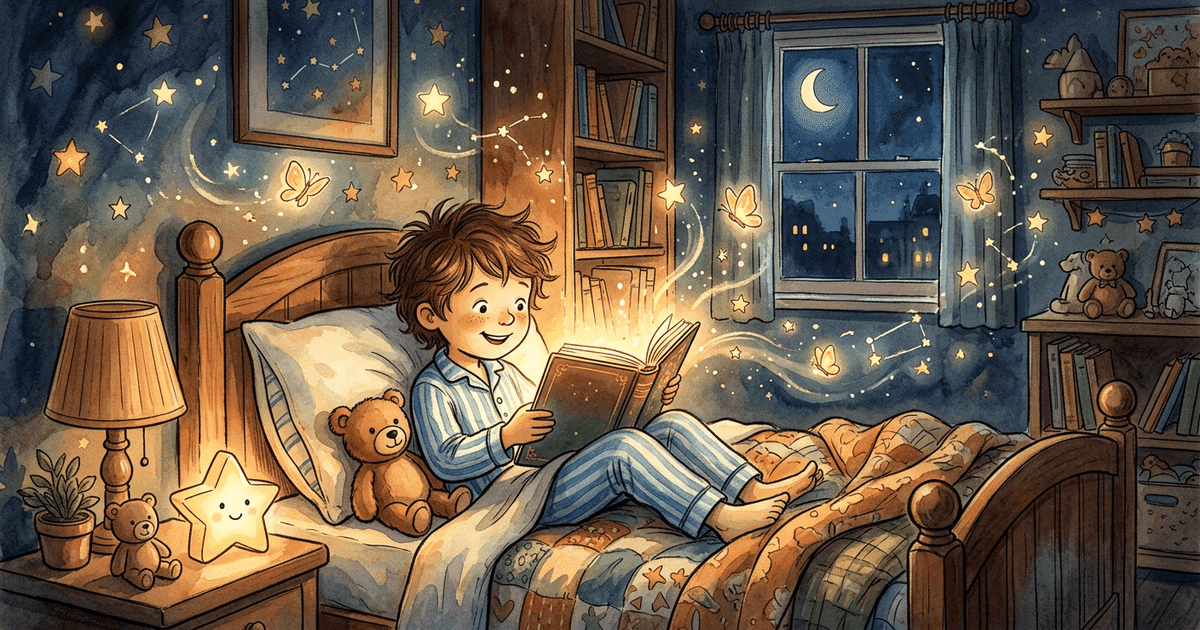
Discover the 7 best children's books about fear of the dark, including personalized stories, classic picture books, and expert tips to help your child sleep bravely.
You have tried the reassuring words. You have checked under the bed, behind the curtains, and inside the closet. You have left the hallway light on, cracked the door open just the right amount, and still your child calls out, voice trembling: "I'm scared of the dark." If this sounds familiar, you are not alone — and you are not failing. Fear of the dark is one of the most common childhood experiences, affecting up to 73% of children between ages 2 and 6. The good news is that the right children's book about fear of the dark can be a remarkably effective tool for helping your child build genuine courage at bedtime.
In this guide, we have gathered seven books that actually work — not just stories that distract, but books grounded in the principles of bibliotherapy that help children process and overcome their fear. Whether your child is a toddler who has just started noticing shadows or a five-year-old convinced there are monsters in every corner, there is a book here that can help.
Make Your Child the Brave Hero of Their Own Story
Create a personalized storybook where your child conquers the dark — featuring their name, their face, and AI-illustrated scenes of nighttime courage.
Create Their Brave Story →Why Children Fear the Dark (and Why It's Normal)
Before diving into book recommendations, it helps to understand why your child is afraid. Fear of the dark is not a sign of weakness, an overactive imagination gone wrong, or a parenting failure. It is a deeply normal developmental milestone.
Between ages 2 and 6, children's brains undergo enormous growth in the areas responsible for imagination and creativity. However, the prefrontal cortex — the part of the brain that handles logical reasoning and distinguishes fantasy from reality — is still developing. This means a child can vividly imagine a monster hiding in the shadows but cannot yet rationally conclude that monsters do not exist.
Evolutionary psychologists point out that this fear is actually hardwired. For thousands of years, children who were wary of the dark survived — darkness concealed real predators. Your child's amygdala (the brain's alarm system) is doing exactly what it was designed to do: scanning for threats in low-visibility conditions. The fact that you live in a safe home with locks on the doors does not matter to a brain running ancient survival software.
This is precisely why telling a child "There is nothing to be scared of" rarely works. You are trying to fight millions of years of evolution with a single sentence. What does work is giving children a new framework for understanding darkness — and that is where books come in. For a deeper dive into the science, read our article on why fear of the dark is completely normal.
How Books Help Children Process Fear
The practice of using books to help children work through difficult emotions is called bibliotherapy, and it has been used by child psychologists for decades. A 2018 study published in the Journal of Child Psychology and Psychiatry found that children who engaged with targeted therapeutic stories showed a 40% reduction in anxiety symptoms compared to a control group.
Bibliotherapy works through three stages:
- Identification: The child recognizes themselves in the story's character. They see someone who shares their fear and feels the same way they do. This alone is powerful — it tells the child "I am not the only one who feels this way."
- Catharsis: As the character faces and works through the fear, the child vicariously experiences those emotions from a safe distance — usually on a parent's lap. They feel the tension, the courage, and the relief without being in actual danger.
- Insight: The child internalizes the coping strategy the character used. Over repeated readings, this becomes a mental script they can draw on when they face their own fear in real life.
The key insight is that books do not just distract a child from their fear. They help the child rewire their emotional response to darkness. Each time a child hears a story where a character successfully navigates the dark, their brain builds and strengthens a neural pathway for courage. For a complete look at this process, explore our guide on how personalized books help children overcome fears.
With that foundation in mind, here are seven books that put these principles into practice.
7 Best Books for Children Afraid of the Dark
#1. A Personalized "Brave at Night" Storybook (Magical Hekaya)
Best for ages: 2-8 | Why it works: Maximum identification — your child IS the hero
There is a reason we are placing this first: no generic book can match the power of a story where your child is the main character. In a personalized brave storybook from Magical Hekaya, your child sees their own name, their own face, and their own bedroom as the setting for a nighttime adventure.
In the story, your child might discover that the shadows in their room are actually friendly creatures putting on a dance show. Or that the mysterious sounds are a family of gentle owls having a conversation outside the window. The darkness transforms from a threatening void into a world of wonder — and your child is the brave explorer who discovers this truth.
Why is personalization so powerful for fear of the dark specifically? Research from the University of Sussex found that children pay attention 30% longer and recall 25% more content when the story features their own name and likeness. But for fear-based stories, the effect goes deeper. When the brave hero who conquers darkness looks like your child and has their name, the lesson stops being abstract. The child does not think "That character was brave." They think "I am brave." The psychological distance between story and reality collapses completely.
Pair this with Magical Hekaya's optional audio narration, and you have a multi-sensory bedtime experience that soothes and empowers at the same time. Many parents report that after just a week of reading their child's personalized brave story, bedtime battles decrease significantly.
Your Child's Name. Your Child's Face. Their Bravest Adventure.
Create a one-of-a-kind storybook where your child discovers that the dark is full of magic, not monsters. Ready in minutes.
Create Their Story Now →#2. "The Dark" by Lemony Snicket (Illustrated by Jon Klassen)
Best for ages: 3-7 | Why it works: Reframes darkness as a character, not a threat
Lemony Snicket takes a brilliantly unconventional approach in this picture book. Laszlo is afraid of the Dark, which lives in his house — in the basement, in the closet, behind the shower curtain. But one night, the Dark speaks to Laszlo and leads him on a journey through the house to find something important: a box of lightbulbs.
What makes this book exceptional is how it personifies the dark as a calm, gentle presence rather than a menacing one. The Dark is not trying to scare Laszlo; it is trying to help him. This reframing is powerful for children because it gives them a completely new mental model. Instead of "the dark is where scary things hide," the takeaway becomes "the dark is just another part of my house, and it is not out to get me."
Jon Klassen's moody, atmospheric illustrations are perfect — dark enough to feel honest, but never frightening. The muted palette actually makes the darkness look cozy rather than threatening. This book respects a child's fear without dismissing it, which is exactly what bibliotherapy calls for.
#3. "Orion and the Dark" by Emma Yarlett
Best for ages: 3-6 | Why it works: Turns the fear object into a friend
Orion is afraid of many things, but he is especially afraid of the Dark. Then one night, the Dark shows up at his window — as a large, friendly, slightly awkward character — and invites Orion on a nighttime adventure. Together they visit all the wonderful things that only happen at night: fireworks, nocturnal animals, city lights, the Northern Lights.
This book works through a classic psychological technique called positive association. By pairing darkness with exciting, beautiful, and fun experiences, the story rewires the child's emotional response. Instead of associating "dark" with "danger," the child begins to associate it with "wonder" and "adventure."
The illustrations are vibrant and joyful, which is a deliberate contrast to the subject matter. Children often laugh during the adventure scenes, and laughter is one of the most effective antidotes to fear. If your child has been exposed to the Netflix adaptation, the book offers a more intimate, parent-child reading experience that many families prefer.
#4. "Can't You Sleep, Little Bear?" by Martin Waddell
Best for ages: 2-5 | Why it works: Models patient, loving parental response
Little Bear cannot sleep because he is afraid of the dark. Big Bear brings him a small lantern, then a bigger lantern, then the biggest lantern of all — but none of them work because "all the dark" is outside the cave. Finally, Big Bear carries Little Bear outside and shows him the moon and stars, and Little Bear falls asleep in Big Bear's arms.
This book is special because it does double duty. For the child, it validates their fear — Little Bear's experience mirrors exactly what they feel, and that recognition alone is comforting. For the parent, it models an ideal response: patience, warmth, and creative problem-solving rather than frustration or dismissal.
The resolution is especially beautiful. Big Bear does not eliminate the dark. He does not pretend it does not exist. Instead, he shows Little Bear that the dark contains something magnificent — the moon. This is the essence of reframing: you cannot take away the darkness, but you can change what the child sees in it.
Winner of the Kate Greenaway Medal, this is a timeless choice for the youngest children who are just beginning to articulate their fear.
#5. "Flashlight" by Lizi Boyd
Best for ages: 2-6 | Why it works: Wordless format gives the child control of the narrative
This is a wordless picture book, and that is precisely what makes it so effective. A child takes a flashlight into the dark woods and discovers all sorts of creatures, plants, and scenes hidden in the darkness. The flashlight beam illuminates only a small circle on each page, while the surrounding darkness hides (but does not threaten) the rest of the world.
"Flashlight" works on a subtle but powerful principle: agency. Because there are no words, the parent and child create the story together. The child decides what the flashlight is revealing. They narrate, they wonder, they explore. This transforms the child from a passive recipient of a scary experience into an active explorer of the dark.
The illustrations are gorgeous — die-cut pages allow the flashlight beam to literally shine through, creating a tactile, interactive experience. Many parents find that after reading this book, their child asks for a real flashlight at bedtime. And a child who wants a flashlight to explore the dark is already halfway to conquering their fear.
#6. "The Owl Who Was Afraid of the Dark" by Jill Tomlinson
Best for ages: 4-8 | Why it works: Shows fear from a surprising perspective; builds understanding gradually
Plop is a baby barn owl who is afraid of the dark — which is a serious problem when you are a nocturnal animal. His mother sends him out to talk to different people about the dark, and each person gives him a different perspective: the dark is exciting, the dark is kind, the dark is fun, the dark is necessary, the dark is fascinating, the dark is wonderful, the dark is beautiful.
The structure of this book is its genius. Each short chapter introduces one new positive association with darkness. This mirrors the therapeutic technique of gradual exposure combined with cognitive restructuring. Instead of trying to flip the child's entire worldview in one sitting, the book builds a new understanding of darkness layer by layer, chapter by chapter.
This is also an excellent choice for slightly older children (ages 5-8) who may feel embarrassed about their fear. Plop is an owl — an animal that is supposed to love the dark — and even he is scared. This normalizes the fear in a way that feels safe and even humorous. The message is clear: being afraid is okay, and understanding is the path to courage.
#7. "Goodnight Moon" by Margaret Wise Brown
Best for ages: 0-4 | Why it works: Creates a soothing ritual of naming and claiming the room
This classic barely needs introduction, but its effectiveness for fear of the dark is often overlooked. In the story, a young bunny says goodnight to every object in the room — the red balloon, the kittens, the mittens, the moon. As the pages progress, the room gradually darkens until the final whispered "Goodnight noises everywhere."
Why does a book from 1947 still work so well? Because it leverages a deep psychological principle: naming creates ownership. When a child names every object in their room, they are mentally mapping their environment. They know what is there. There are no unknowns hiding in the dark — just the same familiar objects they said goodnight to.
The gradual darkening of the illustrations is also therapeutic. It models a gentle transition from light to dark, showing the child that the room does not change just because the lights dim. The red balloon is still there. The moon is still outside the window. Everything is exactly where it should be. For the youngest children who have not yet developed elaborate fears but need comfort at bedtime, this remains the gold standard.
How to Use Books as Part of a Bedtime Routine
Having the right book is only half the equation. How you read it matters just as much. Here are evidence-based strategies for maximizing the therapeutic impact of bedtime reading, especially when working through children's books about fear of the dark.
1. Read Together, Not Alone
The parent's physical presence during reading is not optional — it is part of the therapy. Your warmth, your calm voice, and your proximity send a powerful signal to your child's nervous system: "A trusted adult is here and relaxed. There is no danger." This co-regulation helps the child's amygdala dial down its threat response, creating the emotional safety needed to process the fear rather than just endure it.
2. Pause and Ask Questions
At key moments in the story, stop and ask open-ended questions: "How do you think Laszlo is feeling right now?" or "What would you do if the Dark talked to you?" These questions build emotional vocabulary and help the child practice thinking through fearful situations while calm. This is the foundation of emotional intelligence.
3. Repeat the Same Book
Do not worry if your child asks for the same fear-of-dark book every single night. This is not a sign of being stuck — it is a sign the book is working. Repetition strengthens the neural pathway for the brave response. Child psychologists recommend reading the same therapeutic story at least five to seven times over two weeks for maximum effect. Each reading deepens the child's identification with the brave character and reinforces their internal script for courage.
4. Connect Story to Reality
After the story, gently bridge the narrative to real life: "Remember how the bunny said goodnight to everything in the room? Want to try that with your room?" or "Remember how in your story, you discovered the shadows were just friendly owls? Maybe the shadows in your room are friendly too." This connection is what transforms a bedtime story from entertainment into a genuine coping tool. Our guide on handling monster fears has more practical tips for this bridge-building technique.
5. Build a Consistent Routine
Incorporate the reading into a predictable bedtime sequence. Children thrive on routine because predictability reduces anxiety. After two to three weeks of this routine, most parents notice a meaningful reduction in bedtime resistance and nighttime wake-ups.
6. Combine Books with Physical Tools
Pair your reading with tangible comfort items: a "bravery flashlight" the child can keep by their bed, a warm-toned nightlight (amber or orange — never blue or white, which disrupts melatonin), or a special stuffed animal designated as the "Night Guardian." These physical anchors give the child something to hold onto when the story is over and the lights are dim.
How to Choose the Right Book for Your Child
Not every book on this list will resonate with every child. Here is a quick guide to matching the right book to your child's age and temperament:
- Ages 0-2: Start with "Goodnight Moon" for its soothing ritual quality. At this age, fear of the dark is usually pre-verbal, and the comfort comes from the rhythm of your voice and the predictability of the story.
- Ages 2-4: "Can't You Sleep, Little Bear?" and "Flashlight" are ideal. These books validate fear without making it the central drama, and they keep the tone warm and gentle.
- Ages 3-6: "The Dark," "Orion and the Dark," and a personalized Magical Hekaya story hit the sweet spot. At this age, children are old enough to follow a narrative arc and internalize the reframing.
- Ages 5-8: "The Owl Who Was Afraid of the Dark" is perfect for older children who need a more nuanced, chapter-based approach. Its humor also works well for children who feel embarrassed about their fear.
- Any age: A personalized storybook works across the entire age range because the story and vocabulary are tailored to your child's specific age and developmental level.
When Books Are Not Enough
For most children, a combination of the right books, a consistent routine, and patient parenting will resolve fear of the dark within a few weeks to a few months. However, if your child's fear is so intense that it causes panic attacks, persists well beyond age 8-9, or significantly disrupts sleep and daily functioning, it may be worth consulting a pediatrician or child psychologist. Severe, persistent nyctophobia can sometimes be a sign of an underlying anxiety disorder that benefits from professional support.
Books are a first-line tool, not the only tool. But for the vast majority of children, they are exactly the right starting point.
Help Your Child Discover That the Dark Is Full of Magic
Every child who is afraid of the dark is really just a child with a powerful imagination that has not yet learned to see darkness as a friend. The seven books in this guide — from timeless classics to cutting-edge personalized stories — all share one goal: to give your child a new story about what the dark is. Not a scary void. Not a hiding place for monsters. But a quiet, gentle world full of moonlight, friendly creatures, and adventures waiting to be discovered.
And when the hero of that story is your own child — with their own name, their own face, and their own bedroom — the transformation can be extraordinary.