
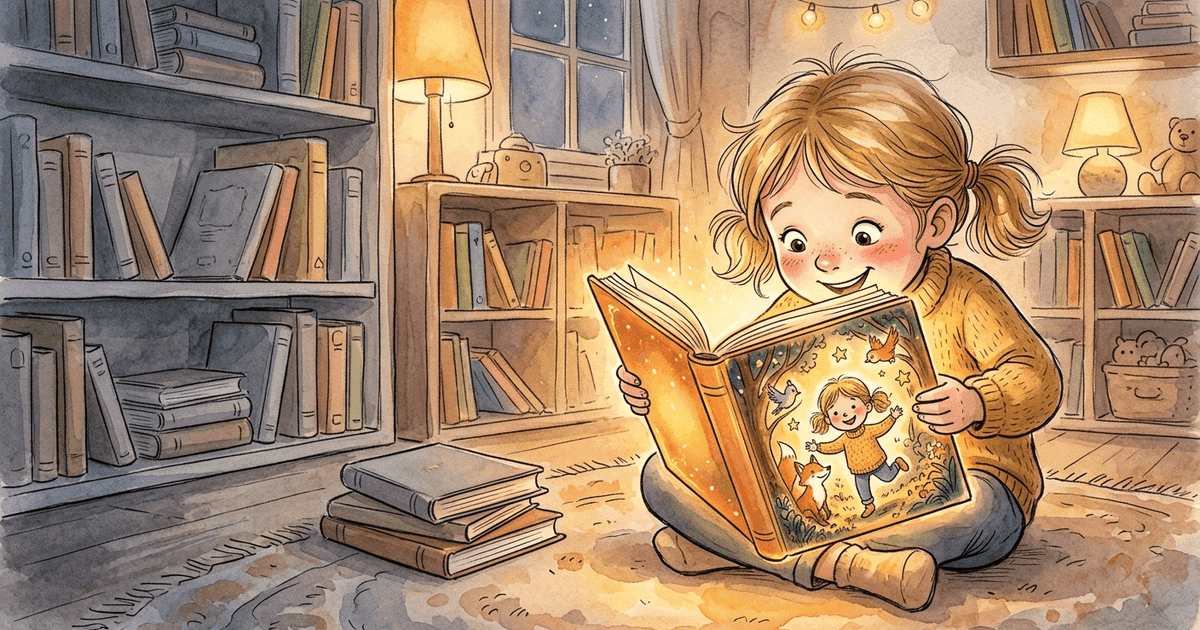
If your child does not like reading, they have not found the right book yet. Personalized books — where your child is the hero — are backed by research as one of the most effective tools for engaging reluctant readers.
Your Child Is Not Broken — They Just Have Not Found Their Book Yet
If you are reading this article, chances are you have a child who does not enjoy reading. Maybe they resist when you suggest picking up a book. Maybe they will do the required school reading but never touch a book voluntarily. Maybe they are falling behind their peers in reading skills, and you are watching the gap widen with growing anxiety.
First, take a breath. Your child is not broken. They are not lazy. They are not destined to be a non-reader forever. The vast majority of reluctant readers are not struggling with a fundamental inability to read — they are struggling with a fundamental lack of reason to read. And that is a solvable problem.
The distinction matters enormously. When we treat reluctant reading as a skill problem, we prescribe more practice, more worksheets, more structured reading time. These interventions increase the volume of reading-related activity but often deepen the child's conviction that reading is an unpleasant chore. When we treat it as a motivation problem — which is what it usually is — we focus on the right question: what would make this child want to read?
Understanding the Reluctant Reader: It Is Not About Intelligence
Reluctant readers come from every intelligence level, every socioeconomic background, and every family type. Some of the most intellectually curious children are reluctant readers. They may love listening to stories, absorb information voraciously through videos and conversations, and demonstrate sophisticated thinking in non-reading contexts. The issue is not their capacity — it is their relationship with the specific activity of sitting down and processing written text.
Common Reasons Children Become Reluctant Readers
Understanding why your child resists reading is the first step toward helping them. The most common factors include:
- Reading feels like work, not pleasure — if every reading experience has been tied to school assignments, reading feels like a job, not a leisure activity
- Books do not reflect their world — children who rarely see characters that look like them, live like them, or face challenges they recognize disengage from stories that feel irrelevant
- Reading level mismatch — books that are too difficult create frustration; books that are too easy create boredom. The Goldilocks zone is narrow.
- Competing entertainment — screens offer instant, effortless stimulation. Books require sustained attention, and the payoff is slower. For a child who has not experienced the payoff of a good book, the comparison is unfavorable.
- Negative identity formation — the child has internalized the belief "I am not a reader," and this identity resists any evidence to the contrary
- Anxiety about performance — children who have been corrected, timed, or evaluated on their reading develop anxiety around the activity itself
The Identity Problem Is the Biggest One
Of all the factors above, negative identity formation is the most difficult to overcome and the most important to address. Once a child decides "I am not a reader," every interaction with books is filtered through that identity. A teacher assigns a book, and the child thinks "this is not for me." A parent suggests reading time, and the child thinks "I am not good at this." A peer discusses a book, and the child thinks "I do not belong in that group."
This identity is remarkably sticky. Evidence that contradicts it — a book the child actually enjoys, a reading assessment that shows improvement — is dismissed as an exception rather than integrated into the self-concept. Breaking through requires not just a good book, but a book that is so personally relevant that the child cannot maintain their distance from it.
This is exactly where personalized books operate.
The Science Behind Why Personalized Books Work for Reluctant Readers
The effectiveness of personalized books for reluctant readers is not anecdotal — it is grounded in well-established psychological principles.
The Self-Reference Effect
Cognitive psychology has demonstrated what is known as the self-reference effect: information that relates to the self is processed more deeply and remembered more accurately than information that does not. When a child reads a story featuring a character with their name and face, every sentence is processed through the self-referential filter. The child is not just reading a story — they are reading about themselves. This deeper processing translates to better comprehension, better recall, and critically, better engagement.
For reluctant readers, the self-reference effect is transformative. A child who normally skims through text or zones out while reading becomes attentive and focused when the text is about them. They want to know what they do next in the story. They want to see how the challenge is resolved. The self-reference effect converts passive reading into active engagement.
Narrative Transportation Theory
Researchers use the term narrative transportation to describe the experience of becoming absorbed in a story — losing track of time and surroundings, feeling genuine emotions about fictional events, and mentally simulating the story world. Narrative transportation is the experience that avid readers describe when they say a book "pulled them in."
Reluctant readers rarely experience narrative transportation because they disengage before it can occur. But personalized books lower the threshold for transportation dramatically. When the main character is literally the reader, the psychological distance between the child and the story collapses. They do not need to imagine being the character — they are the character. This immediate identification makes narrative transportation almost automatic, and once a child has experienced what it feels like to be truly absorbed in a book, they are more likely to seek that experience again.
Self-Efficacy and the Competence Loop
Psychologist Albert Bandura's work on self-efficacy shows that our beliefs about our ability to succeed at a task directly influence whether we attempt the task and how we perform. A child who believes "I am bad at reading" will approach reading with low effort and high anxiety, confirming the belief. A child who believes "I can read this" approaches reading with confidence and engagement, leading to success.
A personalized book interrupts the negative self-efficacy cycle in a subtle but powerful way. The child picks up the book because they are curious about seeing themselves in it — not because they want to practice reading. The motivation is self-referential interest, not reading obligation. As they read, they are engaging with text successfully, building fluency, and having a positive reading experience — all without the performance anxiety that typically accompanies reading for reluctant readers. Each successful reading experience builds self-efficacy, making the next reading experience more likely.
Practical Strategies: Using Personalized Books to Help Your Reluctant Reader
Understanding the science is valuable, but parents need actionable strategies. Here is how to use personalized books effectively:
Strategy 1: Start With the Hook, Not the Expectation
Do not present the personalized book as "a book you need to read." Present it as something interesting you found. "I made something for you — want to see it?" Let the child discover the personalization themselves. The moment they realize the character looks like them and has their name, curiosity takes over. Do not mandate reading time — let them pick it up on their own terms.
Strategy 2: Choose the Right Story Complexity
For reluctant readers, the story should be slightly below their actual reading level. This seems counterintuitive — should we not be pushing them to grow? But the priority for a reluctant reader is not skill development. It is creating a positive experience. A book they can read fluently without stumbling over words allows them to focus on the story itself — the fun part — rather than the mechanics of decoding. Once they are engaged and their identity begins shifting toward "I am someone who reads," you can gradually introduce more challenging material.
Strategy 3: Use Audio Narration as Training Wheels
Many personalized book platforms, including Magical Hekaya, offer audio narration that reads the story aloud while the child follows along with the illustrated pages. For reluctant readers, this is incredibly effective. The audio removes the performance pressure of reading aloud, provides a model of fluent reading, and supports the child through difficult words without requiring them to ask for help. Over time, many children begin muting the audio and reading independently, having built confidence through the supported experience.
Strategy 4: Make It Social, Not Solitary
Reluctant readers often associate reading with isolation — sitting alone, struggling through text, while other kids play. Break this association by making the personalized book a social experience. Read it together. Laugh at the illustrations. Discuss what the character (the child) does in the story. Show it to grandparents on a video call. Share it with a friend. Every social interaction around the book reinforces reading as a positive, connected activity rather than a lonely chore.
Strategy 5: Create a Series of Wins
One positive reading experience is a spark. Three positive experiences in quick succession can light a fire. After your child enjoys their first personalized book, create another one with a different story theme. Then another. Each completed book is a win — a data point that contradicts the "I am not a reader" identity. The child is not reading because they have been told to. They are reading because they keep wanting to see what adventure they go on next.
What Not to Do: Common Mistakes Parents Make With Reluctant Readers
Well-meaning parents often make mistakes that inadvertently deepen a child's resistance to reading. Avoid these:
- Do not force reading as punishment — "no screen time until you read for 30 minutes" makes reading the obstacle between the child and what they actually want to do
- Do not criticize their book choices — if a reluctant reader picks up a comic book, a graphic novel, or a book you consider "below their level," celebrate it. Any voluntary reading is good reading.
- Do not correct every mistake during read-aloud — constant correction creates performance anxiety. Let small errors go and correct only when meaning is lost.
- Do not compare them to siblings or peers — "your sister reads chapter books" is not motivation. It is shame.
- Do not make reading a condition for other privileges — reading should be its own reward, not a transaction
- Do not give up after one attempt — one book that does not work does not mean personalized books do not work. Try a different theme, a different complexity level, a different format.
The Representation Factor: Why Seeing Yourself Matters
Research on representation in children's literature consistently shows that children who see characters that look like them in books are more engaged, more empathetic, and more likely to develop a positive reading identity. For many children — particularly those from underrepresented backgrounds — the standard bookshelf does not reflect their reality. The characters do not look like them, do not live in worlds they recognize, and do not face challenges they relate to.
Personalized books take representation to its logical extreme: the character is not just similar to the child — it is the child. Their face, their name, their story. For children who have never seen themselves as the hero of a book, this experience can be genuinely transformative. It is not just about reading motivation — it is about the fundamental message that books are for them, that stories are about people like them, and that they belong in the world of reading.
Beyond the Book: How Reading Identity Shifts Over Time
The ultimate goal is not to create a child who only reads personalized books. It is to use personalized books as a catalyst for a broader shift in reading identity. Here is how that shift typically unfolds:
- Stage 1: Curiosity — the child picks up the personalized book because they are in it, not because they want to read
- Stage 2: Enjoyment — the child discovers that reading this book is actually fun
- Stage 3: Repetition — the child re-reads the book voluntarily, sometimes multiple times
- Stage 4: Expansion — the child requests another personalized book or begins showing interest in other books
- Stage 5: Identity shift — the child begins to see themselves as someone who reads, not because they were told to, but because they have evidence of their own enjoyment
This process does not happen overnight. For deeply reluctant readers, it may take weeks or months. But the trajectory is consistent: personal relevance creates engagement, engagement creates positive experiences, positive experiences create a new identity, and a new identity creates a reader.
When to Seek Additional Help
Personalized books are a powerful tool for reluctant readers, but they are not a substitute for professional support when it is needed. Consider seeking additional help if:
- Your child shows consistent difficulty with phonics and decoding despite adequate instruction
- Reading aloud is significantly below grade level for their age
- The child experiences physical symptoms (headaches, eye strain, anxiety) during reading
- Reluctance is accompanied by frustration, tears, or genuine distress rather than simply preference for other activities
- Multiple approaches, including personalized books, have been tried for several months without any improvement in attitude toward reading
A reading specialist or educational psychologist can assess whether a learning difference like dyslexia is contributing to the reluctance and recommend targeted interventions alongside motivational strategies.
The Reader Inside Every Child
Every child has the capacity to enjoy reading. The question is never whether they can — it is whether they have found a reason to. For many reluctant readers, a personalized storybook is that reason. It is not a trick or a gimmick. It is a fundamentally different reading experience that rewrites the emotional equation. Instead of "reading is something I have to do," it becomes "reading is something that is about me."
That shift — from obligation to ownership — is the difference between a reluctant reader and a willing one. And sometimes, all it takes to start is a single book where the hero has a familiar face.