
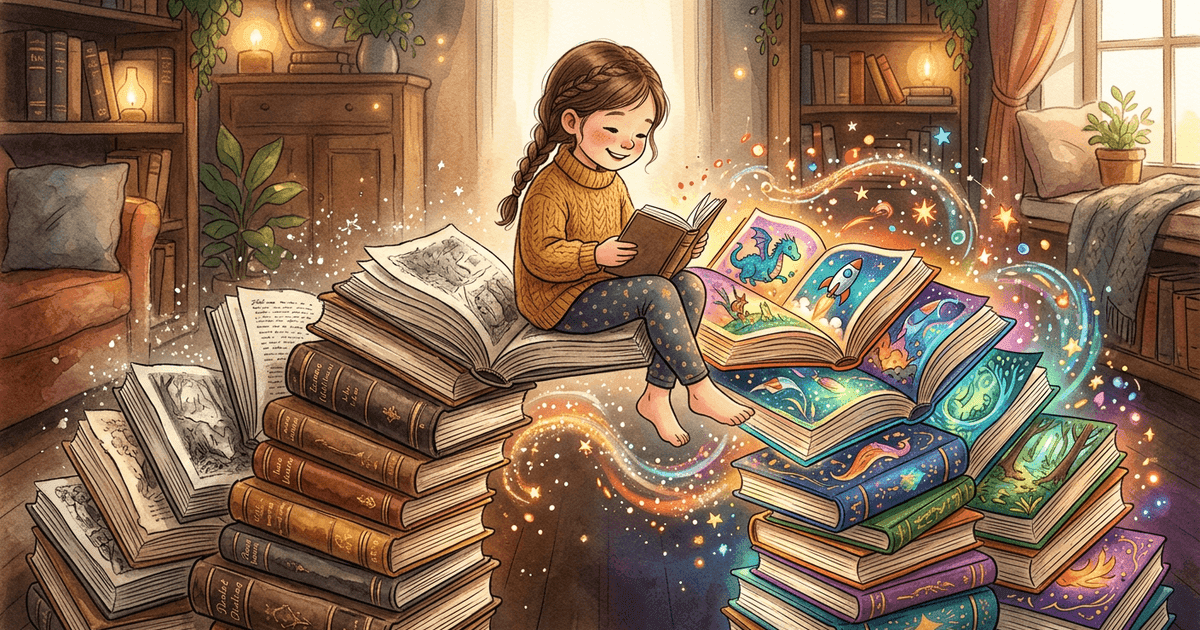
How do AI storybooks actually work? Are AI storybooks safe for kids? The full 2026 parent guide: how the technology generates personalized illustrations from one photo, the safety stack reputable platforms use, and how AI storybooks help children — including reluctant readers — engage with stories.
Short answer for parents in a hurry: An AI storybook is a children's book where the illustrations and text are generated on demand, usually personalized to your specific child via a single uploaded photo. The technology that makes this possible — strong character consistency from one photo across 20–30 illustrations — became reliable in late 2024. Reputable platforms in 2026 are safe when they (a) use template-driven story text, (b) screen every generated image for child-appropriateness, and (c) delete uploaded photos after generation. This guide walks through how AI storybooks actually work step by step, the safety stack reputable platforms use, and the engagement research showing why children read them more than generic books.
The Rise of AI in Children's Literature
Something remarkable is happening in the world of children's books. Reading habits are shifting, attention spans are under siege from screens, and parents are searching for new ways to spark a genuine love of reading in their children. At the center of this transformation is a technology that most people did not associate with bedtime stories until recently: artificial intelligence. The AI storybook is no longer a futuristic concept — it is a reality that is reshaping how millions of families experience storytime, and it is doing so faster than anyone predicted.
For decades, "personalized" children's books meant one thing: stamping a child's name onto a pre-written story with generic illustrations. The character on the page looked the same whether the reader was a girl with curly brown hair in Nairobi or a boy with straight blond hair in Oslo. The story did not adapt. The illustrations did not change. The personalization was, frankly, superficial. But AI has changed the game entirely — delivering real-time generation, photo-realistic personalization, and stories that genuinely reflect the child holding the book. Platforms like Magical Hekaya now create personalized storybooks with photos where the child is the hero, the illustrations match their appearance, and the story speaks directly to their world.
The market has responded. The personalized children's book industry is valued at approximately $570 million in 2026, growing at 9% annually, and AI-powered platforms are the fastest-growing segment within it. The shift from generic name-insertion to true AI personalization is not incremental — it is a paradigm change in how children's literature is created, delivered, and experienced.
See AI Personalization in Action
Create a personalized storybook where your child becomes the hero — with AI illustrations that look like them and audio narration included.
Create Your Child's Story →How AI Creates Personalized Illustrations
The technology behind AI-personalized illustrations is sophisticated, but for parents, the experience is simple. You upload a clear photo of your child. The AI analyzes key visual features — hair color and texture, skin tone, eye color, facial structure, and any distinctive characteristics like glasses or freckles. From this analysis, it builds an illustrated character model: a storybook version of your child rendered in a cohesive art style such as watercolor, cartoon, or classic picture-book illustration.
This character model becomes the foundation for every page. Whether the hero is climbing a magical mountain, befriending a dragon, or tucked into bed under a starlit sky, the AI maintains the character's appearance consistently throughout the book. As we explore in detail in our article on how AI creates unique story illustrations, modern character-reference pipelines achieve over 95% visual consistency across scenes.
A crucial distinction: AI does not photoshop or paste your child's face onto pre-made images. It generates entirely original artwork inspired by your child's features. The result is warm, artistic, and cohesive — a real storybook, not a photo collage. And every generated illustration passes through automated content safety filters before it reaches your child.
Compare this to the traditional approach. A custom-illustrated children's book from a professional artist costs $500 to $5,000 and takes two to eight weeks. An AI-personalized storybook costs under $15 and is ready in under five minutes. The accessibility gap is enormous — and it means that every family, regardless of budget, can now give their child the experience of being the hero of a beautifully illustrated story.
The Engagement Gap — Why Generic Books Are Losing to Personalized Ones
Parents intuitively understand that children pay more attention when a story feels relevant to them. But the science behind this intuition is striking.
The Self-Reference Effect
In cognitive psychology, there is a well-established phenomenon called the self-reference effect. It describes how people process and remember information more deeply when it relates to themselves. For children, this effect is especially powerful. When a child opens a book and sees a character who shares their face, their brain processes the story differently. Neuroscience research shows that self-referential stimuli activate the medial prefrontal cortex — the brain region responsible for connecting new information to one's sense of identity.
In practical terms, the story stops being about "some character" and becomes about them. Every challenge the hero faces becomes their challenge. Every victory becomes their victory.
The Numbers
Research consistently shows that children engage up to three times more with stories where the main character looks like them, compared to stories with generic characters. A 2025 study in the Journal of Applied Developmental Psychology found that children who received photo-personalized books requested re-reads 2.3 times more frequently than children who received name-only books. More re-reads mean more vocabulary exposure, stronger comprehension skills, and deeper emotional development.
Emotional Connection and Confidence
Seeing yourself as the hero of a story has measurable effects on self-perception. Psychologist Albert Bandura's concept of self-efficacy — the belief in one's ability to succeed — is directly strengthened when a child repeatedly experiences narratives in which they are brave, capable, and celebrated. AI storybooks make this scalable — every child can have a story that speaks directly to their specific fears, milestones, or challenges.
For a detailed comparison of how different levels of personalization affect engagement, see our article on personalized books vs name-only books.
Give Your Child the Hero Experience
Children who see themselves in stories read more, engage deeper, and build confidence. Create a personalized AI storybook in under five minutes.
Start Creating Now →Audio Narration — The Next Frontier
Visual personalization is only half the story. The other half is sound. AI-powered audio narration is transforming storybooks from a purely visual medium into an immersive, multi-sensory experience.
How AI Creates Natural Narration
Modern text-to-speech technology has moved far beyond the robotic, monotone voices of a decade ago. Today's AI voices are warm, expressive, and natural-sounding — with appropriate pacing, emotional inflection, and a gentle tone suited for children's content. The narration is generated page by page, syncing with the text so children can follow along as they listen.
Who Benefits Most
- Pre-readers and early readers: Children who cannot yet read independently can enjoy the story on their own, building confidence and familiarity with narrative structure.
- Multilingual families: When a parent is not fluent in the language of the book, audio narration ensures the child still hears proper pronunciation and expression.
- Bedtime routines: On nights when a parent is exhausted or traveling, audio narration lets the child enjoy their personalized story with the same warmth as a read-aloud session.
- Reluctant readers: The combination of hearing their name spoken aloud and seeing their face on the page creates a powerful hook. Learn more about how personalized books help reluctant readers and the role of audio storybooks.
The Future: Parent Voice Cloning
The next evolution of audio narration is already on the horizon: parent voice cloning. Imagine your child hearing a bedtime story narrated by your voice — even when you are not in the room. AI voice cloning technology can create a faithful reproduction of a parent's voice from just one to two minutes of recorded speech. This feature is currently in development at Magical Hekaya and will require explicit parental consent, with full control over voice data.
Safety and Ethics in AI Children's Content
No discussion of AI in children's media is complete without addressing the most important question parents have: is it safe? The answer depends entirely on the platform — and responsible implementation requires multiple layers of protection.
Content Filtering and Age-Appropriateness
At Magical Hekaya, safety is built into every layer of the generation process:
- Prompt-level guardrails: The AI generation prompts are designed with built-in constraints that prevent inappropriate content from being generated.
- Output screening: Every generated image and text passage is automatically screened by content safety classifiers before being included.
- Age-appropriate vocabulary: Language models are constrained to vocabulary and themes appropriate for the target age range.
- Human review: New story templates and illustration styles undergo human review before being made available.
Photo Privacy and Data Security
- Minimal data collection: We collect only the information necessary to generate the book.
- Photo usage: Uploaded photos are used solely for generating the illustrated character and are not stored beyond the generation process.
- COPPA and GDPR compliance: Our entire pipeline is designed with children's privacy regulations as the baseline.
- Parental control: Parents can delete all data — including generated books, child profiles, and account information — at any time.
What the Future Holds for AI Storybooks
The current generation of AI storybooks is only the beginning. The technology is evolving rapidly, and the next wave of innovation will push the boundaries of what a children's book can be.
Interactive and Adaptive Stories
Future AI storybooks will respond to the child. Imagine a story that adapts its vocabulary complexity based on the child's reading level, or a choose-your-own-adventure narrative where the child makes decisions that shape the plot. Adaptive difficulty means a single book can grow with the child — simpler language for a three-year-old, richer vocabulary for a seven-year-old reading the same story.
Multilingual Generation
AI is breaking down language barriers in children's literature. The same personalized story, with the same custom illustrations, can be generated in any supported language — English, French, Arabic, Spanish, Mandarin, and beyond. For multilingual families, this means a child can enjoy their personalized story in every language spoken at home. Magical Hekaya is building toward French and Arabic support, with full right-to-left rendering for Arabic content.
Therapeutic Applications
One of the most promising frontiers is AI-powered bibliotherapy. Therapists and child psychologists are exploring how AI-personalized stories can be used as structured therapeutic interventions. A child dealing with anxiety, a family transition like divorce, or a specific phobia can receive a story designed to address their exact situation — starring themselves as the brave protagonist. The combination of personalization and therapeutic narrative design has the potential to make evidence-based bibliotherapy accessible to every family.
Diverse Representation at Scale
Traditional publishing has long struggled with representation. AI eliminates this gap entirely. Every child — regardless of ethnicity, hair type, skin tone, or physical characteristics — can be the hero of a beautifully illustrated story. As we discuss in AI in children's books: the future of personalization, this democratization of representation is one of the most socially significant outcomes of the AI storybook revolution.
Video and Animation
The line between storybook and animated short is blurring. AI can already combine personalized page illustrations with audio narration to produce video storybooks — shareable on WhatsApp, Instagram, and other platforms. Future iterations will add subtle animation to illustrations: a character's hair blowing in the wind, leaves falling in a forest, stars twinkling in a bedtime scene.
Frequently Asked Questions
Are AI storybooks safe for children?
Yes, when created by responsible platforms. At Magical Hekaya, every AI-generated story and illustration passes through multi-layer content safety filters. Prompts are designed with built-in guardrails, and every output is screened for age-appropriateness before reaching your child.
How does AI create personalized illustrations from a photo?
When you upload your child's photo, the AI analyzes key visual features to build an illustrated character model in a cohesive storybook art style. This model serves as the reference for every page, ensuring the hero looks like your child throughout. The AI creates original artwork — not photo-pastes or filters.
Do children really engage more with AI-personalized stories?
Yes. The self-reference effect means children process information more deeply when it relates to themselves. Studies indicate children engage up to three times more with stories featuring a character that looks like them. Children with photo-personalized books request re-reads 2.3 times more frequently than those with name-only books.
What is the difference between AI storybooks and traditional personalized books?
Traditional personalized books insert the child's name into a pre-written story with identical illustrations for every child. AI storybooks generate unique illustrations based on the child's actual appearance, adapt story themes to specific needs, include audio narration, and deliver the finished book in minutes. For a full comparison, see our article on personalized books vs name-only books.
Can AI storybooks help reluctant readers?
Absolutely. Reluctant readers often disengage because they do not connect with stories offered to them. AI storybooks solve this by making the child the hero — creating an immediate emotional hook. Combined with audio narration, AI storybooks lower the barrier to entry and turn reading into an exciting personal experience.
What languages do AI storybooks support?
Magical Hekaya currently supports English, with French and Arabic (including full right-to-left rendering) planned for upcoming phases. AI text-to-speech technology supports natural-sounding narration in dozens of languages, making it especially valuable for bilingual and multilingual families.
The Reading Revolution Starts at Home
The way children learn to love reading is changing. Generic books with generic characters served their purpose for generations, but they are no longer the only option — and increasingly, they are not the best option. AI storybooks represent a fundamental shift: stories that see your child, reflect your child, and speak to your child as an individual.
Whether you are looking for a way to reignite your child's interest in reading, a unique and meaningful gift, or a tool to help your child navigate a specific fear or milestone, an AI storybook delivers an experience that generic books simply cannot match. The reading revolution is not happening in a distant future — it is happening in living rooms and bedrooms right now, one personalized story at a time.