
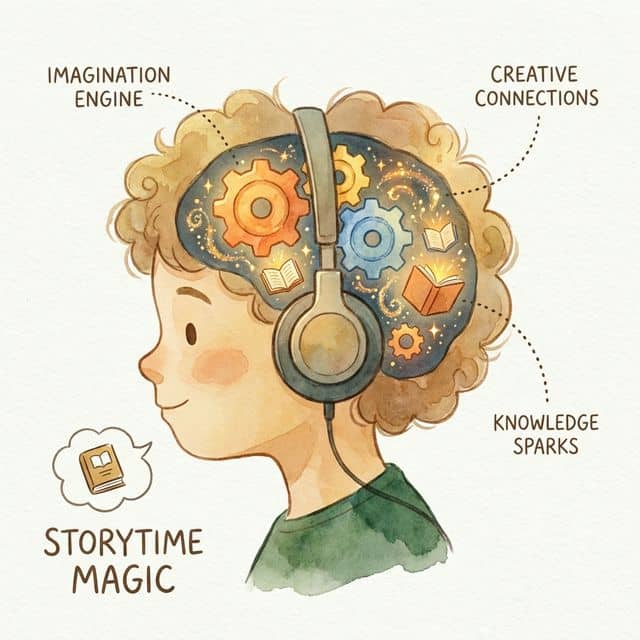
Explore the science of bibliotherapy for kids — how targeted stories boost emotional intelligence, reduce anxiety, and why personalized books amplify it.
More Than Just Storytime
Every parent knows that reading to children is "good." But few realize just how powerful reading can be as a psychological tool. The practice of using books to help children process emotions has a name — bibliotherapy — and it's backed by decades of scientific research.
In this article, we'll unpack the science: what happens in a child's brain when they hear a story, why some stories are more effective than others, and why personalized stories take the therapeutic benefit to a whole new level.
See Bibliotherapy in Action
Create a personalized story where your child is the hero — and experience the therapeutic power of seeing themselves conquer fears in their own adventure.
Create Your Child's Story →What Exactly Is Bibliotherapy?
Bibliotherapy, derived from the Greek words biblion (book) and therapeia (healing), is the structured use of literature to help individuals understand and cope with psychological challenges. It was first formally recognized as a therapeutic approach in the 1930s, and it has since become a standard tool in child psychology.
For children, bibliotherapy typically works through three stages — and it is especially effective when applied to common nighttime fears, as we see with children's books about fear of the dark:
- Identification: The child sees themselves in the character. ("That character is scared of the dark — just like me!")
- Catharsis: The child experiences the character's emotional journey — the fear, the struggle, and the relief — vicariously.
- Insight: The child extracts a lesson or coping strategy. ("The character breathed deeply and the fear got smaller. Maybe I can try that.")
This process is remarkably similar to cognitive behavioral therapy (CBT) techniques used for adults — but delivered through narratives that children naturally engage with.
What the Research Says
The evidence for bibliotherapy is robust:
- A meta-analysis of 22 studies published in Clinical Child and Family Psychology Review found that bibliotherapy was effective in reducing anxiety, depression, and behavioral problems in children aged 3–12.
- A 2018 randomized controlled trial showed that children who participated in a bibliotherapy program exhibited a 40% reduction in anxiety symptoms over 8 weeks, compared to 12% in the control group.
- Research from the University of Sussex found that reading for just 6 minutes reduced stress levels by 68% — more effective than listening to music (61%) or taking a walk (42%).
- A longitudinal study tracking 300 children over 3 years found that those exposed to regular "emotional literacy" reading scored significantly higher on empathy and self-regulation measures at age 8.
What Happens in the Brain
Neuroscience offers a fascinating window into why stories work so well:
Mirror Neurons and Empathy
When children listen to a story about a character experiencing fear, their mirror neurons fire as though they are experiencing the fear themselves. This neural mirroring is the basis of empathy — and it's also why children can "practice" being brave through stories without being in actual danger.
The Default Mode Network
Stories activate the brain's default mode network (DMN) — the same network involved in self-reflection, imagination, and planning. This means that when a child hears a story, their brain is actively simulating the scenario, predicting outcomes, and processing emotional responses. It's not passive entertainment — it's active emotional learning.
Cortisol Reduction
Studies using saliva cortisol testing show that children's stress hormone levels decrease measurably during story reading. The rhythmic, predictable nature of a story — combined with parental proximity — activates the parasympathetic nervous system, shifting the body from "fight or flight" to "rest and digest."
Give Your Child a Personalized Therapeutic Story
Bibliotherapy works best when your child sees themselves in the story. Create an AI-personalized book where they are the brave hero — backed by the science above.
Build Their Story Now →Why Personalized Bibliotherapy Is the Next Frontier
Traditional bibliotherapy uses published books selected to match a child's situation. It works well. But personalized bibliotherapy — where the child is literally the character in the story — is proving to be significantly more effective.
Here's why:
1. Stronger Identification
The first stage of bibliotherapy — identification — happens automatically with a personalized book. The child doesn't need to imagine that they're like the character. The character is them. Same name, same appearance, same world. This eliminates the cognitive gap and accelerates the therapeutic process.
2. Greater Engagement
Research shows that children engage with personalized content for 30% longer than generic content. They ask to re-read personalized books more frequently, and they recall more details. More engagement = more emotional processing = better outcomes.
3. Enhanced Self-Efficacy
When the hero of the story is literally the child, every victory in the story becomes a personal victory. This directly feeds into what psychologist Albert Bandura called "self-efficacy" — the belief in one's own ability to succeed. With each reading, the child's internal narrative shifts from "I'm scared" to "I can handle this."
Putting It Into Practice
How can parents leverage bibliotherapy at home?
- Choose stories that match the challenge. If your child fears the dark, choose a story about conquering the dark. If they're anxious about school, choose a first-day-of-school story.
- Read together consistently. Bibliotherapy works through repetition. One reading plants the seed; multiple readings nurture it — and this shared, repeated reading is where the broader benefits of reading personalized books compound.
- Discuss, don't lecture. Ask open-ended questions: "How do you think the hero felt?" "What would you do?" Let the child arrive at insights themselves.
- Personalize whenever possible. A story where your child is the hero will always be more powerful than one where they merely relate to the hero.
The Future of Emotional Wellness for Children
Bibliotherapy isn't a trends — it's a scientifically validated approach that aligns with how children's brains naturally learn and process emotions. And with advances in AI-powered personalization, tools like Magical Hekaya are making personalized bibliotherapy accessible to every family.
Create a Personalized Story for Your Child → | Learn More About Bibliotherapy →