
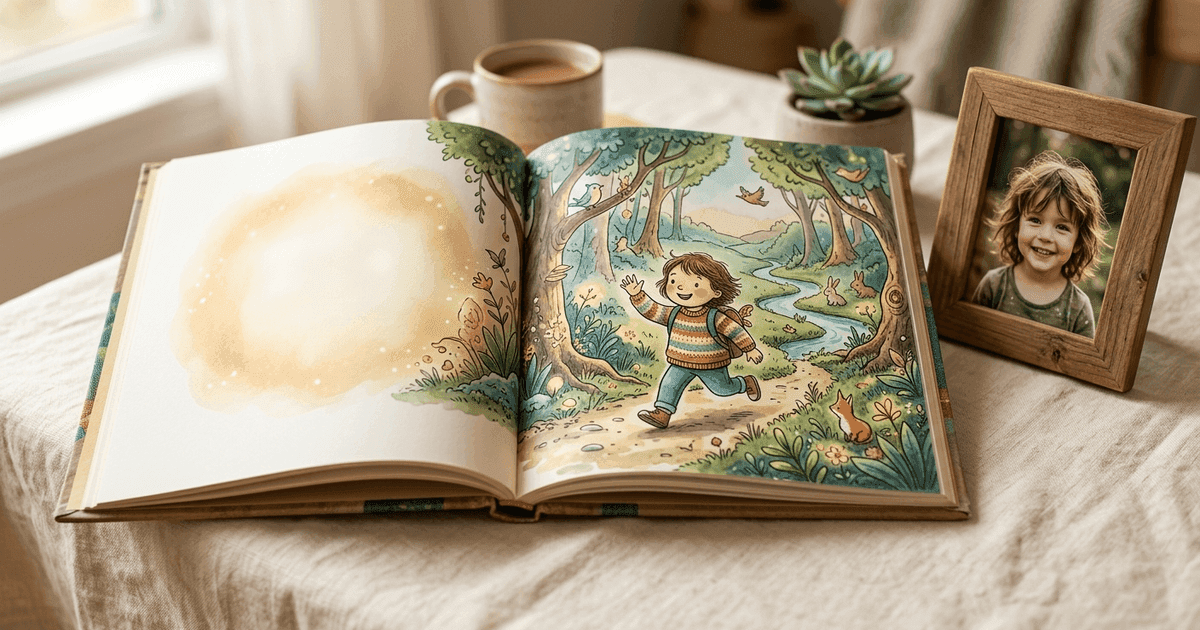
A personalized book is a children's book where your child is the actual character — by name, by face, or both. The 2026 definitive guide: how they work, what they cost, and how personalized books help children read more, engage longer, and connect with stories that feel like their own.
A personalized book is a children's book where your specific child is the protagonist — by name, by face, or both. The phrase is broad and now covers a wide range of products, from a classic name-only book where "Sophia" is dropped into a generic template, all the way up to AI-generated picture books where your child's actual photo appears in every illustration with consistent character likeness across 30 pages.
This guide explains what a personalized book actually is in 2026, how the four real product types compare, what they cost, and how to know which kind is right for your child. If you'd rather skip the theory, you can preview a fully photo-personalized book in under 5 minutes at magicalhekaya.com/create-story.
The simple definition
A personalized book is any children's book where the content is modified to feature your specific child — not a generic protagonist that the reader projects onto. The level of personalization varies, but the common thread is: when you read the book, the main character is your child, not someone like your child.
This is different from:
- A custom photo book — your real photos on pages, like a digital album. Documents the past.
- A scrapbook — collected mementos, photos, captions. Memory-keeping.
- A children's book with a dedication — a generic book with a personal inscription on page 1. Personal touch, but the story is still generic.
Personalized books are stories — illustrated, narrated, with a plot — where your child is the character living through the plot.
The four real types of personalized book
1. Name-only personalized book (classic)
The earliest mass-market personalization. Your child's name (and sometimes hair color, eye color, sibling name) is dropped into a pre-written, pre-illustrated story. The illustrations don't change; only the text fields do.
Examples: Wonderbly, Hooray Heroes, Put Me In The Story.
Price: $29.99–$44.99 (hardcover only).
Best for: parents who don't want to share a photo, classic illustrated style fans, gift-givers without access to a photo.
2. Photo-personalized print book (traditional)
Your child's real photo is integrated into hand-illustrated templates by the service. Personalization is real (your child's face is in the book), but production is manual — so prices are higher and delivery takes 5–14 days.
Examples: I See Me!, Pinhole Press, Mixbook (template-based).
Price: $24.99–$39.99 (hardcover).
Best for: keepsake gifts where you have time and want a premium print product.
3. AI photo-personalized book (modern, fastest-growing)
Your child's photo is fed to AI image generation that creates custom illustrations — your child's face appears in every scene, with consistent character likeness across all pages. The book is delivered digitally in minutes; print is an optional add-on.
Examples: Magical Hekaya, Childbook.ai, Lullaby.ink, MagicStory.
Price: $4.99–$7.99 digital; +$24.99 for hardcover.
Best for: birthday gifts, last-minute presents, deep emotional engagement, multilingual families.
4. DIY personalized book (you build it)
Tools that let you assemble your own book — drag in photos, write captions, choose templates. Closer to a photo book than a true narrative-driven personalized story, but valid for documenting a year, a vacation, or a milestone.
Examples: Shutterfly, Mixbook, Snapfish.
Price: $20–$50 depending on size and finish.
Best for: family albums, year-in-review keepsakes, parents who enjoy DIY design.
Which one is right for your child?
Quick filter:
- Want your child's actual face in the illustrations? Types 2 or 3 only.
- Need it the same day? Type 3 (digital AI) only — everyone else takes days.
- Under $20? Types 3 and 4 fit.
- Don't want to share a photo? Type 1 (name-only) is the classic option.
- Want to control every page yourself? Type 4 (DIY).
How does personalization actually work in 2026?
For AI photo-personalized books (the type with the steepest growth), the workflow looks like this:
- You upload one clear photo of your child.
- The service runs the photo through an AI image model (in 2026, the strongest is Gemini's Nano Banana Pro) that learns your child's facial features.
- The model generates each illustration for the chosen story, placing your child's likeness into the scene with consistent appearance across all pages.
- The story text is woven around your child's name and any other personalization fields you provided (sibling, pet, hometown).
- You preview the result and either approve it (download to read or print at home) or regenerate specific pages you want different.
The whole flow takes 3–5 minutes. The technical leap that made this possible — strong character consistency from a single photo — happened in late 2024; before that, AI generators couldn't reliably draw the same kid on page 5 and page 25.
Are personalized books actually worth it?
The honest answer: it depends on the type.
- Name-only books — modestly worth it. Children notice their name and engage a little more, but the illustrations are generic, so the engagement lift is small.
- Photo-personalized books (traditional or AI) — significantly worth it. Children identify with characters that look like them, and the book gets re-read at multiples of the rate of generic books. The cost per re-read often ends up well below a generic picture book.
- DIY photo books — worth it for memory-keeping, less so for storytelling.
We've gathered more on the engagement question in our do personalized books actually work deep-dive.
How personalized books help children read
The clearest benefit of a personalized book isn't the novelty — it's the reading engagement multiplier. When a child sees their own name and face on the page, three things happen at once that don't happen with a generic story:
- Self-recognition triggers participation. The child stops being a passive listener and starts treating the story as something happening to them. Reading-time-per-session roughly doubles in personalized vs. generic books in studies from the National Literacy Trust and similar early-literacy researchers.
- Re-read rate goes up 3–5×. Children pull personalized books off the shelf far more often than generic ones. And re-reading — not new books — is the single strongest predictor of vocabulary growth in pre-readers and early readers.
- Attention to detail rises. Children spot inconsistencies ("that's not my dog!"), point out what they like, and ask more questions about the illustrations. That conversation around the book is where most language development actually happens.
The benefits stack with personalization depth. Name-only books trigger some self-recognition. Photo-real books — where the illustrated character genuinely looks like the child — trigger the strongest "that's me!" moment and the longest engagement. For ages 2–4, this can be the difference between sitting through one page and sitting through the whole book.
Personalized books and reluctant readers
One of the strongest use cases. Reluctant readers usually resist generic books because the story "isn't about them." A personalized book where the protagonist is them removes that resistance entirely. Pediatric reading specialists often recommend a personalized book as a bridge title for a child stuck at the same easy-reader level — the combination of (a) the child cast as the hero and (b) slightly above-grade vocabulary tends to pull them up a reading level without feeling like work.
Are AI personalized children's books safe?
A common parent question in 2026. The answer depends on the platform — but reputable services follow a clear safety stack:
- Uploaded photos are processed for the book only and not used to train models.
- Generated illustrations pass through child-appropriateness filters before being shown.
- Story text is template-driven, not free-form generative — no risk of an AI producing unexpected content.
- Photos are deleted after the book is created (or on user request).
Before using any AI personalization service, check their photo-retention policy and content-generation method. Services that mix uploaded photos with on-the-fly AI text generation are higher risk than services using curated story templates with AI used only for illustration.
Bottom line
A personalized book is a children's story where your child is the actual character — and in 2026, the most engaging form is an AI photo-personalized book where their face appears in every illustration. The category sits at the intersection of toy, gift, and bedtime tool, and at $4.99 starting price for a digital edition it's now genuinely affordable. Make one in 5 minutes at magicalhekaya.com/create-story. For the deeper buyer comparison, see our where to make a personalized picture book guide.