
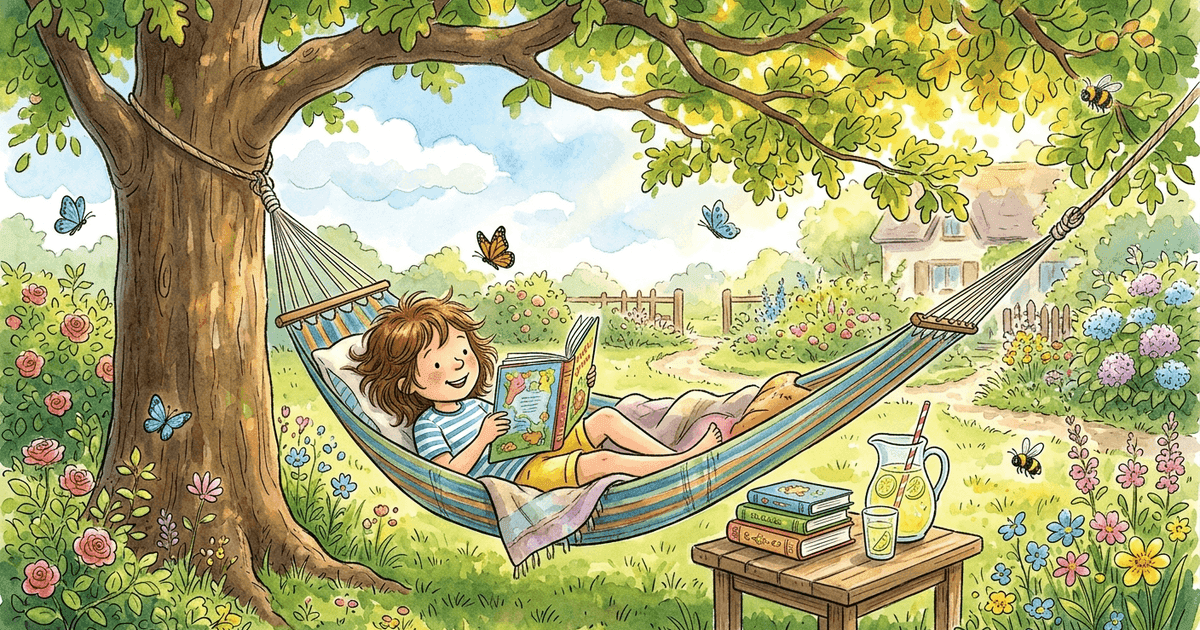
The summer slide is real — kids can lose months of reading progress over break. Here is how to build a summer reading routine they actually enjoy, including the secret weapon of personalized books.
Summer Is Coming — and So Is the Reading Slide
Every June, a quiet crisis begins in households across the country. The last day of school arrives, backpacks are emptied, and a long stretch of unstructured days opens up ahead. For many children, the books that were part of daily life during the school year gradually disappear — replaced by screens, outdoor play, camp activities, and the general beautiful chaos of summer.
This is not inherently a problem. Children need unstructured time, physical activity, and freedom from academic pressure. But the data on summer reading loss is stark and consistent: children who do not read during summer break can lose two or more months of reading progress. Over multiple summers, this loss compounds. By the time they reach middle school, the gap between summer readers and non-readers can be measured in years.
The solution is not turning summer into an extension of school. It is making reading feel like something a child wants to do — and that is where most parents feel stuck. How do you convince a child who associates books with homework to voluntarily read during their vacation?
Why Traditional Summer Reading Lists Often Fail
Libraries and schools publish summer reading lists every year with the best of intentions. And every year, a significant percentage of children ignore them entirely. The reason is not that the books are bad — many summer reading lists are thoughtfully curated with excellent titles. The problem is structural.
The Obligation Problem
When reading is presented as a list to complete — even without grades attached — it feels like an assignment. Children are remarkably skilled at detecting when something "optional" is actually expected, and their resistance is proportional to the perceived obligation. The moment summer reading feels like school, it loses its most important quality: voluntariness.
The Relevance Problem
Curated lists, by definition, are chosen by adults. Even well-intentioned lists reflect adult assumptions about what children should enjoy rather than what they actually want to read. A child who loves dragons will not be motivated by a list that does not include a single dragon book, no matter how age-appropriate or award-winning the selections are.
The Identity Problem
For children who do not yet see themselves as "readers," a summer reading list reinforces a category they feel excluded from. The child who struggled with reading during the school year sees a list of ten books and thinks "that is not for me." The list, meant to encourage, actually confirms their identity as a non-reader.
A Better Approach: The Personalized Summer Reading Challenge
Instead of a traditional reading list, consider building a personalized reading challenge that puts your child at the center — literally. Here is a framework that works:
Step 1: Start With a Personalized Book
Before summer officially begins, create a personalized storybook featuring your child as the hero. This serves two purposes. First, it gives them a book they are genuinely excited to read — because they are in it. Second, it sets the tone for summer reading as something fun and personal rather than obligatory and generic. When the first book on their summer reading journey stars them, the whole endeavor starts on the right foot.
Platforms like Magical Hekaya can generate a fully illustrated, personalized storybook in minutes. The child's face appears in every illustration, their name is woven into the narrative, and the story is designed for their age and reading level. It is not a gimmick — it is a genuine book that happens to feature someone the child cares about deeply: themselves.
Step 2: Let Them Choose 70 Percent of Their Books
Autonomy is the single most important factor in summer reading engagement. Let your child choose the majority of what they read. Comic books count. Graphic novels count. Books about Minecraft count. A book they have already read three times counts. The goal is volume and consistency, not prestige.
Your 30 percent — the books you suggest — should be based on their interests, not your literary aspirations. If they love animals, find animal books. If they love gross things, the "Disgusting Facts" genre exists for a reason. Meet them where they are, not where you wish they were.
Step 3: Build Reading Into the Rhythm of the Day
Do not leave reading as a floating intention that competes with every other summer activity. Anchor it to a specific time that makes sense for your family:
- After lunch — the natural low-energy period when active play pauses
- Before bed — the classic reading time that also supports sleep
- During car rides — perfect for audio versions of personalized books
- Quiet hour — many families institute a daily quiet hour where screens are off and reading is one of the approved activities
The specific time matters less than the consistency. When reading happens at the same time every day, it stops being a decision and becomes a habit.
Step 4: Make It Social
Reading does not have to be solitary. In fact, for many children, reading becomes more appealing when it has a social component:
- Family read-aloud — take turns reading chapters aloud after dinner
- Reading buddy — pair with a friend or cousin and read the same book, then discuss it
- Book show-and-tell — share favorite books with friends during playdates
- Personalized book sharing — show grandparents or relatives the personalized book featuring the child as the hero
Step 5: Track Progress Without Pressure
A simple visual tracker — a paper chain with one link per book, a bookshelf poster where they color in a book for each one finished, or a reading passport with stamps — provides a sense of accomplishment without grades or evaluations. The tracker celebrates volume, not difficulty. A picture book and a chapter book each get the same credit. The point is reading, not performing.
Age-by-Age Summer Reading Guide
Different ages need different approaches to summer reading. Here is a guide tailored to developmental stages:
Ages 3 to 5: Read-Aloud Adventurers
At this age, summer reading is almost entirely parent-driven, and that is perfectly appropriate. Aim for 15 to 20 minutes of read-aloud time daily. Include a mix of:
- Picture books with rich illustrations and rhythmic text
- A personalized book featuring the child (creates ownership and excitement)
- Books about summer themes — beach, garden, camping, ice cream
- Interactive books with flaps, textures, or pop-ups
- Repetitive books that invite the child to chime in with familiar phrases
Ages 5 to 7: Emerging Readers
This is the critical window for summer reading because these children are actively developing fluency. Losing momentum over summer can mean spending the first months of the next school year re-learning skills. Include:
- Early reader books at or slightly below their school reading level (confidence building)
- Picture books that they can enjoy without decoding pressure
- A personalized adventure book for motivation
- Books with audio companions for independent "reading" practice
- Nonfiction about topics they find fascinating
Ages 7 to 10: Independent Explorers
Independent readers need freedom more than structure. Let them drive their reading choices with gentle guidance:
- Chapter books and series (a good series can fuel an entire summer)
- Graphic novels — studies show they develop inference skills and visual literacy
- A personalized book that matches their reading level and interests
- Magazines or newspapers for short-form reading
- One "stretch" book that is slightly above their level, read together with a parent
The Personalized Book Advantage for Summer Reading
Personalized books serve a unique function in a summer reading plan that no other type of book can replicate. Here is why:
They Bridge the Motivation Gap
The hardest part of summer reading is getting started. A child who has been out of the reading habit for two weeks needs a hook — something compelling enough to break the inertia. A book where they are the illustrated hero provides that hook. They do not pick it up because they should. They pick it up because they want to see what happens to them next.
They Work for Reluctant Readers
Children who resisted reading during the school year will not magically embrace it during summer. But a personalized book changes the equation because the resistance is not about the act of reading — it is about the content not feeling relevant. When the content is literally about them, the relevance barrier disappears.
They Create Shareable Moments
Summer is social. A child who has a personalized book will show it to friends, cousins, and grandparents. This social sharing reinforces reading as a positive, pride-worthy activity rather than a solitary obligation. Each time the child shows someone their book, they are revisiting the text, practicing reading aloud, and building positive associations with books.
Building a Summer Reading Kit
Make the practical side of summer reading as easy as possible with a dedicated reading kit:
- A reading bag or basket — fill it with their chosen books, a personalized book, bookmarks, and a small reading log
- A cozy reading spot — designate a specific place for reading, whether it is a blanket under a tree, a hammock, a bean bag chair, or a fort made of cushions
- A reading light — if they read before bed, a clip-on book light makes it feel special
- A library card — if they do not have one, getting their own library card is a summer milestone in itself
- A device with their digital books — for families using personalized digital books, having a dedicated device (even an old phone) makes digital reading accessible without the distraction of other apps
What If Your Child Truly Resists Summer Reading?
Some children will resist reading no matter how well you set up the environment. If this is your situation, lower the bar dramatically:
- Start with just 5 minutes per day — even 5 minutes of reading prevents some summer loss
- Count listening to audiobooks or the audio narration in a personalized book as reading time
- Let them read anything — cereal boxes, road signs, video game instructions, comic strips
- Read aloud to them — being read to still builds vocabulary, comprehension, and positive associations
- Never punish them for not reading — punishment creates negative associations that make the problem worse
The goal of summer reading is not literary excellence. It is maintaining the neural pathways that support reading fluency and building positive emotional associations with books. Any reading — even five minutes, even "easy" books, even personalized books they have already read ten times — serves that goal.
Making This Summer Different
The summer slide is real, but it is not inevitable. Children who read regularly during summer break not only maintain their skills — they often return to school ahead of where they left off. The key is removing friction, providing motivation, and making reading feel like a choice rather than a chore.
Start with a personalized book that puts your child at the center of an adventure. Build a reading routine that fits your family's summer rhythm. Let your child lead their reading choices. And remember that every page turned — whether it is a picture book, a graphic novel, a chapter book, or a personalized storybook — is a page in the right direction.