
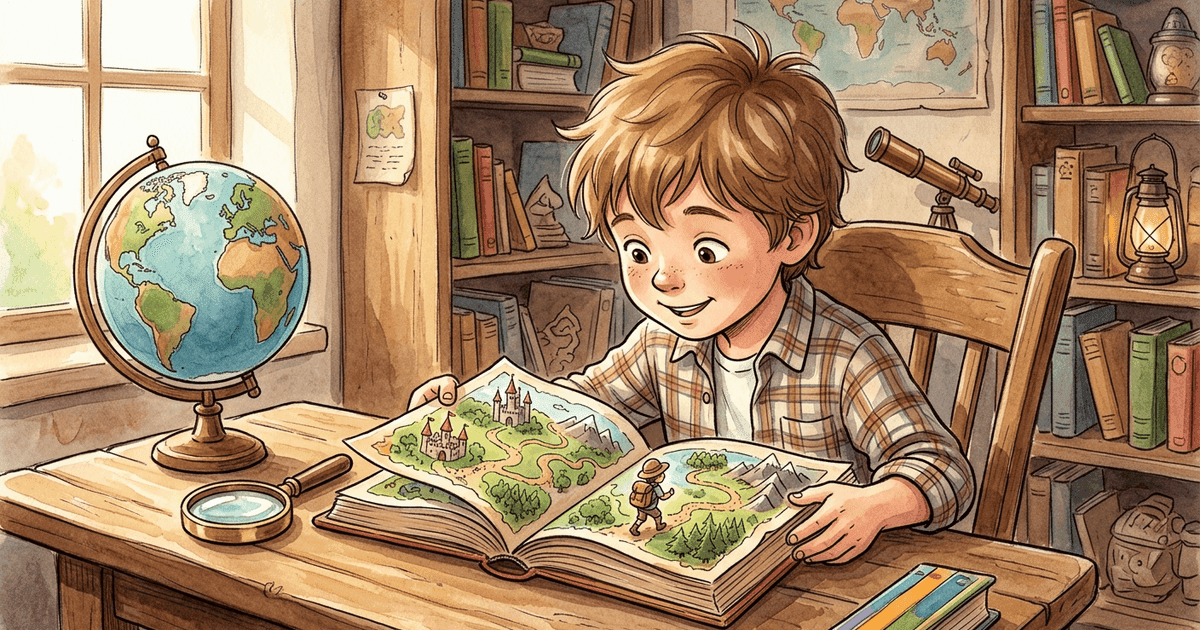
At seven, kids are reading on their own — and personalized books need to rise to the occasion. Longer stories, real adventures, and characters that look like them keep independent readers engaged.
Seven Is a Turning Point — And Their Books Need to Keep Up
Something significant happens around age seven. The child who sat on your lap and listened to picture books is now sitting cross-legged on their bed, turning pages on their own. They are sounding out unfamiliar words, following multi-chapter plots, and forming opinions about what makes a story good or boring. Seven is the age when reading shifts from something that is done to a child to something the child does for themselves.
This transition is exciting, but it also creates a challenge for gift-givers. The personalized books that delighted them at three or four — simple sentences, bright primary colors, plots that amounted to "you are special" — no longer match who they are. A 7-year-old handed a book designed for a preschooler will sense the mismatch immediately. They might politely flip through it, but it will not become the book they choose to read again.
The right personalized book for a 7-year-old respects their growing intelligence while leveraging the one thing that makes personalized books uniquely powerful at any age: the thrill of seeing yourself as the hero.
What Makes Seven Different: The Developmental Sweet Spot
Understanding what is happening developmentally at age seven explains why the right personalized book can have such a profound impact on reading habits.
Reading Fluency Is Emerging
Most 7-year-olds are transitioning from "learning to read" to "reading to learn." They have mastered basic phonics and sight words, and they are beginning to read with enough fluency that the story — not the mechanics of decoding — becomes the point. This is the moment when a child either falls in love with reading or begins to see it as a chore. The books they encounter during this window matter enormously.
Identity Formation Is Accelerating
At seven, children are increasingly aware of who they are as individuals. They compare themselves to peers, identify their strengths and weaknesses, and build narratives about the kind of person they are. A personalized book that shows them as brave, clever, or kind does not just entertain — it contributes to their developing self-concept. Research in developmental psychology shows that the stories children engage with during this period actively shape how they see themselves.
They Crave Real Stories, Not Just Affirmation
A 4-year-old is satisfied by a story that says "you are wonderful." A 7-year-old needs to see why the character is wonderful — through actions, choices, and challenges overcome. They want plot. They want obstacles. They want the character (themselves) to earn the outcome, not just receive it. This is a critical distinction that separates good personalized books for this age from mediocre ones.
What to Look for in a Personalized Book for a 7-Year-Old
Not all personalized books are created equal, and the gap between the best and worst options is especially wide at this age. Here are the features that matter most:
Story Complexity That Matches Their Mind
The story should have a genuine narrative arc — a problem to solve, obstacles to overcome, and a satisfying resolution that the character earns through effort or cleverness. Multiple scenes, dialogue between characters, and at least one moment of real tension or decision-making are essential. A story where nothing goes wrong and the child simply walks through a series of pleasant scenes will feel flat to a 7-year-old.
Vocabulary That Stretches Without Frustrating
The text should include words that a 7-year-old might not know but can figure out from context. Words like "determined," "mysterious," "ancient," or "courageous" are exactly right for this age — challenging enough to build vocabulary, familiar enough in context to be decoded without help. Avoid both baby-simple language and artificially complex prose.
Illustrations That Look Like Them — Really Like Them
This is where modern AI-powered personalized books have transformed the market. Traditional personalized books used generic cartoon avatars or awkwardly pasted photos. Today, platforms like Magical Hekaya use a single uploaded photo to generate illustrations where the child character genuinely resembles the real child — their features, their expression, integrated naturally into richly illustrated scenes. For a 7-year-old, who is acutely aware of how they look and how they are represented, this authenticity is the difference between a book that feels real and one that feels fake.
Themes That Resonate at Seven
The best themes for this age include:
- Mystery and detective stories — 7-year-olds love solving puzzles and feeling clever
- Adventure quests — journeys through magical or challenging landscapes with real stakes
- Science and discovery — exploring space, the ocean, or the natural world
- Friendship challenges — navigating social situations and learning about loyalty
- Overcoming fears — facing something scary and discovering inner courage
The Reading Motivation Factor
Here is a truth that every reading specialist knows but few parents hear: the single biggest predictor of reading improvement is not the quality of instruction or the reading level of the material. It is motivation. A child who wants to read will read more, and a child who reads more will get better at reading. The cycle is that simple and that powerful.
Personalized books are motivation machines. When a 7-year-old opens a book and sees their own face on the cover, their own name in the first sentence, and their own likeness illustrated into an adventure — they want to keep reading. Not because someone told them to, not because it is assigned homework, but because the story is about them. This intrinsic motivation is worth more than any reading program or incentive chart.
Studies on personalized learning materials consistently show that children spend more time engaging with content that features their own name and image. For 7-year-olds who are at the critical juncture between enthusiastic readers and reluctant ones, this boost in engagement can make a meaningful difference in their reading trajectory.
Digital vs. Print: What Works Best at Seven
Seven-year-olds are capable of engaging with both digital and print formats, and each has advantages at this age.
Digital Books
Digital personalized books offer audio narration, which serves a valuable function even for independent readers. A 7-year-old can follow along with the narration, hearing correct pronunciation of unfamiliar words while reading them on the page. This simultaneous input — seeing and hearing words together — accelerates fluency development. Digital books are also instantly deliverable, easily shareable with grandparents and family, and can be accessed on any device.
Printed Books
A printed personalized book at age seven has particular social value. Children this age show books to friends, bring them for show-and-tell, and display them on their shelf as identity markers. A printed book that features them as the hero becomes a point of pride — a physical object that says "I am the kind of person who goes on adventures." The tactile experience of turning pages also supports deeper comprehension, as research on reading medium consistently shows.
The Best Approach
Many parents find the optimal combination is a digital book with audio narration for everyday reading and before-bed listening, plus the high-resolution, print-ready PDF you can print at home for the shelf. The digital version gets daily use; the printed-at-home copy becomes the keepsake.
How Personalized Books for 7-Year-Olds Have Evolved
The personalized book industry has changed dramatically in just the past few years, and the changes are especially meaningful for the 7-year-old age group.
Five years ago, personalized books for this age were essentially the same books designed for 3-year-olds with slightly longer sentences. The personalization was limited to inserting a name into a pre-written template, and the illustrations were generic cartoon characters with the child's hair color selected from a dropdown menu. The result felt impersonal despite being called "personalized."
Today, AI-powered platforms can generate fully original stories tailored to a child's age, interests, and reading level. The illustrations are created using the child's actual photo, producing artwork where the character genuinely looks like the child. Audio narration uses the child's name naturally within the spoken text. The entire experience feels like a real published book that happens to star your child — not a fill-in-the-blank template.
This evolution matters most for 7-year-olds because they are old enough to detect and reject inauthenticity. A toddler does not care if the cartoon character looks nothing like them. A 7-year-old does. The bar is higher, and modern personalized books finally clear it.
Gift-Giving Guide: When a Personalized Book Is the Perfect Choice
A personalized book makes an excellent gift for a 7-year-old in several specific situations:
- Birthday gift — stands out from the pile of toys and games because it is uniquely theirs
- Back-to-school encouragement — a story about a child who conquers new challenges builds confidence for the school year
- Reading milestone celebration — reward the child who just started reading independently with a book that makes independent reading irresistible
- Grandparent gift — grandparents who do not know what kids are "into" these days cannot go wrong with a personalized book
- Holiday gift — a Christmas or Eid book featuring the child as the hero creates a lasting keepsake
- Just because — sometimes the best gift is the one that arrives on an ordinary Tuesday
What Parents Say About Personalized Books for This Age
The most consistent feedback from parents of 7-year-olds who receive personalized books falls into three themes:
Surprise at the re-reading rate. Parents expect the book to be read once and shelved. Instead, they find their 7-year-old returning to it repeatedly — reading it to younger siblings, reading it before bed, packing it in their bag for car rides. The personalization creates an attachment that generic books rarely achieve at this age.
Impact on reading confidence. For children who are still building fluency, reading a book where they are the main character removes the performance anxiety that often accompanies independent reading. The child is not struggling through someone else's story — they are reading their story, which changes the emotional stakes entirely.
Conversation starter about identity. Several parents note that personalized books spark conversations about character traits. "Would you really be brave enough to enter that cave?" "What would you do if you found that treasure?" These discussions, prompted by the personalized narrative, contribute to the child's developing sense of self in ways that standard fiction does not.
Making the Choice: What Matters Most
When selecting a personalized book for a 7-year-old, prioritize these factors in order:
- Story quality — the narrative should be genuinely engaging, not just a vehicle for the child's name
- Illustration authenticity — the character should actually look like the child, not a generic avatar
- Age-appropriate complexity — the reading level and themes should match a 7-year-old's capabilities and interests
- Format options — having both digital (with audio) and print available gives you flexibility
- Speed of delivery — especially for gifts, instant digital delivery is a major advantage
The right personalized book does not just give a 7-year-old something to read. It gives them a reason to read — and at this pivotal age, that reason can shape their relationship with books for years to come.