
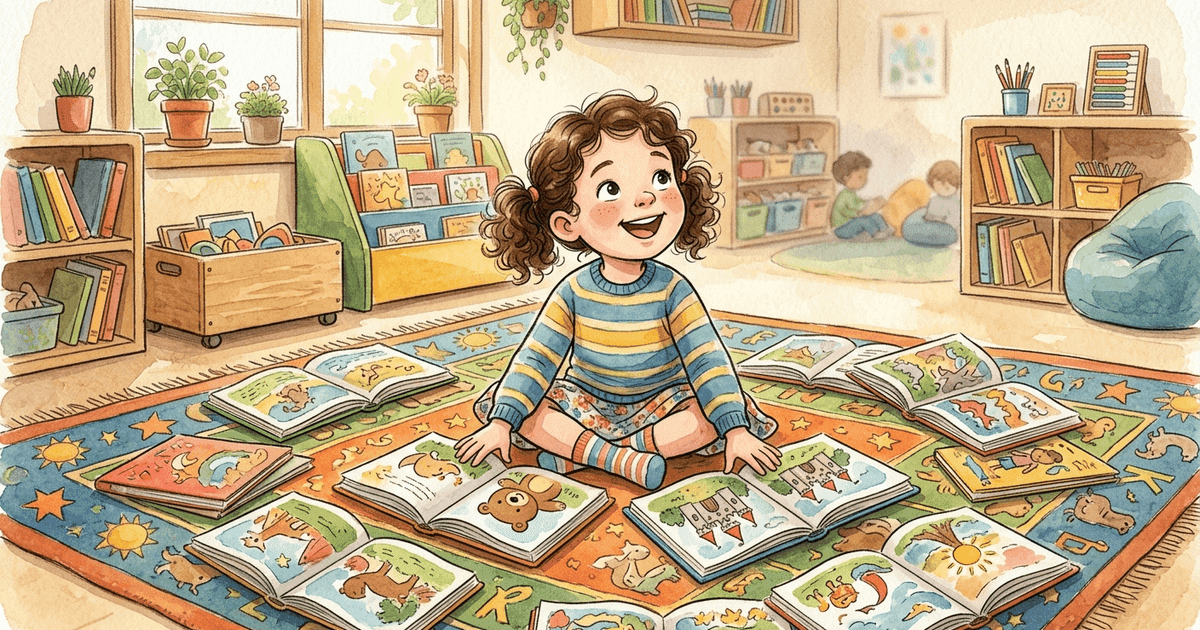
The 25 best books for kindergarten-age kids in 2026 — tested against real 5- and 6-year-olds. Picture books, early readers, and kindergarten stories to read aloud that actually survive the rotation.
Kindergarten Is When Books Become Their Books
Something shifts in kindergarten. The toddler who liked Llama Llama Red Pajama becomes a five-year-old who has opinions about books — who will ask for specific titles by name, who will reject a book they're bored of, who will laugh on cue at a page they've memorised. This is the age when reading stops being something done to a child and starts being something they own.
The books that fill this moment matter. Below: 25 picks, organised by type, chosen specifically for the kindergarten sweet spot — age 5–6, attention span 15–25 minutes, reading level emerging but not yet independent for longer texts.
8 Kindergarten Stories to Read Aloud (Picture Books)
These are read-aloud picks — books where the experience is the adult reading to the child, not the child decoding independently. The vocabulary and emotional complexity are above independent reading level, which is exactly where read-aloud material should sit.
- Last Stop on Market Street — Matt de la Peña. Newbery-winner. Urban, gentle, genuinely moving.
- Julián Is a Mermaid — Jessica Love. Identity, grandmother love, brave self-expression.
- Jabari Jumps — Gaia Cornwall. The scary-thing book every kindergartener should hear.
- The Day You Begin — Jacqueline Woodson. For the child who feels different; powerful first week of school.
- Ada Twist, Scientist — Andrea Beaty. Curiosity as superpower.
- The Rabbit Listened — Cori Doerrfeld. On grief, being listened to, emotional intelligence.
- A Sick Day for Amos McGee — Philip C. Stead. Caldecott-winning, gentle, perfect wind-down.
- Where the Wild Things Are — Maurice Sendak. Still unmatched at kindergarten age.
6 Funny Books Kindergarteners Demand Over and Over
Humour is the biggest predictor of re-read demand at this age. These are the books kindergarteners will quote back, act out, and request at bedtime for months.
- Don't Let the Pigeon Drive the Bus! — Mo Willems. Peak kindergarten humour. The whole Pigeon series is worth owning.
- Dragons Love Tacos — Adam Rubin. Absurdist. Funny on read one, funnier on read twenty.
- The Book with No Pictures — B.J. Novak. No pictures, all silliness. Kindergarteners howl.
- Interrupting Chicken — David Ezra Stein. A meta picture book for kids who interrupt picture books.
- The Day the Crayons Quit — Drew Daywalt / Oliver Jeffers. Clever, funny, read-aloud-friendly.
- Giraffes Can't Dance — Giles Andreae. Rhyming, heart-warming, perfect for the "feeling different" years.
6 Early Readers for the Child Learning to Read
Early readers are specifically designed for kindergarteners decoding on their own — controlled vocabulary, short sentences, repetition, illustration-heavy. These are independent-reading books, not read alouds.
- Elephant & Piggie series — Mo Willems. The gold standard early reader. Dialogue-driven, hilarious, accessible.
- Pete the Cat (I Can Read! series) — James Dean. Repetition, rhyme, cheerful. Kindergarten classic.
- Fly Guy series — Tedd Arnold. Short, funny chapters. For kindergarteners ready for a real book.
- Biscuit series — Alyssa Satin Capucilli. Beginning reader, warm, dog-centric.
- Henry and Mudge series — Cynthia Rylant. Gentle, a boy and his dog. Great first-chapter-book bridge.
- Mercy Watson series — Kate DiCamillo. A pig who loves toast. Early chapter book for the more confident end of kindergarten.
3 Books Specifically for the Kindergarten Transition
The transition into kindergarten is a big one — separation, new routines, new peers, new expectations. These three books are specifically about that moment.
- The Kissing Hand — Audrey Penn. A raccoon's mother leaves a kiss on his paw to keep with him at school. For separation anxiety.
- First Day Jitters — Julie Danneberg. A twist ending makes this resonate for both kids and adults.
- Wemberly Worried — Kevin Henkes. For the child who worries — gently addressed, no toxic positivity.
2 Worth-Reading 2026 Releases
- Every Monday Mabel — Jashar Awan. The magic of ordinary best-day-of-the-week.
- Downpour: Splish! Splash! Ker-splash! — Yuko Ohnari. Sensory, rainy, visually joyous.
7 More Kindergarten Books That Earned a Spot on Our List
The 25 above are the core. These seven rounded out the shortlist — any of them could swap into the core if your specific kindergartener responds to them. Worth having in rotation:
- The Snowy Day — Ezra Jack Keats. A Caldecott winner from 1962 that's still one of the most beautiful quiet books ever made. Perfect for kindergarten snow days.
- Corduroy — Don Freeman. A teddy bear searches for his missing button in a department store. Warm, patient, iconic.
- Knuffle Bunny — Mo Willems. Trixie loses her bunny at the laundromat. Handles toddler-transition-to-kindergarten emotions perfectly.
- The Princess in Black — Shannon Hale. Early chapter-book series with a princess/superhero twist. Strong for late-kindergarten readers.
- Each Kindness — Jacqueline Woodson. Quiet, serious, essential. Handle with care for the emotionally ready child.
- The Word Collector — Peter H. Reynolds. A boy collects words. Supports early reader vocabulary development with heart.
- We Are Water Protectors — Carole Lindstrom. Caldecott winner. Environmental themes handled with poetry for the 5–6 range.
Kindergarten Reading Levels: Don't Stress the Number
By spring of kindergarten, most classrooms assess reading level using one of several systems — Fountas & Pinnell levels, Lexile measures, DRA, or "guided reading levels" — and parents often get a number like "ending kindergarten at level C/4/DRA-4/100L." This is useful to teachers; it should be nearly invisible to parents.
Reading level charts exist on a spectrum. A kindergartener at level A is reading single-sentence picture books with heavy picture support. A kindergartener at level E or F is reading short early-chapter books independently. Both are fine. Both are normal. Kindergarten is where the spread between kids is largest, and by grade 2, most kids converge.
What parents should actually focus on:
- Daily exposure — read aloud and listen to them read, every day, without fail.
- Choice — let them pick their independent reading books even if the choice seems "too easy" or "too hard." Autonomy matters.
- Comfort with mistakes — decoding errors are data, not failures. If they misread "the" as "that," gently correct and move on.
- Comprehension over speed — a slow reader who understands beats a fast reader who doesn't. Ask "what happened?" more than "how fast can you read?"
Kindergarten Pacing: How to Build a Reading Week That Actually Works
The most sustainable kindergarten reading routines look like this across a week:
- Monday–Thursday evening (15–20 min): Parent-read picture book. Above their independent level — stretch vocabulary.
- Monday–Thursday evening (10–15 min): Child-read early reader. At their actual level — build confidence.
- Friday: Variety night. A longer chapter-book read aloud split over multiple Fridays. Or audio book + drawing.
- Saturday morning: Library visit or bookstore browse. Let them pick three books for the week.
- Sunday: A personalised book, a graphic novel, or a favourite re-read. Low-pressure reading for pleasure.
Total weekly reading exposure: ~150–200 minutes. That's less than half the screen time of an average American 5-year-old. It's achievable.
Personalised Books for Kindergarten Life Events
The list above covers literary quality. But kindergarten is also a year of big personal events, and those events often land harder for a child when the story is specifically about them.
Three moments where a personalised book works better than a classic:
- The first day of school — A personalised story where your child walks into kindergarten and has a brave adventure (illustrated with your child's actual face) lands differently than reading The Kissing Hand. Many parents use both. Our first day of school personalised storybook is built for this.
- A new sibling arriving mid-year — Picture books about new babies exist; a book where the illustrated big brother or sister is your actual child is a different emotional category. See our personalised big-brother book guide.
- A specific fear or worry — Fear of the dark, a specific anxiety, a loss — a personalised story where your child faces and resolves that specific thing works as a gentle form of bibliotherapy. Our fear of the dark landing explains the approach.
How a Good Kindergarten Reading Routine Looks
A strong kindergarten reading routine in 2026 has three parts:
- Daily read aloud (15–25 minutes) — you read, they listen. Books above their independent reading level. This builds vocabulary, listening comprehension, and story love.
- Daily independent reading (10–15 minutes) — they read early-reader books to you, themselves, or a sibling. Short, successful sessions build confidence.
- Weekly novelty — a library visit, a new personalised book, a bookstore pick. Variety keeps momentum.
Consistency beats ambition. Fifteen minutes every night is better than two hours once a week. The kindergarten year sets reading habits that last through elementary school — it's the highest-leverage reading year you'll ever invest in.
The Short Version
Buy: Last Stop on Market Street. Jabari Jumps. Julián Is a Mermaid. Don't Let the Pigeon Drive the Bus. The Day the Crayons Quit. Elephant & Piggie (any five of them). The Kissing Hand. Where the Wild Things Are. Giraffes Can't Dance. Ada Twist, Scientist.
Add one personalised book for any big life event happening this year. Read aloud every night, even if they're reading on their own by spring. The kindergarten year is unusually short and unusually formative — the books that fill it become the books they'll remember for life.