
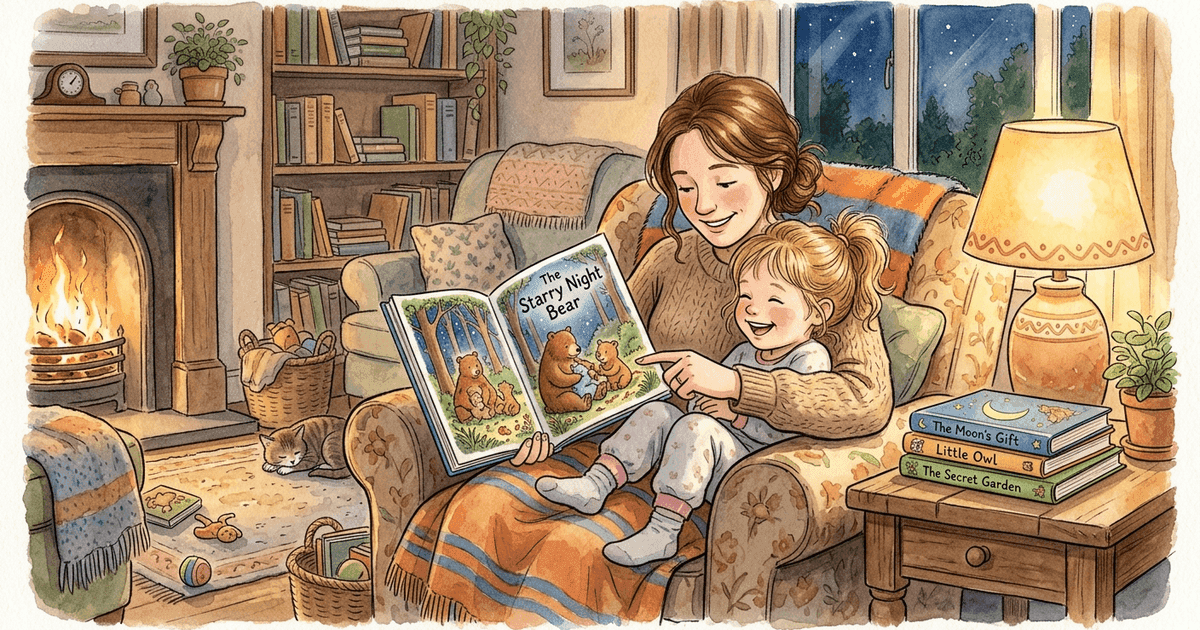
The complete guide to children's read alouds — 50 tested picks, read-aloud technique tips, age-by-age recommendations, and why reading out loud is the single highest-ROI thing you can do for your child's vocabulary and confidence.
The Single Highest-ROI Thing You Can Do for Your Child's Brain
There's a specific piece of parenting advice that, if you actually follow it, moves every measurable outcome — vocabulary, reading comprehension, attention span, emotional regulation, even academic performance a decade later. It's unbelievably simple, it costs nothing, and most parents already know about it: read aloud to your child, every day, for as long as they'll let you.
Children's read alouds are not a nice-to-have. Studies from the National Literacy Trust, the American Academy of Pediatrics, and decades of longitudinal research from Yale and Ohio State show that children who are read aloud to daily hear approximately 1.4 million more words by kindergarten than children who aren't. By fifth grade, the gap between a daily-read-aloud child and a rarely-read-aloud child is roughly four years of reading level. Four years. From something you can do in 15 minutes before bed.
This guide has two halves. The first half is the list — 50 tested read alouds, organised by age, with notes on why each one works. The second half is the craft: how to actually read aloud well, the traps to avoid, and how to turn read alouds into a ritual your child will cling to.
Part One: 50 Best Children's Read Alouds, By Age
Every book below has been tested against three criteria: does it hold attention, does it reward a second reading, and does it survive the "read it again" demand without driving the parent insane. Books that fail the third criterion — no matter how beloved — are not on this list. (Goodnight Moon, we respect you, but fifty-seven nights in a row will break a grown adult.)
Ages 0–2: First Read Alouds
The goal at this age isn't comprehension — it's rhythm, rhyme, and the feeling of a book as a comforting object.
- Brown Bear, Brown Bear, What Do You See? — Eric Carle / Bill Martin Jr. The rhythm drills into a baby's brain and will still be quoted at age 8.
- Where's Spot? — Eric Hill. The original lift-the-flap. Toddlers lift every flap every time.
- The Very Hungry Caterpillar — Eric Carle. The holes in the pages are a sensory hook; the days-of-the-week structure is a sneaky literacy win.
- Dear Zoo — Rod Campbell. Flaps. Animals. Parent-friendly brevity.
- Peek-a-Who? — Nina Laden. Perfect for a 12-month-old's attention span.
- Sheep in a Jeep — Nancy Shaw. Rhyming chaos. Read it fast; the pace matters.
- Ten, Nine, Eight — Molly Bang. A gentle bedtime countdown that's become a quiet-classic for two-year-olds.
- Pat the Bunny — Dorothy Kunhardt. The interactive touch pages survive a century of babies.
- First 100 Words — Roger Priddy. Not a narrative, but the vocabulary exposure is massive and kids will name every object.
- Goodnight Goon — Michael Rex. The Goodnight Moon parody that won't drive you insane on night fifty.
Ages 3–4: Preschool Read Alouds
Now the plot matters. These books reward repeat readings with jokes parents only notice on the fifth time through.
- The Gruffalo — Julia Donaldson. Arguably the best children's read aloud of the last 30 years. Rhythm, plot, clever twist.
- We're Going on a Bear Hunt — Michael Rosen. The call-and-response rhythm is designed for reading out loud. Do the voices.
- Don't Let the Pigeon Drive the Bus! — Mo Willems. Four-year-olds physically cannot resist yelling "NO!" at the pigeon.
- The Day the Crayons Quit — Drew Daywalt / Oliver Jeffers. Letters from crayons. Funny, clever, has real emotional range.
- Room on the Broom — Julia Donaldson. Same rhythmic magic as The Gruffalo.
- Dragons Love Tacos — Adam Rubin. Absurdist humour preschoolers memorise.
- Not a Box — Antoinette Portis. The simplest story in the world, and the most imagination-expanding.
- Press Here — Hervé Tullet. The interactive book that looks like an app but requires no battery.
- Llama Llama Red Pajama — Anna Dewdney. Rhyming bedtime anxiety that every preschooler relates to.
- The Book with No Pictures — B.J. Novak. No pictures, all words — and preschoolers howl laughing.
- Interrupting Chicken — David Ezra Stein. A meta read-aloud about a chicken who interrupts read alouds. Perfect for kids who interrupt read alouds.
- Hug — Jez Alborough. One word ("Hug") told entirely through illustration. Emotional range exceeds the vocabulary.
Ages 5–6: Kindergarten Read Alouds
Kindergarten read alouds are where children transition from listeners to participants. The best picks here have genuine story structure with emotional complexity kids this age are ready for.
- Last Stop on Market Street — Matt de la Peña. Newbery-winning picture book. Gentle moral, beautiful writing.
- Julián Is a Mermaid — Jessica Love. Identity, grandmother love, brave self-expression. Visually stunning.
- Jabari Jumps — Gaia Cornwall. The classic "doing the scary thing" story, done perfectly.
- Stick and Stone — Beth Ferry. Friendship, bullying, resilience — handled with grace.
- The Paperbag Princess — Robert Munsch. A subversive classic that five-year-olds adore.
- Where the Wild Things Are — Maurice Sendak. Still unmatched. Read it at the right age and it becomes a core memory.
- Alexander and the Terrible, Horrible, No Good, Very Bad Day — Judith Viorst. Validates bad-day feelings.
- The Invisible String — Patrice Karst. For separation anxiety, bedtime fears, and goodbye days.
- Each Kindness — Jacqueline Woodson. Emotional, complex, memorable — handle with care.
- A Sick Day for Amos McGee — Philip C. Stead. Gentle, kind, slow — perfect for winding down.
- The Pout-Pout Fish — Deborah Diesen. Rhyming emotional-regulation story.
- Bear Snores On — Karma Wilson. Rhythmic, repetitive, cosy.
- Ada Twist, Scientist — Andrea Beaty. Curiosity as superpower.
Ages 7–10: Elementary Read Alouds
Stories for elementary students can stretch into early chapter books read across multiple nights. The read-aloud ritual does NOT end when the child learns to read — some of the most important years are 7–10, when they can handle complex narrative but still love hearing it.
- Charlotte's Web — E.B. White. The first great chapter-book read aloud. Read it slowly — one chapter a night.
- The Tale of Despereaux — Kate DiCamillo. Beautiful language that rewards reading aloud.
- The BFG — Roald Dahl. Made for read-aloud voices.
- James and the Giant Peach — Roald Dahl. Same energy.
- The Lion, the Witch and the Wardrobe — C.S. Lewis. Chapter-length adventure, still works in 2026.
- Wonder — R.J. Palacio. A novel that every 9-year-old should hear out loud.
- Because of Winn-Dixie — Kate DiCamillo. Southern voice, warm and gentle.
- The Wild Robot — Peter Brown. Modern classic; read it before the movie.
- Matilda — Roald Dahl. Irresistible out loud.
- Sarah, Plain and Tall — Patricia MacLachlan. Short chapters, big emotional weight.
- A Wolf Called Wander — Rosanne Parry. Nature-adventure for 8–10.
- The Miraculous Journey of Edward Tulane — Kate DiCamillo. Read the last chapter out loud even if you cry.
- Pax — Sara Pennypacker. Beautiful, slow, emotionally sophisticated.
- The Vanderbeekers of 141st Street — Karina Yan Glaser. Family-adventure series with satisfying arcs.
- Roll of Thunder, Hear My Cry — Mildred D. Taylor. For the oldest end of the range; historical, serious, essential.
Part Two: How to Actually Read Aloud Well
Knowing what to read is half the battle. Knowing how to read it aloud is the other half — and most parents wing this without realising how much of a difference deliberate technique makes.
Slow Down. Then Slow Down More.
The single most common mistake parents make when reading aloud is reading too fast. In your head, your internal pace is adult-normal. Out loud, to a child, the right pace is about 60–70% of that — deliberately unhurried, with long pauses at page turns. Children's brains are processing both the words and the illustrations. Give them time. A page should breathe for 2–3 seconds after the last word before you turn it.
Let Them Interrupt
When your child asks a question, stops the book, points at an illustration and wants to talk about the dog — that is the read aloud working. This is called dialogic reading, and it's the single biggest predictor of vocabulary growth and reading comprehension. Answer the question. Ask them a question back ("what do you think the dog is feeling?"). Let the book stop for a minute.
Finishing the book is not the goal. Finishing the book on a schedule is definitely not the goal. Two pages with rich conversation beats twenty pages read silently past a distracted child.
Do Voices, But Don't Over-Perform
A slightly different tone for a different character is enough. You don't need to be a voice actor. Most parents resist doing voices because they're self-conscious — don't be. The only audience that matters is four years old, and they have no standards to compare you against. A low rumble for the bear, a high squeak for the mouse, and a normal voice for the narrator. That's all it takes.
Read Books That Bore You
Your child will have a favourite book. You will read it seventy-four times. You will hate it by read nineteen. You will read it the seventy-fifth time anyway. The repetition is the whole point — it's how the brain learns predictability, rhythm, and narrative structure. This phase passes faster than you think. Years later you'll quote that book back to them and they'll laugh.
Make the Ritual Protected
The families who stick with daily read alouds have one thing in common: the read aloud has a fixed time — usually right before bed, sometimes right after school — and it's protected. No phones. No TV in the background. No "just finish your broccoli first." The read aloud is the reward and the moment, not the thing squeezed in when nothing else is happening.
Bring in Read-Aloud Technology Thoughtfully
Audio books, narrated digital storybooks, and AI-generated personalised books all have real value — but they're supplements, not replacements. A narrated audio book in the car on a long drive is great. A parent reading aloud for 15 minutes before bed is different, because the read aloud is a shared-attention event. Your child is watching your face, following your finger on the page, feeling close to you. No app replaces that.
Where the tech shines: filling gaps. Travelling parents, sick days, bedtime when the parent is overseas. A personalised audio bedtime story narrated in a warm voice, featuring your child as the illustrated hero, is not a replacement for you — but it's a beautiful bridge for the nights you can't be there.
Making Your Child the Hero of the Read Aloud
One emerging shift in children's read alouds in the last few years: personalisation. Instead of your child listening to a story about a generic protagonist, the protagonist is them — illustrated from their actual photo, named after them, doing the adventure the parent picks. The effect on a 3–6 year old is dramatic. Kids who half-listen to generic books sit rapt when they recognise themselves on the page.
This doesn't replace the classics (nothing replaces Gruffalo). But for nights when you want something new, something specific to a life event (new sibling, moving house, first day of school, fear of the dark), a personalised read aloud is the category of book that holds attention the longest. Our storybook maker and AI bedtime story generator are built around this idea — illustrated, narrated, personalised read alouds ready in under 5 minutes.
The Long Game
Ten years from now, when your child is fifteen and reading their own novels in their own room, you will miss the read-aloud years. You will miss the small body curled on your lap, the sticky hands turning pages, the voice asking "again?" for the fourth time. The part of parenting that is physically close, emotionally available, and grounded in a shared story doesn't last forever — and it is replaced by other beautiful things, but nothing exactly like it.
So: tonight, pick a book. Sit down. Slow down. Let them interrupt. Do the voices. Read the same book again if they ask. The research on vocabulary and reading level is real and it matters — but the real reason to read aloud is that you only get a few thousand of these nights, and they go faster than anyone warns you.
Fifty books on a list is a lot. Pick one tonight. Start there.