
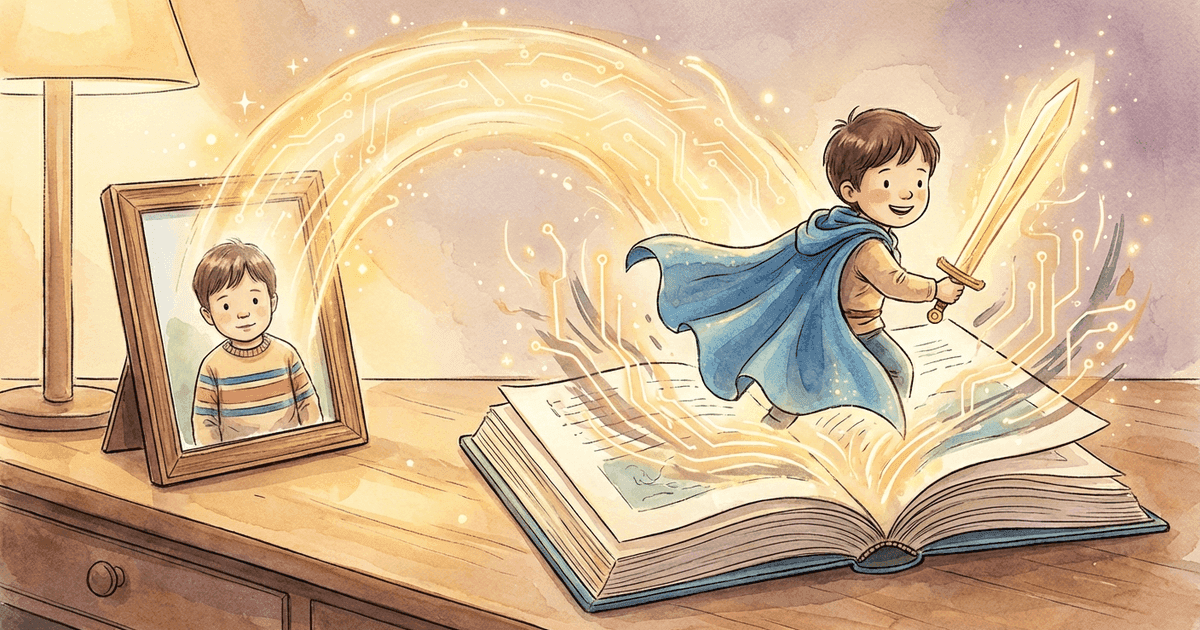
Parents searching for an AI book where their child is the hero are looking for something specific and genuinely new. This article explains exactly how it works, what to look for, and why these books are becoming the most-given personalized gift of 2026.
What Parents Are Actually Looking For
When a parent searches for "AI book where my child is the hero," they're not looking for a general explainer about artificial intelligence. They've heard about something — from a friend, on social media, in a parenting group — and they want to understand exactly what it is and whether it's real. They want to know: can you actually upload a photo of my child and get back a story where the character looks like my kid?
The answer is yes. That technology exists. It's been available for a few years, but 2025 and 2026 represent a significant leap in quality — the AI illustrations are now accurate enough that children recognize themselves instantly, and the stories are coherent and age-appropriate enough to be read repeatedly without feeling artificial.
This article explains exactly what an AI book where the child is the hero is, how the technology works, why children respond to it the way they do, and how to choose the right service for your family.
What an AI Storybook Actually Is
The term "personalized children's book" covers a wide spectrum. At one end, there are books that simply replace a generic name with your child's name in a pre-written story with pre-drawn illustrations. These have been available since the 1980s and are widespread — "personalized" in name only.
At the other end — and this is where AI photo books sit — the child's actual photo is fed into a generative AI system that creates illustrations specifically for that child. The character in the story has the child's face, the child's coloring, the child's physical features. The name, obviously, is correct. But the face is also correct. And that changes everything.
Between these two extremes are hybrid approaches: name-and-details books that personalize the text more thoroughly but still use stock illustrations, or books that use a child's photo to select a "closest matching" pre-drawn character. These are better than name-only books, but they're not the same as true AI generation from the child's actual photo.
When parents ask about an AI book where the child is the hero, they're asking about the real thing — a book generated from their child's photo, producing illustrations that are recognizably that specific child.
How the AI Turns a Single Photo Into a Hero Character
The process is more sophisticated than it might appear from the outside, but from the user's perspective it's remarkably simple. Upload a photo, confirm the child's name and details, choose a story theme, and receive a complete illustrated book. What happens between the upload and the finished book is where the technology does its work.
When a photo is uploaded, the AI performs a process called feature extraction — it analyzes the image and identifies the key visual attributes of the face. Skin tone and undertones. Eye shape and color. Hair texture, color, and length. Face shape. Distinctive features. These attributes are encoded into a character model specific to this child.
That character model is then used to generate each illustration in the book — a process called consistent character generation. This is technically difficult, which is why earlier AI systems often produced a character that looked different on every page. Modern systems maintain visual consistency across all pages, so the hero of page one is recognizably the same character as the hero on page ten.
Each scene is generated around this consistent character model, placing the child's likeness into the specific situations the story calls for: running through a magical forest, standing at the door of an adventure, meeting a friendly animal companion. The result is a complete picture book where every illustration features the same recognizable child character.
The illustrations are stylized — they look like professional children's book illustrations, not photorealistic renders — which is exactly right. Children's book art has its own visual grammar of warmth and wonder, and the AI is trained to produce illustrations within that aesthetic. The result looks like it was drawn by a professional illustrator who had your child sitting in front of them as a reference.
Why "Child as Hero" Matters Psychologically
The difference between seeing a story character with your name and seeing a story character with your face is not trivial. Psychologists who study childhood development and literacy have a name for the cognitive mechanism involved: the self-reference effect.
The self-reference effect describes the brain's tendency to process and retain information more deeply when that information is related to the self. When we see our own face — or a face we recognize as ours — in a scene, our brain engages more fully, processes more deeply, and forms stronger memories. In the context of a children's storybook, this means that a child who sees themselves as the hero is not just passively receiving a story. They are experiencing it as something that happened to them.
This has real consequences for how children relate to stories and to reading. A child who sees themselves as the hero of a story that ends in triumph, kindness, or courage isn't just entertained — they're being shown something about who they are and who they can be. Research on confidence and self-concept in early childhood consistently finds that children who see themselves represented positively in stories develop stronger self-esteem and greater willingness to engage with reading over time.
A child who hates sitting still for a story will often sit through a book that stars themselves. This is not manipulation — it's the most fundamental principle of engagement: people care about stories about themselves.
What AI Storybook Services Exist: An Honest Comparison
The market for AI children's storybooks has grown significantly in the past two years. Here's an honest overview of the major options and how they compare.
Magical Hekaya
Magical Hekaya is built specifically for personalized AI-illustrated storybooks with a strong focus on photo accuracy, story quality, and global accessibility. The platform offers 72+ story themes covering adventure, bedtime, milestones, birthdays, cultural and seasonal themes (including Islamic and Ramadan-specific stories, which are largely absent from competitors). Digital books are ready in under 5 minutes starting at $4.99. Audio narration is included with every book. The platform is fully mobile-friendly and designed to be accessible to non-technical users including grandparents. Every book comes as a high-resolution, print-ready PDF that is yours forever, so you can download and print a copy at home if you like. Content safety filters ensure all generated content is age-appropriate and child-safe.
Childbook.ai
Childbook.ai is one of the earlier entrants in this space and offers AI generation from a child's photo. The platform is more focused on creative flexibility — users can customize the story text more deeply — but the interface is more complex and the story themes are more limited. The illustration quality has improved significantly but still shows more variation between pages than Magical Hekaya's consistent character model. Better suited to parents who want maximum creative control and are comfortable with a less polished experience.
Other Competitors
Several other services offer photo-based personalized books, but most either use a "closest match" approach (selecting from pre-drawn character options) rather than true AI generation from the photo, or they focus on name-only personalization with high-quality traditional illustration rather than AI generation. The distinction matters — if you want a character who specifically looks like your child, generated from their actual photo, the options are narrower than the crowded "personalized book" market might suggest.
The Gift Angle: Why AI Hero Books Are the Most-Given Personalized Gift in 2026
Something shifted in the personalized gift market between 2024 and 2026. For years, "personalized gift" meant name-on-it: engraved jewelry, name-printed mugs, monogrammed towels. The personalization was decorative, not experiential.
AI photo books are experiential personalization. The child doesn't just see their name — they see themselves, in a story, doing something extraordinary. The experience of opening that book and recognizing yourself as the hero is categorically more powerful than seeing your name on a mug. Word of mouth has driven explosive awareness: parents share the reaction videos, grandparents order them after seeing a friend's grandchild respond, and the gift has become a go-to recommendation in parenting communities across every major platform.
In 2026, AI hero books are the fastest-growing category within personalized gifts for children. The technology is good enough that the products genuinely deliver on the promise. The price point (starting at $4.99 for the digital version) is accessible enough that the gift isn't limited to luxury buyers. And the experience is novel enough that recipients consistently say they've never received anything like it.
For birthdays, Christmas, christenings, first days of school, new siblings, or simply a Tuesday — the AI hero book has become the gift that people reach for when they want to give something memorable.
For more on how these books are changing the landscape of children's reading, see our article on how AI storybooks are changing children's reading, and for the broader category, our guide to what an AI children's book actually is.
Privacy and Safety: What Happens to the Photo
Given that these books involve uploading a photo of a child, it's entirely appropriate for parents to ask hard questions about privacy and safety. Here's how Magical Hekaya handles it.
The uploaded photo is used for one purpose: to generate the character illustrations for the book. It is not stored on any server after the book is generated. It is not used for training future AI models. It is not shared, sold, or used for advertising. Parents who want confirmation of this can review the privacy policy, which is written in plain language rather than legal boilerplate.
On the content safety side, every generated illustration passes through a content moderation filter before being included in the finished book. This filter is designed to catch anything that is inappropriate for children — violent imagery, frightening scenes, or anything that would fail standard children's content guidelines. Story themes are pre-approved before being made available to users, and the text generation operates within strict age-appropriate parameters. The result is a product that is safe by design, not just by policy.
The platform is fully compliant with GDPR (for European users) and COPPA (for US users under 13). Parents can request deletion of their account and all associated data at any time.
Create Your Child's Personalized Book
Upload a photo and your child becomes the hero — illustrated AI storybook with audio narration, ready in under 5 minutes.
Start Creating NowFrequently Asked Questions
What is an AI book where the child is the hero?
An AI children's book where the child is the hero is a fully illustrated storybook generated by artificial intelligence using a photo of a real child. The AI extracts the child's visual features from the photo and creates illustrations where the main character looks like the actual child — not a generic cartoon with the same name, but a character recognizably, specifically them. The child's name, appearance, and story are woven together into a complete picture book that feels genuinely, unmistakably made for that one child. Services like Magical Hekaya produce these in under 5 minutes from a single uploaded photo.
How accurately does the AI capture what my child looks like?
Modern AI illustration systems are significantly more accurate than anything available even two years ago. Given a clear, front-facing photo, the AI captures face shape, skin tone, eye color, and hair with enough accuracy that the child recognizes themselves immediately. Parents consistently report the "That's ME!" reaction within seconds of the child opening the book. The illustrations are stylized — they look like proper children's book art, not photorealistic renders — but the resemblance is unmistakable to anyone who knows the child.
Are AI storybooks safe for children?
Yes, when created by a reputable service with proper safeguards. Magical Hekaya applies content safety filters to all generated illustrations and story text — nothing violent, frightening, or age-inappropriate passes through. All story themes are designed for children aged 0-10. Uploaded photos are used only for illustration generation and are not stored, sold, or used for any other purpose. The platform is fully GDPR and COPPA compliant, and parents can request complete data deletion at any time.
How is an AI hero book different from a regular personalized book?
A regular personalized book — the kind that has existed since the 1980s — inserts a child's name into a pre-written story with pre-drawn generic illustrations. The character in those illustrations looks nothing like your child; they simply happen to share the same name. An AI hero book generates illustrations from the child's actual photo, producing a character who is physically, visually recognizable as your specific child. This is the difference between hearing your name in a story and actually seeing yourself as the hero — and the emotional impact is categorically different. See our full comparison in our guide to books where the child is the main character.