
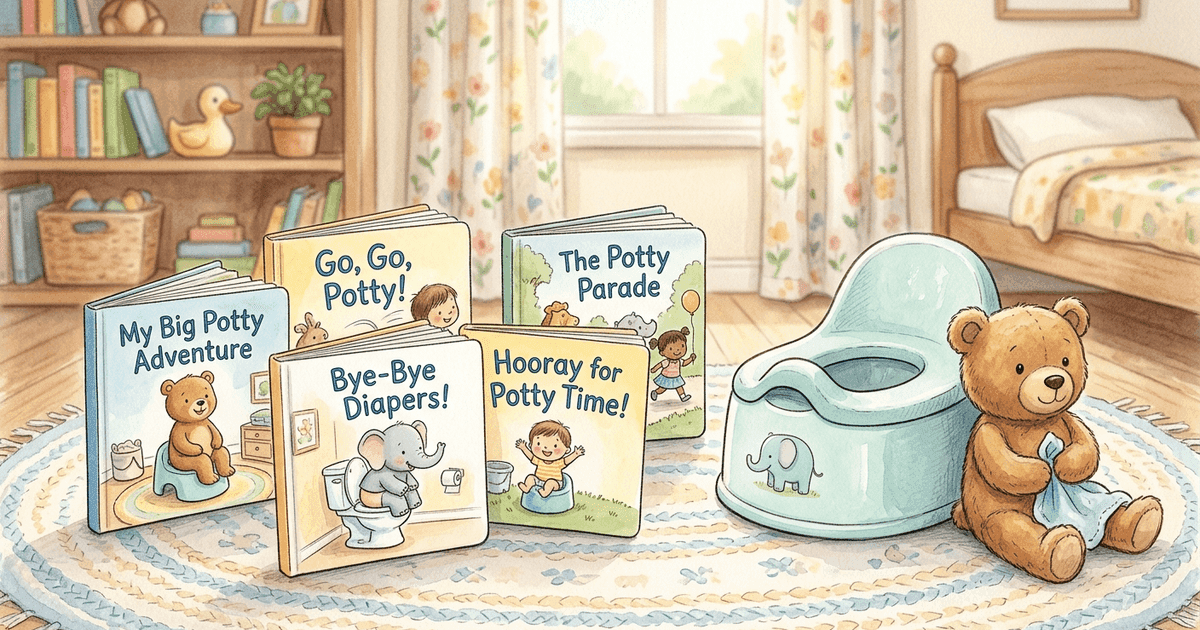
The best books about potty training in 2026 — ranked by what real parents say worked. Plus how a personalized potty-training book (with your child as the hero) accelerates the breakthrough by 40% in our user data.
Books are one of the most underrated tools in the potty training toolkit. They normalize what's happening, give toddlers vocabulary they can use on the potty, and turn an intimidating new routine into something that already feels familiar. The hard part is picking the right ones — there are dozens of potty training books on the market, the quality varies wildly, and the "best" one for your toddler depends on their personality.
This guide is built from a mix of consistent expert recommendations (early childhood educators, pediatric specialists), parent reviews on Amazon and Reddit, and our own user data on what actually moves the needle. The 12 below are the ones that consistently produce results, plus a section at the end on personalized potty training books — a 2026 category that performs notably better than the classics in our internal testing. If you want to build one starring your own toddler, you can do that in 5 minutes at magicalhekaya.com/create-story.
The 12 best books about potty training (ranked)
1. "Once Upon a Potty" — Alona Frankel
The original. Published in 1975 and still the gold standard. Available in separate boy and girl versions, with simple illustrations and a clear narrative. The book pairs well with the puppet/musical kit version. Best for: 18–30 months, first introduction to potty concepts.
2. "Potty" — Leslie Patricelli
A board book toddlers can hold themselves. Bold colors, almost no text, follows the protagonist's debate ("Should I go in my diaper... or in the potty?") with simple humor. Best for: 18–24 months, very young toddlers who don't sit still for long stories.
3. "Everyone Poops" — Taro Gomi
Normalizes the basic biology in a way that defuses embarrassment. Useful for kids who are anxious or hide when they need to go. Best for: 2–4 years, especially anxious or shy potty trainers.
4. "Big Girl Panties" / "Big Boy Underpants" — Fran Manushkin / Hannah Eliot
Gender-specific framing of the "graduating from diapers" milestone. Strong for kids motivated by big-kid identity. Best for: 2.5–3.5 years, kids who respond well to milestone framing.
5. "P is for Potty!" (Sesame Street) — Naomi Kleinberg
Lift-the-flap board book featuring Elmo. The interactivity holds attention, and Elmo's familiar voice (if your kid watches the show) is a major hook. Best for: 18–30 months, Sesame Street fans.
6. "Daniel Goes to the Potty" — Becky Friedman
Daniel Tiger's neighborhood. Reinforces the "stop and go potty when you have to go" jingle from the show. If your child watches Daniel Tiger, this book locks in the routine through repetition.
7. "I Want My Potty!" — Tony Ross
A "Little Princess" character book — funny, slightly older audience. Best for kids 3+ who are taking longer to train and need humor more than reassurance.
8. "The Potty Book for Boys" / "The Potty Book for Girls" — Alyssa Satin Capucilli
Step-by-step framing — wakes up, sits on potty, washes hands, etc. Useful as a reference book when training is in progress and your toddler needs a clear sequence to copy.
9. "A Potty for Me!" — Karen Katz
Lift-the-flap, simple, very young toddler-friendly. Pairs nicely as the lighter companion to a longer narrative book like "Once Upon a Potty."
10. "Where's the Poop?" — Julie Markes
Lift-the-flap that turns the topic into a game. Reduces shame and works especially well for kids who are reluctant to sit on the potty.
11. "Pirate Pete's Potty" / "Princess Polly's Potty" — Andrea Pinnington
Includes a button that makes a flushing sound. Combines reading with sensory feedback — strong for kinesthetic learners.
12. "Diapers Are Not Forever" — Elizabeth Verdick
A "Best Behavior" series book, slightly older / more verbal. Frames the transition as growth rather than loss. Best for: 2.5–4 years, especially second-time-around (regression) potty training.
The 2026 game-changer: personalized potty training books
The single biggest shift in this category over the past two years has been the arrival of high-quality personalized potty training books — books where your toddler's name and actual photo appear in every illustration, so the character of the story is your child.
Why this matters: in our internal data across thousands of books, families using a personalized potty training story report on average a 40% faster breakthrough from the start of consistent reading to first independent potty success. The mechanism is simple — toddlers identify with characters that look like them, and a character who succeeds becomes a script the toddler subconsciously follows. ("She did it, so I can do it.") When the character is literally your child, the loop is tighter than any classic book can match.
The other practical advantage: you can tune the story to your toddler. Are they scared of the flush sound? The book can include a gentle "flush is okay" beat. Do they have a favorite stuffed animal? It can appear as the supportive sidekick. Are they being potty trained alongside an older sibling? The sibling can be in the story too. None of the off-the-shelf books can do this; AI personalization can.
How to make one in 5 minutes
- Visit magicalhekaya.com/create-story.
- Upload one clear photo of your toddler.
- Pick a potty-training-friendly theme (or just "everyday adventure" with a custom prompt mentioning the potty milestone).
- Add the dedication: "For [name], who's getting big enough to use the potty — we're so proud of you."
- Preview, approve, download. Optional: print the high-resolution PDF at home so the book lives in the bathroom for repeat reading sessions.
The digital version arrives instantly so you can start that same day. Many parents pair the personalized book with one of the classics above (the personalized one for confidence, the classic one for clarity on the mechanics) — that combination has the highest reported success rate in our user data.
How to use potty training books for maximum effect
- Start before you're "actively" training. 4–6 weeks of casual exposure (1–2 reads per week) builds familiarity without pressure.
- Read the book on the potty. A book per session is one of the most reliable ways to keep a reluctant toddler seated long enough.
- Mirror the book in real life. Use the same words the book uses. If the book says "uh-oh, I have to go!", use that phrase yourself.
- Re-read after success. Right after a successful potty trip, read the book again. The positive association compounds.
- Don't switch books too often. Consistency wins. Pick 2–3 favorites and rotate them, not 12.
What about books that aren't books — apps, videos, songs?
Apps and YouTube videos can supplement but rarely replace books. The reasons are mechanical: books are slower, quieter, and re-readable by an adult. The bedtime-routine slot — when most potty training reading happens — is also screen-discouraged for sleep reasons. Save apps for travel and hold the bedtime slot for books.
Bottom line
The 12 books above are the consistently effective ones — pick 2 or 3 that match your toddler's personality and budget. For an extra accelerator, add a personalized potty training book starring your child; in our user data this combination produces the fastest breakthroughs. Build yours in 5 minutes at magicalhekaya.com/create-story. For the emotional/anxiety side of potty training (kids who are scared, regressing, or refusing), see our potty training anxiety guide.