
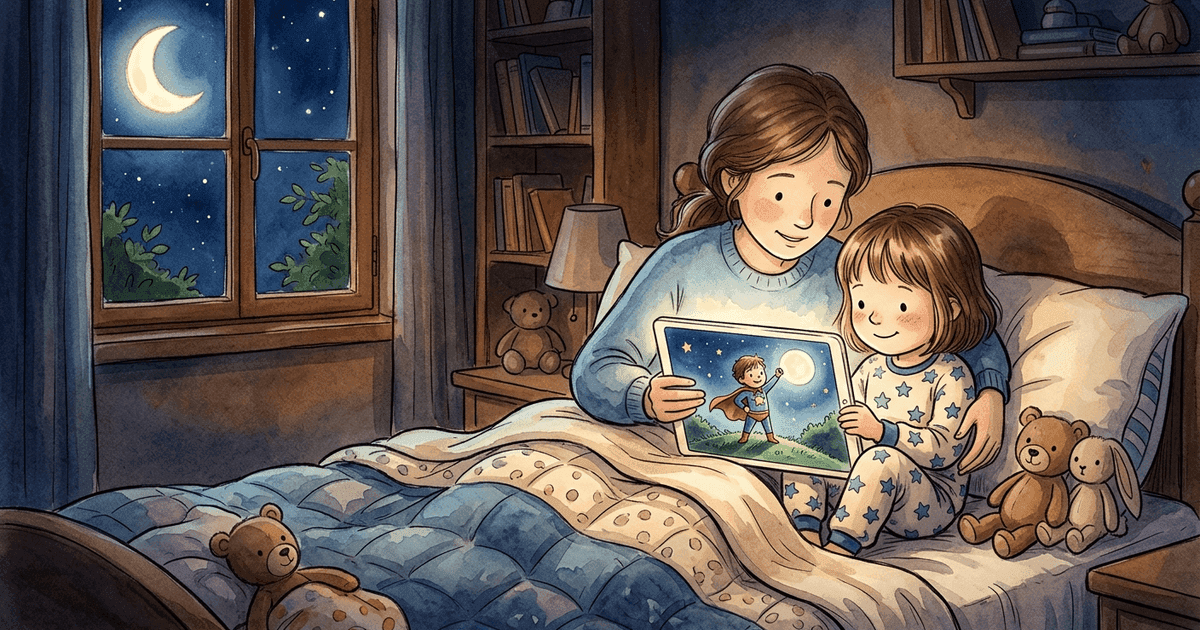
An AI bedtime story generator can save the night — but not all of them work. Here's the 2026 guide to picking one, using it well, and turning it into a nightly ritual your child will demand.
The AI Bedtime Story Generator Category Has Quietly Become Great
Two years ago, if you typed "AI bedtime story generator" into Google, the results were a mess — sketchy websites, half-working chatbots, and free story generators that gave you a page of bland filler text. In 2026, the category has matured dramatically. There are now serious free tools (Perchance, Easy-Peasy, Squibler, Bedtimestory.ai, Gemini Storybook, Oscar Stories) and serious paid tools (Magical Hekaya, The Magic Story Machine), and the quality gap between them matters a lot depending on what you're trying to do.
This guide is for parents who've heard about AI bedtime stories and want to actually use one — tonight, tomorrow, or as part of a longer-term bedtime ritual. We'll cover: which tools to use, which to skip, how to use them well, and when an AI bedtime story is the right call vs. a library book.
Why Parents Are Switching to AI Bedtime Stories
Reading the same bedtime book every night for months is a form of parenting love — and a form of parenting torture. Every family hits a point where the parent has read the library book so many times they can recite it with their eyes closed, and the child still wants it one more time. This is both beautiful and slowly draining.
AI bedtime story generators solve a specific problem: endless variety without needing to own 500 books. A new story every night. A story about the exact thing happening in your child's life today — starting preschool tomorrow, scared of thunder, missing a grandparent. A story where the illustrated main character has your child's actual face.
For the right family in the right rhythm, this changes bedtime. Not because the AI story is better than Julia Donaldson — it isn't. But because it's infinitely available, highly specific, and personalised in a way no library book can be.
At-a-Glance: 9 AI Bedtime Story Generators Compared
| Tool | Price | Photo → Hero | Illustrations | Audio Narration | Speed | Best for |
|---|---|---|---|---|---|---|
| Magical Hekaya | $4.99 | ✅ consistent | ✅ 20 pages | ✅ included | <5 min | Nightly ritual, gift, keepsake |
| Gemini Storybook | Free | ⚠️ drifts | ✅ 10 pages | ✅ basic | 1–2 min | Quick free story |
| Perchance | Free | ❌ | ⚠️ stock-ish | ❌ | 30 sec | Last-minute text |
| Easy-Peasy.AI | Free tier | ❌ | ⚠️ optional | ❌ | 30 sec | Text prompts |
| Squibler | Free | ❌ | ⚠️ basic | ❌ | 1 min | Longer stories (7–10 yr) |
| Bedtimestory.ai | Free + paid | ⚠️ paid tier | ✅ | ⚠️ paid tier | 2–3 min | Free quick, paid for polish |
| Oscar Stories | Subscription | ❌ | ✅ | ✅ | 2 min | Recurring library |
| Magic Story Machine | Subscription | ⚠️ limited | ✅ | ✅ | 3 min | Family accounts |
| Scarlett Panda | Free daily | ❌ | ✅ | ⚠️ | N/A | Pre-generated daily story |
The 2026 Landscape: Free vs Paid AI Bedtime Story Generators
Free AI Bedtime Story Generators — Best For: One-Offs, Experiments, Budget-Conscious Families
The strongest free options in 2026:
- Perchance AI Bedtime Story (perchance.org/ai-bedtime-story) — no sign-up, unlimited, includes basic images. Quality variable. Great for "need a story right now."
- Easy-Peasy.AI — free bedtime story template, generates quickly. Text-first; images are optional and generic.
- Squibler — free AI story generator (with pictures), no sign-up. Handles longer narratives better than most free tools. Better for 7–10 year olds.
- Bedtimestory.ai — free tier with the option to include your child and family members as characters. Strong brand for the use case; feature tier for photo integration.
- Gemini Storybook (Google) — free, 10-page illustrated story with narration. Requires Gemini account. Character look shifts across pages.
- Oscar Stories — positioned as an AI storyteller for families; subscription model with a limited free tier.
What to expect from free tools: usable text, generic illustrations, inconsistent character design across pages, no built-in hardcover printing, varying data-retention policies. For a Tuesday-night "just make something" use case, they work fine. For a gift, a keepsake, or a child who'll notice visual inconsistency — they fall short.
Paid AI Bedtime Story Generators — Best For: Keepsakes, Gifts, Photo-Real Personalisation
The paid category is smaller and more serious:
- Magical Hekaya — $4.99 per digital book with audio narration included; photo-real illustrations that stay consistent across pages; delivered as a high-resolution, print-ready PDF you can print at home; English, French, and Arabic.
- The Magic Story Machine — subscription model for a personalised AI bedtime story service.
- Bedtimestory.ai (paid tier) — unlocks photo integration and more advanced features beyond the free limit.
What you get from paid tools: photo-real consistent character design (your child actually looks like themselves, on every page), audio narration included by default, a high-resolution print-ready PDF, explicit data-privacy commitments, and generally better narrative structure tuned for bedtime pacing (no cliffhangers, no stimulation, calm endings).
How to Pick the Right AI Bedtime Story Generator for Your Family
Use this decision tree:
- Tonight, need a story, no time, don't care about polish → Perchance or Squibler. Free, fast.
- Your child is 5–9, you want a longer adventure → Squibler for the text length, Magical Hekaya for photo-real illustration.
- You want to hear the story narrated while the child looks at pictures → Gemini Storybook (free) for casual use, Magical Hekaya for quality audio + consistent visuals.
- You want a bedtime book the child will demand every night for months → a photo-real paid tool. Without the child in the illustrations, novelty fades fast.
- You want a printed book you can gift or keep → export Magical Hekaya's high-resolution, print-ready PDF and print it at home, or send any tool's PDF to Blurb / Shutterfly for printing.
- Sensitive to AI training on your child's data → paid tools with explicit policies only. Avoid free tools with ambiguous data clauses.
Five Prompt Templates That Produce Better Bedtime Stories
The single biggest lever on AI bedtime story output is the prompt. "Write a bedtime story" produces forgettable filler. A structured prompt produces something your child actually wants to hear twice. Steal these templates:
Template 1: The Calm-Down Adventure
"A calm bedtime story for [NAME], age [AGE], about [CHILD] going on a gentle nighttime adventure to [DESTINATION — a dreamy place, not scary]. Along the way they meet [ONE friendly character]. The story should build to a quiet, contented ending where [CHILD] falls asleep in the story. No cliffhangers, no loud moments, no scary parts. Total length: about 500 words across 10 pages."
Template 2: The Bibliotherapy Story (for a specific fear or worry)
"A bedtime story for [NAME], age [AGE], who is worried about [SPECIFIC WORRY — the first day of school, thunder, a new sibling, the dark]. In the story, [CHILD] encounters a gentle version of that worry, and with help from [a safe character — a parent figure, a kind animal, a glowing star], discovers that the worry is smaller than it felt. Ending: [CHILD] goes to bed proud of being brave. Tone: reassuring, never dismissive of the feeling."
Template 3: The Family-Event Story
"A bedtime story for [NAME], age [AGE], celebrating [EVENT — a new sibling arriving, moving to a new house, a grandparent visiting]. Feature [OTHER FAMILY MEMBERS BY NAME] as illustrated characters. Capture the specific emotional texture of the event — part exciting, part uncertain — and resolve with [CHILD] falling asleep secure and loved."
Template 4: The Curiosity Story
"A bedtime story for [NAME], age [AGE], who loves [SPECIFIC INTEREST — dinosaurs, space, ocean animals, trains, cooking]. In the story, [CHILD] goes on a gentle evening adventure that explores this interest and ends peacefully back in bed. Weave in 3–4 age-appropriate real facts about [INTEREST] so the story teaches while it wind-downs."
Template 5: The Series Continuation
"A continuation of last night's story. [CHILD] is still in [THE WORLD FROM LAST NIGHT] with [SAME CHARACTERS]. Tonight they [NEW SMALL ADVENTURE]. Keep tone and character design consistent with the previous story."
These templates work on every AI bedtime generator (paid or free) and turn a mediocre output into a usable one. Save them in a notes app; paste and modify nightly. Two minutes of prompt-craft produces a dramatically better story than a generic "bedtime story please" request.
How to Actually Use an AI Bedtime Story Generator Well
Getting the tool right is half the battle; prompting it well is the other half. Here's what works:
Be Specific About the Child
The more specific the prompt, the better the story. "A bedtime story for my 5-year-old named Maya" is OK. "A bedtime story for Maya, age 5, who loves dinosaurs, just started kindergarten, and is scared of the dark" produces a much better story because the AI has enough to personalise the plot. Include: name, age, interests, any current life events, any fears you want the story to help with.
Give It a Bedtime Theme, Not a Generic "Bedtime Story"
Generic bedtime stories are usually boring. A themed bedtime story — "Maya discovers a magical star that helps her brave the dark," or "Leo explores a forest where every animal reassures him that his feelings matter" — reads better and often lands the emotional note bedtime needs. Think of the AI as a co-author: you pick the theme and arc, it fills in the prose and illustrations.
Use Photo-Real Tools for the Weekly "Special Story"
Many families settle into a pattern: routine bedtime books (the library classics, the usual favourites) four nights a week, and a personalised AI-generated bedtime story two or three times a week. The personalised story becomes the 'special' book; the classics stay classics. This avoids overloading on AI-generated content and keeps the variety-and-depth balance right.
Mind the Screen
The one real downside of any digital bedtime story is blue light before sleep. Mitigations:
- Dim the screen. Night-mode / dark-mode on the tablet. Lower brightness dramatically.
- Use audio-only if possible. Play the narration, turn the screen face-down once the story starts.
- Print the best ones at home. A printed copy of your child's favourite AI-generated bedtime story eliminates the screen entirely.
- End the story at least 15 minutes before lights-out. Not right up to sleep onset.
Don't Replace Library Books — Add to Them
The research on read alouds is clear: variety matters. Reading the same AI-generated tool's output every night is worse for language development than alternating between AI stories, library picture books, chapter books, and non-fiction. Keep the bookshelf full. AI fills a specific need (personalisation, novelty, on-demand specificity) — it doesn't replace the broader reading diet.
Safety: What to Check Before Uploading Your Child's Photo
Any AI bedtime story generator that accepts your child's photo is handling sensitive data. Before uploading to any tool — free or paid — check three things:
- Training data: is your photo used to train the underlying AI model? The right answer is no. Some free tools bury "yes" in their ToS.
- Retention: how long is the photo kept? Can you delete it on demand?
- Third-party sharing: is the photo shared with any other service or vendor?
Magical Hekaya's commitment: photos used only for generating that specific book; not used to train models; not shared with third parties; deletable at any time. For any tool without a clear equivalent, the conservative default is not to upload a child's photo.
The Sleep Science Question: Does an AI Bedtime Story Actually Help Kids Sleep?
Pediatric sleep research is unambiguous about bedtime stories in general: a consistent calm-activity routine before sleep correlates strongly with faster sleep onset, fewer night wakings, and better overall sleep quality in children ages 2–10. The mechanism is partly physiological (slower heart rate, lower cortisol during the wind-down) and partly associative (the story becomes a learned cue for sleep).
What the research doesn't differentiate: whether the story comes from a library book, an audio app, or an AI generator. Functionally, they're the same — what matters is the ritual, not the author. An AI bedtime story included in a consistent routine produces the same sleep-onset benefits as a library book in that same routine.
Where AI bedtime stories can help more than a library book: for anxious sleepers, a story specifically addressing tonight's specific worry (new daycare starting tomorrow, a doctor's appointment looming, an argument with a friend) lands more precisely than a generic classic. The ability to generate a story on-demand tuned to what your child is actually feeling tonight is a real advantage — most families don't have a library book for every specific emotional moment.
Where AI bedtime stories can help less: when the novelty of "a new story every night" becomes stimulating instead of soothing. Some kids settle better with the comforting repetition of their one favourite library book re-read for the hundredth time. Watch your child's response. If the AI story energises them instead of winding them down, scale back.
Common Failure Modes (And Fixes)
Six specific ways AI bedtime story generators go wrong and how to prevent each:
Failure 1: The story is stimulating instead of calming
Fix: explicitly prompt for a calm ending, no cliffhangers, no climactic fight scenes. Add "no loud moments" and "ends with the character falling asleep in the story" to your prompt. Most free generators default to adventure-stakes pacing, which is wrong for bedtime.
Failure 2: The child character looks different on every page
Fix: use a tool with character-consistency built in (Magical Hekaya), or if using free tools with image generation, regenerate each page's illustration using the first page's image as a reference. Character drift is the #1 complaint about free AI bedtime story generators.
Failure 3: The vocabulary is too adult or too juvenile
Fix: specify age in the prompt and include reading level — "for a 4-year-old, vocabulary at late-preschool level, sentences under 15 words." Most AI output defaults to a middle-school reading register unless you steer it.
Failure 4: The story is generic AI slop with no emotional specificity
Fix: give the AI real details. Your child's name, age, a specific interest, an event from today, a family member's name. Specificity is what separates a story the child remembers from a story that evaporates on the last page.
Failure 5: The audio narration is monotone or too fast
Fix: check the tool's voice options — most have multiple voices and sometimes a speed control. Bedtime-appropriate narration is slower than normal reading speed, warmer in tone, with longer pauses at punctuation. If the tool has no speed control, that's a signal the tool isn't bedtime-tuned.
Failure 6: Screen time right up to lights-out
Fix: use audio-only mode with the screen dimmed or face-down, or print the book. Don't end a bedtime ritual with bright-screen time; the blue-light impact on melatonin is real, especially for children under 10.
Copyright, Ownership, and Selling AI Bedtime Stories You Generate
For personal use (reading to your own child), copyright doesn't meaningfully restrict you. For commercial use — selling the stories, publishing to Amazon KDP, distributing to other parents — check the specific tool's terms of service first. As of 2026:
- Tools explicitly allowing commercial use: Magical Hekaya (you own the generated book), Midjourney Pro, ChatGPT Plus. Generally: paid tiers grant commercial rights; free tiers don't.
- Tools with ambiguous or restrictive terms: most free tools. Read before selling anything.
- US copyright of AI output: the output alone isn't copyrightable, but your human contribution (prompts, edits, curation, arrangement) makes the overall work eligible. Register with the US Copyright Office clearly documenting your role.
If you're planning to turn your AI bedtime story output into a published children's book, read our companion guide: how to create a picture book with AI, step-by-step.
The Bedtime Ritual, Upgraded
The best bedtime rituals are small, repeatable, and rich enough that the child wants to come back to them. AI bedtime story generators don't reinvent that — a good picture book has always done it. What they change is the specificity: a story about your child, for your child, tonight. That has a different quality than a book about a generic protagonist, and once you've done it for a week, you feel the difference.
If you want to try the photo-real option, our AI bedtime story generator is here — free to preview. If you want to experiment with free tools first, Perchance and Squibler are the lowest-friction starting points. Either way, the concept works. Pick a tool, write a better prompt than "bedtime story," and read the result tonight. You'll know within a week whether it's earned a place in the rotation.